49 works in this view — arrow keys or swipe to move between them.
Dance in Art
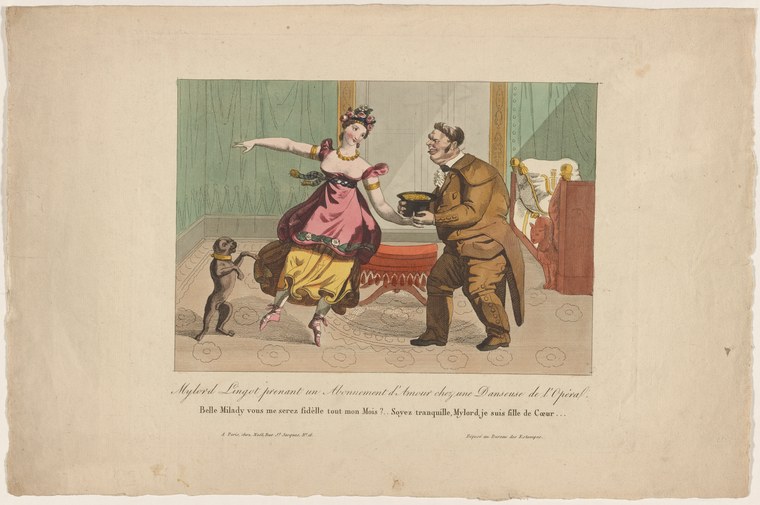
Mylord Lingot prenant un abonnement d'amour chez une danseuse de l'Opéra
Unknown artist
- Collection:
- Prints depicting dance
- Source:
- New York Public Library
- Rights:
- Public domain — free to use, share and adapt.
- Recorded as:
- Public Domain
This work documents the intersection of dance aesthetics, fashion, and sexual economics in the late Enlightenment/Romantic period: it shows how the visual codes of theatrical dance—extension, curve, display—were understood as inseparable from female bodies offered for consumption and patronage. For dance historians, it reveals contemporary attitudes toward opera dancers as objects of desire and subjects of financial negotiation, while for art historians it demonstrates how satirical prints used the gesture vocabulary of neoclassical style to critique the institutions that sustained them.
What you are looking at
A hand-colored engraving depicting a theatrical or satirical scene of seduction and courtship. A woman in an elaborate pink silk gown and yellow underskirt, her hair crowned with feathers and jewels, performs or reclines in a deliberately theatrical pose with her arm extended. She is attended by a portly gentleman in brown coat and breeches, whose body language suggests both deference and desire. A small dog or pug stands between them, its posture echoing the woman's curved line. The setting is an interior—visible are green-paneled walls, gilt door frames, and what appears to be a red cushioned chair or settee. The composition is shallow and frieze-like, emphasizing the relationship between the three figures and the domestic intimacy of the scene. The engraving is tinted with restraint, allowing the delicate pen work to show through, and signed at bottom left.
The dancing
The woman's body is the center: she reclines or leans back with one arm extended outward in an arc, the other at her side, her torso curved in a serpentine S-line that emphasizes her corsetry and fashionable silhouette. Her weight appears to shift through her hips and legs. The gentleman stands upright but slightly forward-leaning, his arms gesturing toward her in a posture of supplication or admiration. Neither figure is in ballroom hold or engaged in partner dancing; instead, the woman's pose suggests display, flirtation, or a choreographed moment of exposure and appeal. The dog's stance mirrors the woman's curve, humanizing it as a gesture rather than accident.
The dance depicted
This is not a depiction of structured ballroom or theatrical dance, but rather a satirical or comedic scene built on bodily display and the codes of courtship theater that borrowing from dance vocabulary. The woman's extended arm, arched torso, and elaborately dressed presentation recall the gestural language of 18th-century opera, pantomime, and aristocratic flirtation rather than a named dance style. The French title (see below) explicitly names this as a subscription negotiation at the Opéra—a reference to the historical practice of wealthy men financially supporting dancers. The scene parodies or documents this transactional relationship through exaggerated posture and costume, using the visual rhetoric of dance—the S-curve, the theatrical arm, the studied moment—without naming a specific style.
How it was made
This is a hand-colored engraving, printed from a copper plate and then tinted with watercolor or gouache. The fine line work and cross-hatching characteristic of engraving are visible in the background shading and fabric texture, while the selective hand-coloring emphasizes the woman's costume and creates visual focus. The technique allowed for wide circulation as a print: multiple impressions could be pulled and sold, making this a commercial product aimed at an educated middle and aristocratic audience familiar with both Opéra politics and satirical social commentary. The restraint in coloring and the precision of the engraved line suggest an audience with some visual sophistication.
About this work
A hand-colored engraving, likely from the late 18th or early 19th century, depicting a satirical negotiation between a wealthy gentleman and an opera dancer. The woman's elaborately fashionable dress, theatrical posture, and exaggerated gesture reference both the aesthetic codes of neoclassical dance and the real economics of the Opéra, where patronage and financial 'subscription' were inseparable from performance. The scene uses the visual language of dance—the extended line, the curved body, the studied moment—to mock or expose a social transaction. The print circulated in France as a commentary on fashion, desire, and the theater world, preserving a snapshot of how dance and dancers were perceived in relation to wealth and seduction.
How to look at it
Observe the woman's arm and torso: the extended line and the S-curve of her spine are deliberate, rehearsed, the vocabulary of stage presence. Her pose is not natural repose but a composed display. Note how the gentleman's body leans toward her with hands open—a gesture of supplication or desire. The dog, positioned between them, reads the scene's social awkwardness or comedy: the woman's curved posture is so studied that even the animal echoes it. The background—the paneled walls, the carefully rendered furniture—insists that this is a domestic interior, not a stage, which makes the theatrical quality of her pose all the more pointed: she is performing seduction at home, as a form of labor or transaction.
The artist
The artist is not recorded in the catalogue. The style and subject matter suggest a French printmaker working in the late 18th or early 19th century, when satirical engravings of Opéra life, fashion, and aristocratic behaviour were a thriving market. The technique and hand-coloring practice are consistent with commercial French printmaking of the period, likely produced for a Parisian audience.
The period
In the late 18th century, the Paris Opéra was a site of social theater as much as artistic performance: wealthy men publicly negotiated 'subscriptions' to support dancers, a practice that formalized a relationship between financial patronage and access (sexual or otherwise). Neoclassical dance was moving toward greater extension, verticality, and the aestheticized arm line—visible in the woman's pose here. Simultaneously, satire and caricature (visual commentary on manners, dress, and social hypocrisy) were flourishing as print genres. This engraving sits at the intersection: it uses the refined gesture language of neoclassical aesthetics to expose the financial and sexual negotiations underpinning the Opéra world.
Where it lives
The work is held in the New York Public Library's collection of prints depicting dance. It is catalogued by title and date information is not recorded. The print format, tinting technique, and archival condition suggest it has been part of a collection of French satirical and theatrical prints.
Questions about this work
What does the French title mean?
The title translates roughly as: 'My Lord Lingot taking out a subscription for love from a dancer of the Opéra,' with a subtitle glossing the transaction: 'Lingot, you must truly be mad; I'm not sure / Sire, tranquility aside, I have my share of it.' The dialogue is flirtatious and mocking. 'Subscription' (abonnement) was a real financial arrangement: wealthy men paid the Opéra for regular access to its female dancers, both as patrons and as clients. This print satirizes the pretense and economics of that relationship.
Is this actually dance?
Not in the technical sense of a named style or choreography. However, it is built entirely on the visual codes of dance and theater: the extended arm, the curved spine, the composed moment, the idea of the body as display. It belongs in a dance collection because it documents how dance aesthetics—neoclassical extension and line—were understood and used in non-dance contexts, and because it reveals how dancers' bodies were perceived as commodities and objects of desire. The dance vocabulary is real; it is just being applied to social seduction rather than stage movement.
When was this made?
The record does not provide a date. However, the style of dress, the engraving technique, the fashion of the hair and feathers, and the subject matter (Opéra subscription culture) all suggest a print from the late 18th or early 19th century, most likely between 1780 and 1830. A more precise dating would require archival research or comparison with signed and dated prints from the same atelier.
Who was Lingot?
The record does not identify him. He may have been a known public figure or a fictional type—the satire may name a real man or refer to a stock character of aristocratic excess. The fact that he is named in the title suggests either that he was recognizable to the original audience or that his name itself was comical (Lingot can suggest 'lingot'—ingot, or something made of metal; possibly a pun). Without additional archival context, his identity cannot be confirmed.
More dance artwork





