49 works in this view — arrow keys or swipe to move between them.
Dance in Art
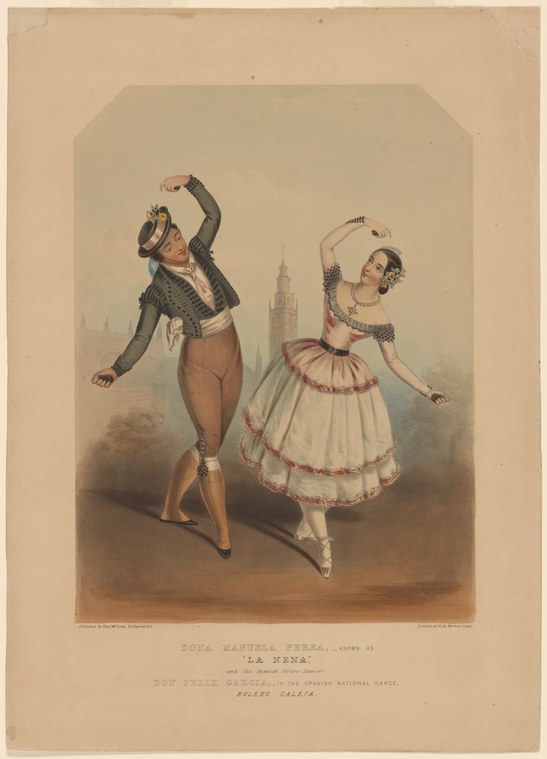
Dona Manuela Perea, known as La Nena, and the Spanish bolero dancer Don Felix Garcia, in the Spanish national dance, bolero caleta
Unknown artist
- Collection:
- Prints depicting dance
- Source:
- New York Public Library
- Rights:
- Public domain — free to use, share and adapt.
- Recorded as:
- Public Domain
This print provides a rare named record of specific dancers performing bolero caleta with documented technique and costume, offering evidence of how the dance was executed and valorized in professional theater. For historians of Spanish dance and 19th-century theatrical culture, it is a primary visual document of performance practice before film, showing the exact pose and relationship choices that defined the form.
What you are looking at
A hand-colored lithograph shows two Spanish dancers in an interior stage setting, positioned against a neutral backdrop with architectural elements suggesting a theater or studio space. On the left, a male dancer in tight breeches and a dark bolero jacket with elaborate braiding leans back dramatically, one arm raised high with palm open, the other extended downward in a gesture of flourish. His posture is deeply arched, with weight thrown back in a pose of theatrical abandon. On the right, a female dancer in a white gathered skirt trimmed with red ribbon stands in profile, wearing a dark bolero jacket matching the male dancer's, with her arms extended in a graceful asymmetrical frame—one raised, one lowered. Her pose is poised and controlled. Both dancers wear ornate necklaces or jewelry at the neck. The composition emphasizes the contrast between the male dancer's explosive, back-arching movement and the female dancer's more composed, vertically-aligned stance. The warm beige and brown tones of the paper, with soft modeling of shadow beneath the figures, create a sense of stage lighting. The title and names are printed below the image in a serif typeface.
The dancing
The male figure dominates through extreme flexibility and extension, with his torso hyperextended backward—a position requiring significant spinal mobility—while maintaining engagement through his raised arm and open palm. The female dancer maintains an upright carriage with longer lines through her body, her asymmetrical arm position (one elevated, one lowered) creating a dynamic but controlled frame. Neither dancer appears to be in closed hold with the other; instead they occupy the same stage space as separate performers executing complementary movements. The postures suggest individual virtuosity rather than partnership, though the paired composition indicates a duet or ensemble piece.
The dance depicted
The work is identified in its own title as bolero caleta (also known as bolero gitano or Andalusian bolero), a Spanish solo and duet dance form distinct from the Cuban bolero. Bolero was a theatrical and social dance of 19th-century Spain and Spanish America, performed in theaters and ballrooms with high technical demands and expressive, often melancholic character. The extreme spinal extension shown in the male dancer's pose and the rotational potential suggested by both figures' positions are consistent with bolero technique as practiced in this period. The theatrical setting, the ornamented dress, and the separation of the dancers into distinct moments or phrases rather than a synchronized hold all support identification as a theatrical bolero performance rather than a social couple's dance. The image captures the dance mid-performance, emphasizing individual technical display within a duet framework.
How it was made
This is a hand-colored lithograph, a technique that allowed for mass production and wide circulation of theatrical imagery in the 19th century. The base image was drawn on stone in greasy crayon or ink, then inked and printed on paper, with watercolor or gouache added by hand afterward—visible here in the careful coloring of the dancers' skin, the red ribbon trim, and the soft modeling of shadows. Lithography allowed for fine detail and tonal gradation, making it ideal for costume documentation and publicity. The technique's capacity for large editions made such prints affordable souvenirs for theater-goers and important records of celebrated dancers and performances; this suggests the named dancers—Manuela Perea (La Nena) and Félix García—were recognized performers of the period, and this print served as both advertisement and souvenir.
About this work
This hand-colored lithograph documents a performance of bolero caleta by two named Spanish dancers, Manuela Perea and Félix García. The print captures a moment of high technical display within a theatrical duet, emphasizing the individual virtuosity of each dancer through dramatically contrasted poses—the male dancer's extreme arching extension set against the female dancer's more vertical, controlled frame. As a theater print from an unspecified but likely mid-to-late 19th century date, it is a primary record of how this Spanish dance form was performed and celebrated in the era when Spanish bolero was both a concert attraction and a model for social dance. The work belongs in a gallery of dance in art because it documents a specific historical moment in the performance of a now-specialized form, and because it demonstrates how lithographic printing made dance visible and shareable across wide audiences.
How to look at it
Observe the extreme contrast in body position and energy between the two dancers: the male dancer's arched spine and explosive arm gesture are frozen at a moment of maximum extension and display, while the female dancer is caught in a moment of poised stability. This contrast—between male virtuosity on display and female composure in form—reflects both the gender conventions of 19th-century theatrical performance and the specific technical demands of bolero, which prized individual bravura and the dancer's ability to sustain difficult shapes. The asymmetrical arm positions of the female dancer and the reached-back quality of the male dancer's torso suggest movement that is both stationary and dynamic: the lithographer has captured a held pose, but one designed to appear suspended in action rather than static.
The artist
The artist is not recorded in the catalogue. The print was made in Paris (as noted in the inscription) and distributed through Parisian print publishers who specialized in theatrical and dance imagery. Such prints were typically made by specialist lithographic atelier workers, some of whom became known names but many of whom did not receive credit. The work's style and quality suggest a professionally trained hand with knowledge of theatrical anatomy and movement.
The period
Spanish dance, especially bolero and other Andalusian forms, enjoyed considerable vogue in European concert halls and salons during the 19th century, particularly among audiences in Paris and London. The Romantic era's appetite for exotic, emotionally expressive movement and for dances coded as authentically national or regional made Spanish dance a prestige attraction. At the same time, bolero was evolving from a social dance into a specialized theatrical form performed by trained professionals. This print dates from the height of that theatrical interest, when named Spanish dancers toured European capitals and were immortalized in lithographic prints sold to audiences as both souvenirs and status markers.
Where it lives
The print is held in the New York Public Library's Prints collection, which specializes in theatrical imagery, stage costume documentation, and performance ephemera from the 18th century onward. It is catalogued as a hand-colored lithograph, reflecting its status as a reproducible print rather than a unique work, and as a item of theatrical and dance history rather than fine art.
Dance in this work
Questions about this work
What is bolero caleta and how is it different from Cuban bolero?
Bolero caleta (or bolero gitano) is a Spanish Andalusian dance form, distinct from the Cuban bolero that emerged later and became a Latin ballroom standard. The Spanish bolero is typically faster, more virtuosic, and more integrated with folk and theatrical traditions; it emphasizes individual technical display and was a concert and stage form in the 19th century. Cuban bolero, by contrast, is slower and more lyrical, developed in the Caribbean and later standardized as a ballroom dance.
Who were these dancers and how famous were they?
Manuela Perea (known as 'La Nena') and Félix García were professional Spanish dancers celebrated enough to be named in a published theatrical print, which suggests they were recognizable to Parisian audiences of their time. However, detailed biographical information about them is scarce in surviving records. The fact that this lithograph was made and distributed indicates they were among the Spanish performers who achieved international renown in 19th-century European concert halls.
Why is the male dancer arched so far back? Is that really how bolero was danced?
The extreme spinal extension was characteristic of theatrical bolero technique in this era, part of the dance's reputation for virtuosity and emotional expressiveness. However, the lithographer may have exaggerated the pose for dramatic effect and for the technical challenge it posed to the artist. Theatrical prints often intensified gesture and position to make the movement more visually striking on the page and more memorable to audiences.
Why doesn't the print have a date?
The catalogue record does not provide a date, and the print itself does not bear one. This was not uncommon for lithographs of the period, especially popular or oft-reprinted images. The style of dress, the Paris printing location, and the subject matter suggest a date in the mid-to-late 19th century (roughly 1840s–1880s), but without documentation it cannot be narrowed further.
More dance artwork





