49 works in this view — arrow keys or swipe to move between them.
Dance in Art
Folk and ethnic costumes
Unknown artist
- Collection:
- Prints depicting dance
- Source:
- New York Public Library
- Rights:
- Public domain — free to use, share and adapt.
- Recorded as:
- Public Domain
For historians of folk and ethnic dance, this image documents the visual appearance of performers in their period costume—a primary source for reconstructing the aesthetic context of regional dance traditions. The systematic variation of poses and dress suggests this was a reference work used by artists, costume-makers, and possibly choreographers, making it evidence of how early modern visual culture transmitted knowledge about non-elite performance traditions.
What you are looking at
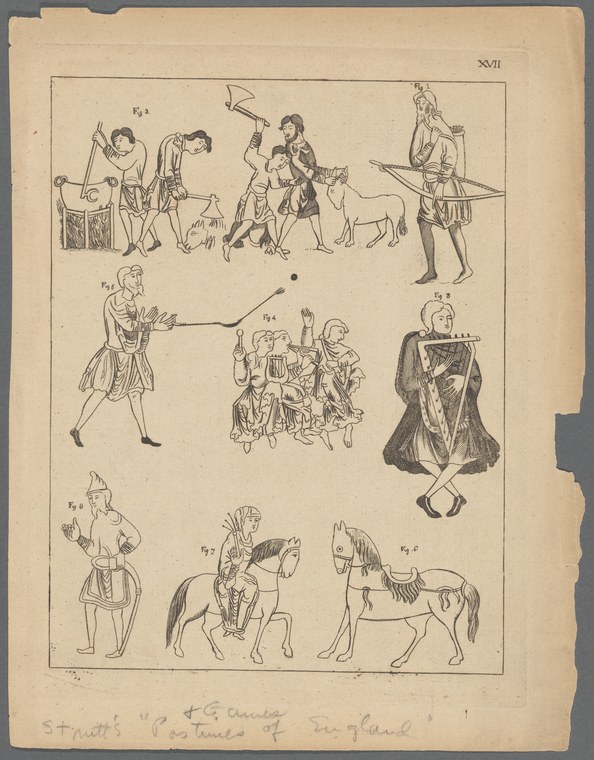
This is a page of figure studies arranged in three horizontal registers, each showing variants of costumed figures in what appear to be folk or ethnic dress. The top register depicts a procession or narrative sequence: figures in short tunics and armor-like garments, one wielding an axe, another in a scaled or quilted breastplate, progressing leftward past a small structure and a goat. The middle register shows a standing figure in a long tunic on the left; a group of three or four smaller figures (possibly children or attendants) clustered in the center wearing draped garments; and on the right, a single standing figure in a long robe or cloak with arms raised or held in a formal pose. The bottom register presents three mounted or standing figures: a warrior or nobleman in ornate dress with a broad stance; a figure seated or positioned on horseback in elaborate garments; and a horse or mounted figure on the right. All figures are rendered in brown ink line drawing with minimal shading, on a tan paper ground. The inscriptions beneath each grouping suggest this is a reference document or costume study, possibly cataloguing regional or historical dress variants.
The dancing
The bodies throughout are rendered with attention to silhouette and outline rather than volumetric form. Many figures stand in formal, heraldic poses with arms held at specific angles—some with hands on hips, others with arms raised or extended. The mounted figures sit upright, suggesting a stiff or ceremonial rather than dynamic riding posture. Proportions vary markedly: some figures are stocky and compact, others attenuated. There is no evidence of weight transfer, flexion in the knees, or the continuous line through the body that characterizes active dance. The gestures are presentational rather than gestural; these appear to be standing poses in costume rather than figures captured mid-movement.
The dance depicted
While the catalogue title names 'folk and ethnic costumes,' the image shows no clear evidence of dance in progress. The figures are posed rather than moving; there are no partnered holds, no dynamic weight shifts, no footwork visible. The standing poses are formal and heraldic, more consistent with costume or dress documentation than with choreographed movement. If this is documentation of folk dance, it records the appearance of dancers in their costumes at rest, not the action of dancing. The variety of dress—from military or martial garments to long robes—suggests an ethnographic or historical reference document rather than a depiction of a specific dance tradition.
How it was made
This is an engraving or woodcut executed in brown line on paper, with systematic cross-hatching used sparingly for shadow and texture (visible on some of the cloaked and armor-clad figures). The technique is consistent with early modern (16th–17th century) costume or armor documentation, where systematic variation and repetition of figures on a page served reference purposes. The style suggests print circulation rather than unique manuscript—the careful layout, numbered or labeled figures, and exhaustive variant display all point to a published work or preparatory plate for publication. This would have been accessible to a broad audience: costume-makers, tailors, military historians, and artists.
About this work
This is a systematic costume study rendered as an engraved plate, displaying military dress, folk garments, and formal robes in schematic variation. Rather than a scene of dance in action, it functions as a wardrobe reference—documenting the silhouettes, proportions, and details of regional or historical costume across figures of different rank and age. The composition recalls Renaissance and early modern costume books, particularly those documenting armor, clerical dress, and ethnic or national variations in clothing. While the catalogue title names folk and ethnic costume, the formality of presentation and the absence of active movement place this within the tradition of dress documentation rather than narrative choreographic imagery. It sits in the archive as evidence of how dancers were clothed rather than how they moved.
How to look at it
Attend to the deliberate repetition and variation: how the artist has shown the same basic garment or pose in multiple contexts, and how dress elements (belts, closures, hem lengths, sleeves) shift to mark rank or function. Notice that the figures are nearly always frontal or in strict profile—not the three-quarter views that would reveal active weight or moment. The presence of small subsidiary figures (children, attendants) grouped around central adults suggests a hierarchy of scale and importance rather than a choreographic relationship. The animals (goat, horse) are integrated into the same systematic study, implying this is natural-history or ethnographic documentation rather than narrative art.
The period
This work belongs within the European tradition of costume documentation that flourished from the 16th century onward, exemplified by works such as Cesare Vecellio's *Habiti Antichi et Moderni* (1590) and Hans Burgkmair's *Weißkunig* costume illustrations. During the Renaissance and early modern period, the ethnographic and military varieties of human dress became a subject of systematic visual study, both as art and as practical reference. Folk dance costumes, when documented in this period, were often presented within this framework of cultural or regional difference—less as evidence of movement practice and more as markers of identity, status, and geographic origin.
Where it lives
This work is held in the NYPL's Prints collection as part of a series on folk and ethnic costume, classified as a dance-related image. It is a single engraved plate or sheet, consistent with European print publication of the 16th–18th centuries.
Questions about this work
Is this actually a depiction of dance?
Not in the sense of capturing movement. These are costumed figures posed formally, documented for their dress rather than their choreography. If this was used by dancers or choreographers, it served as a reference for appearance and costume—what to wear—rather than how to move. The value to dance history is documentary: evidence of what folk dancers looked like, not how they danced.
What regional or ethnic traditions does this show?
The dress styles—including armor, tunics, long robes, and what may be Levantine or Eastern European garments—suggest a broad geographical survey. Without captions or inscriptions (if they exist) being fully legible in this image, the specific regional attributions are uncertain. The variation in military and civilian dress suggests this may be a comprehensive costume book rather than a focused study of a single tradition.
When was this made?
The style of the engraving and the costume forms suggest the 16th or 17th century, consistent with the Golden Age of European costume documentation. However, the catalogue record does not provide a date, and the image alone cannot establish a precise one. The technique and the kind of reference work it represents place it within early modern print culture.
More dance artwork





