49 works in this view — arrow keys or swipe to move between them.
Dance in Art
Folk and ethnic costumes
Unknown artist
- Collection:
- Prints depicting dance
- Source:
- New York Public Library
- Rights:
- Public domain — free to use, share and adapt.
- Recorded as:
- Public Domain
For a dance gallery, this image matters as material evidence of the dress context for Scottish and British folk dance, showing how the substantial plaids and elaborate bonnets that appear in actual dance depictions of the period were constructed and worn. It documents a moment when folk costume was being collected, illustrated, and circulated to urban audiences as objects of romantic interest and cultural pride.
What you are looking at
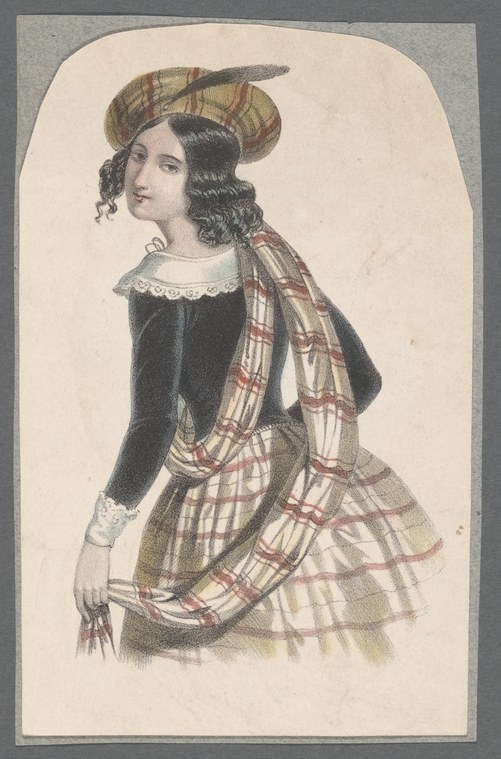
A young woman in three-quarter pose stands against a plain ground, her body turned to show the profile of her face while her torso faces slightly forward. She wears a dark (navy or black) long-sleeved dress with a white lace collar at the neckline and white cuffs at the wrists. Over this fitted bodice she wears a large tartan shawl or plaid wrap in cream, red, and green, draped asymmetrically across her body and trailing behind her like a train. Her dark hair is long and curled, gathered at the back of the head, and topped with an elaborate tartan bonnet or cap trimmed with feathers or decorative plumes. The woman holds what appears to be a small fan or ornament in her hand. The image is delicately colored with soft tones, rendered in a technique that suggests hand-applied color over an engraved or lithographic base. The composition is intimate and genteel, presenting the figure as a fashion or costume study rather than a narrative scene.
The dancing
A single standing figure occupies the frame, relaxed in posture with weight evenly distributed. Her arms hang naturally; the right hand holds a small accessory. There is no active bodily movement or dance position evident. The pose is a three-quarter turn that was conventional for fashion illustration—designed to display the costume from multiple angles simultaneously rather than to convey motion or dancing action.
The dance depicted
This is not a depiction of dance in action. The catalogue title 'Folk and ethnic costumes' suggests the image documents regional or folk dress rather than a dance scene. The tartan and the style of the bonnet suggest Scottish or Lowland British folk costume, but the figure is presented as a stationary model in fashionable 19th-century dress rather than as an active dancer. The image serves as costume documentation or fashion illustration of the kind common in printed collections of regional types.
How it was made
The work appears to be a hand-colored lithograph or engraving, recognizable from the linear quality of the outlines and the delicate wash of color—particularly visible in the tartan pattern, which shows the characteristic dotted or stippled texture of period chromolithography. The technique allowed for mass production and wide distribution, making such costume studies affordable as part of printed series or periodicals aimed at a middle-class audience interested in ethnography, fashion, or travel.
About this work
This is a 19th-century hand-colored fashion print documenting Scottish folk costume, presented as a standing figure study rather than a dance image. The garment assembly—dark dress, lace collar, substantial tartan plaid worn as a wrap, and elaborate tartan bonnet—represents the kind of regional folk dress that fascinated urban print consumers in the Victorian era. While catalogued as 'Folk and ethnic costumes,' it does not depict dance itself, but rather the costume context in which folk dances would have been performed.
How to look at it
Observe the careful rendering of the tartan's pattern and color—the artist has taken pains to show the exact weave and hue of the plaid wrap. Notice how the pose is deliberately still and frontal enough to display the full assembly of garments: the dark dress as base, the lace collar, the tartan shawl, and the bonnet. The print is designed as a teaching image, showing how these elements fit together on the body, rather than capturing a moment of movement or dance.
The artist
The artist is not recorded. The style and production method suggest a commercial print house or periodical publisher active in the 19th century, likely British or European. Such costume studies were produced as sets or series for popular consumption.
The period
The print dates to a period of intense Victorian interest in folk culture, regional identity, and ethnographic documentation. The 1830s–1860s saw a boom in illustrated costume books, periodicals, and fashion plates that presented regional dress from across Europe and beyond. Tartan and Scottish costume held particular appeal as Romantic symbols of wild, authentic culture, partly stimulated by Walter Scott's novels and the influence of Queen Victoria's enthusiasm for the Scottish Highlands.
Where it lives
Held in the New York Public Library's collection of prints depicting dance, though this particular work is more accurately a costume study than a dance scene. The NYPL's inclusion of it suggests they understood it as contextual material for understanding the dress environment of folk dance.
Questions about this work
Is this person dancing?
No. The figure stands in a static pose designed to display costume detail. This is a fashion or ethnographic print, not a dance depiction. It would have been used as a reference for costume, fashion, or regional dress rather than to document an actual dance performance or style.
What is the tartan pattern supposed to be?
The catalogue does not specify a particular tartan, and without additional documentation it is not possible to identify it with certainty. It appears to be a Lowland or general Scottish tartan of the type popular in fashion and travel literature during the 19th century, when such patterns had become symbols of Scottish identity.
Who wore this outfit and when?
This represents the kind of folk costume collected and illustrated for urban audiences in the 19th century. It is not certain whether this particular assembly was actually worn as a daily costume or whether it was an idealized or romanticized presentation of Scottish dress assembled for visual interest and sale as a print.
Why is this in a dance collection?
Costume context matters for understanding historical dance. Folk dances were performed in such dress, and prints like this help historians understand what dancers wore, how garments moved, and how regional identity was expressed through both clothing and movement. The print documents the visual world in which folk dance took place.
More dance artwork





