49 works in this view — arrow keys or swipe to move between them.
Dance in Art
Folk and ethnic costumes
Unknown artist
- Collection:
- Prints depicting dance
- Source:
- New York Public Library
- Rights:
- Public domain — free to use, share and adapt.
- Recorded as:
- Public Domain
For historians of Russian dance and material culture, this print is evidence of what dancers wore and how their bodies were typically positioned when not in motion—information that can illuminate period dance reconstruction. But it is more useful as a record of social presentation and dress than as a source on choreography or movement itself.
What you are looking at
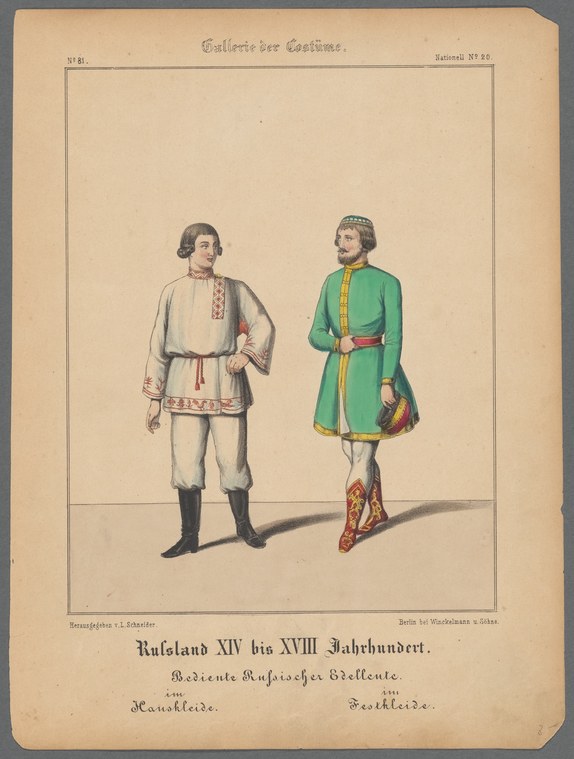
This is a hand-coloured print showing two male figures in Russian costume of the 14th–18th centuries, standing in a simple, neutral interior space defined by a ruled rectangular border. The figure on the left wears a pale linen tunic (kosovorotka) with decorative red embroidery at the neck and hem, paired with dark fitted breeches and black boots; he stands with weight evenly distributed, one hand at his hip, in a pose of informal readiness. The figure on the right wears a longer green coat or kaftan with gold trim and a red belt cinched at the waist, also with dark breeches and decorated boots in red and gold; he too stands at ease, one hand loosely at his side, the other suggesting a gesture or movement. Both men have dark, shoulder-length hair and bearded faces characteristic of Russian male portraiture. The composition presents them as ethnographic subjects rather than narrative protagonists—a didactic display of regional dress and masculine bearing rather than a scene of social or ceremonial activity.
The dancing
Both figures stand in a symmetrical display pose, with weight evenly held and bodies upright but relaxed, neither in motion nor in any formal dance frame. The left figure's hand-on-hip posture is confident and grounded; the right figure's looser stance with arm extended slightly suggests a moment of informal address or presentation. There is no physical connection between them, no partnership, and no suggestion of footwork or the preparatory tension that would indicate an imminent movement. The bodies are presented as static forms, ideal types rather than dancers captured mid-gesture.
The dance depicted
This print does not depict dance. It is an ethnographic costume plate showing male dress and social bearing in early Russian culture. While the figures stand in poses that suggest openness and readiness—postures that might appear in social contexts where dance occurred—there is no evidence of active movement, musical accompaniment, or choreographic intent. The work is documentary rather than performative: it records how men of this period dressed and held themselves, not how they danced.
How it was made
This is a hand-coloured engraving or woodcut (the technique is evident in the crisp line work and the regular border), likely from a larger ethnographic or historical series given its catalogue number and the German text visible at the top. The use of color—applied by hand in clear, bounded areas rather than through chromolithography—suggests 19th-century production, probably German or Central European. The technique allowed for both precision in rendering textile detail (the embroidery, trim, and patterned boots are clearly delineated) and wide circulation in educational and museum contexts; such prints were common in antiquarian and ethnographic collecting from the 1880s onward.
About this work
This is a costume and ethnographic documentation print, not a dance image. It belongs in a collection about dance only insofar as it documents the material culture in which dance occurred—the dress, body carriage, and social presentation of men in early Russian society. The work is part of what appears to be a series on historical Russian costume (the title reads "Rusland XIV bis XVIII Jahrhundert / Resident Russischer Geselleute" and "Kostleide"), and would have been used in museums, schools, and historical societies to educate viewers about the visual appearance and material culture of a specific time and place. It is a static, didactic image whose value lies not in capturing dance but in preserving how dancers might have dressed and held themselves.
How to look at it
Examine the precision with which textile details are rendered—the embroidery, the trim, the patterning on the boots—as evidence of the artist's documentary intent. Notice the symmetrical presentation and neutral stance: these are not dynamic poses but static exemplars, meant to display the costume as it would appear when worn, not as it would appear in motion. The hand-coloring is also worth attention: the choice of which areas to fill and with which hues reflects 19th-century ideas about authentic historical color.
The artist
The print bears the notation "Besold gez. v. Schaefer" and "Berlin N Weidenbauert v Schönk", suggesting it was drawn (gezeichnet) by Besold and published or printed in Berlin in the mid-to-late 19th century. It is part of a larger series on historical costumes ("Gallerie der Kostüme"), a type of publication that became popular in the 19th century as part of the expansion of ethnographic and antiquarian studies.
The period
The print was made in the 19th century, a period when European scholarly and popular interest in ethnography, costume history, and national identity was intense. The focus on Russian dress reflects both the expansion of Russian imperial influence in European consciousness and the growing academic discipline of costume history, which sought to recover and document material culture from earlier periods through visual means. Such prints were educational tools, appearing in museum collections, historical societies, and scholarly works.
Where it lives
The work is held by the New York Public Library as part of its collection of prints depicting dance and costume. It is one item in what appears to be a larger 19th-century German series on historical costumes, catalogued under a generic title. No information about accession, edition, or original purpose beyond publication in Berlin is recorded.
Questions about this work
Is this actually a dance image?
No. While both figures stand in poses that suggest readiness and social presence, there is no evidence of active movement, choreography, or musical accompaniment. The print is ethnographic documentation of dress and male bearing, not a depiction of dance in progress.
What do the costumes tell us about Russian dance?
These garments—the tunic with embroidered neckline, the kaftan with belt, the fitted breeches and decorated boots—are what dancers in early Russian society would have worn. They suggest a culture in which movement was possible within fitted garments, and in which decorative detail and colorful trim were valued as visible markers of status and identity.
Why is this in a dance collection?
It documents the material culture in which dance occurred. For researchers studying period dance, costume is essential evidence; this print preserves how dancers dressed and held their bodies when not actively performing, information valuable for historical reconstruction and understanding the physical experience of dance in its original context.
More dance artwork





