49 works in this view — arrow keys or swipe to move between them.
Dance in Art
Folk and ethnic costumes
Unknown artist
- Collection:
- Prints depicting dance
- Source:
- New York Public Library
- Rights:
- Public domain — free to use, share and adapt.
- Recorded as:
- Public Domain
For dancers and historians, this work is valuable not as instruction in technique but as evidence of how early 19th-century German communities structured festivity and spectacle. It shows that folk celebration involved gathering, witnessing, and often physical challenge or display—modes of community engagement that informed later formalized folk dance traditions. The emphasis on costume and public assembly illuminates the social functions of folk culture.
What you are looking at
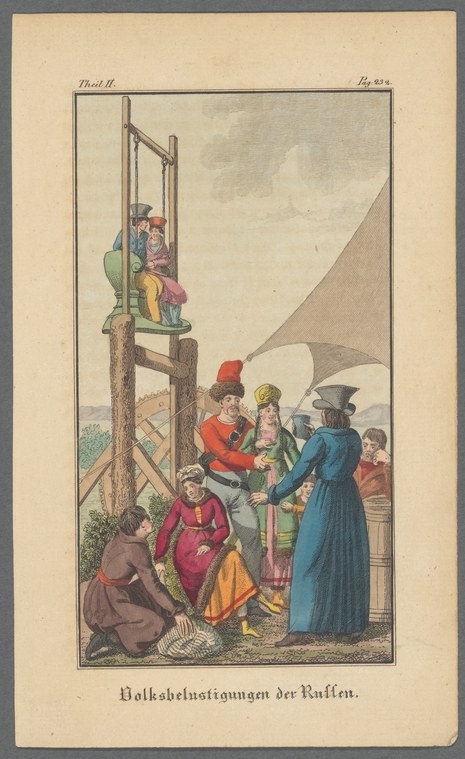
A crowded street scene showing German folk celebration, likely early 19th century. In the foreground, a diverse group of figures in colorful regional costume stands watching a tall wooden scaffold or platform structure. Two or three figures are climbing or positioned on the scaffold's ladder and platform, which is decorated with a large sail or canvas. The watching crowd includes women in red and pink dresses, men in blue coats and top hats, and children. The composition is vertical and narrow, emphasizing the height of the structure. The setting appears to be outdoors, with a clear sky and architectural elements suggesting a town or village square. The hand-coloring of the print shows vivid blues, reds, yellows, and browns across the figures' garments.
The dancing
The figures on the scaffold are active—one person appears to be climbing or demonstrating something physical on the wooden structure, while the crowd below stands in loose groups watching. The body language of the spectators is still and observational, leaning slightly forward in interest. The composition does not show a coordinated group dance; instead, it depicts audience attention to a performance or demonstration. The standing figures are upright and formal, typical of public assembly in period dress.
The dance depicted
The title 'Volksbefestigungen der Raffen' (Folk Festivities of the Raffen) suggests a regional German folk celebration, but the image does not depict dancing in any conventional sense. Instead, it appears to show a public entertainment, perhaps a climbing race, acrobatic display, or dare on the scaffold structure. The event involves spectacle and physical challenge rather than rhythmic group movement. Without clearer identification of the specific 'Raffen' tradition, the dance or celebratory nature remains obscure; this may document a folk custom involving feats of strength or daring rather than choreographed dance.
How it was made
Hand-colored engraving or etching, characteristic of early 19th-century German popular prints. The technique allowed for mass production and wide circulation among a local or regional audience, enabling documentation of folk customs and regional dress. The clear linear composition and careful rendering of costume detail suggest this was designed for educational or ethnographic purposes—to record and disseminate knowledge of regional identity and folk practice. The hand-coloring adds accessibility and appeal for a popular audience.
About this work
This is an early 19th-century German engraving documenting a folk celebration identified as a 'Raffen' tradition. The work belongs in a gallery of dance in art not as a record of choreographed dance, but as visual evidence of folk festivity and the public ceremonial gathering of communities in period costume. It represents the intersection of social ritual, regional identity, and physical challenge—areas where dance and folk culture overlap. The print's explicit focus on regional dress makes it a document of how communities performed their identity through costume and gathering.
How to look at it
Attend to the contrast between the active figure(s) on the scaffold and the attentive crowd below. The composition emphasizes height and challenge—the viewer's eye is drawn upward to the physical feat. Notice the care taken in rendering each figure's costume: the specificity of regional dress suggests this print was meant to document and disseminate knowledge of 'Raffen' identity through visible markers. The crowd's stillness and focus frames the scaffold as theater.
The artist
Unknown artist. The print's style and format are consistent with early 19th-century German popular or pedagogical engraving. The work belongs to a tradition of ethnographic folk documentation that grew with Romantic-era interest in regional and national identity.
The period
Early 19th century, during a period of intense European interest in folk culture, regional identity, and Romantic nationalism. German-speaking regions were documenting and celebrating their distinct local customs through prints, collections, and public display. This image sits within that wave of ethnographic documentation—capturing dress, gathering practices, and regional ritual as markers of cultural identity during a time when such traditions were being collected, systematized, and performed for wider audiences.
Where it lives
Print from the New York Public Library's collection of dance-related prints. The source identifier and holding suggest this was collected as a document of folk or dance culture, though the selection logic is not explicit in the record.
Dance in this work
Questions about this work
Is this a dance?
Not in the conventional sense of choreographed movement. It documents a folk festival or public entertainment involving a scaffold and physical challenge, watched by a costumed crowd. The image captures gathering, spectacle, and community participation—activities closely related to dance culture but distinct from dance itself.
What is a 'Raffen'?
The specific 'Raffen' tradition is not clearly documented in readily available sources. The German title suggests a regional folk celebration or festivity. This print may be one of the few surviving visual records of the practice, making identification difficult without additional archival research.
Why is this in a dance collection?
Folk festivity and public ceremonial gathering are adjacent to dance culture and were often documented together in 19th-century ethnographic practice. This print records how communities performed identity and celebrated together through costume, gathering, and public spectacle—the broader social contexts in which dance emerged.
What period is this from?
The style, hand-coloring technique, and costume details place this in the early 19th century, likely between 1800 and 1840. The print belongs to the period of Romantic nationalism and intense European interest in documenting regional folk culture.
More dance artwork





