49 works in this view — arrow keys or swipe to move between them.
Dance in Art
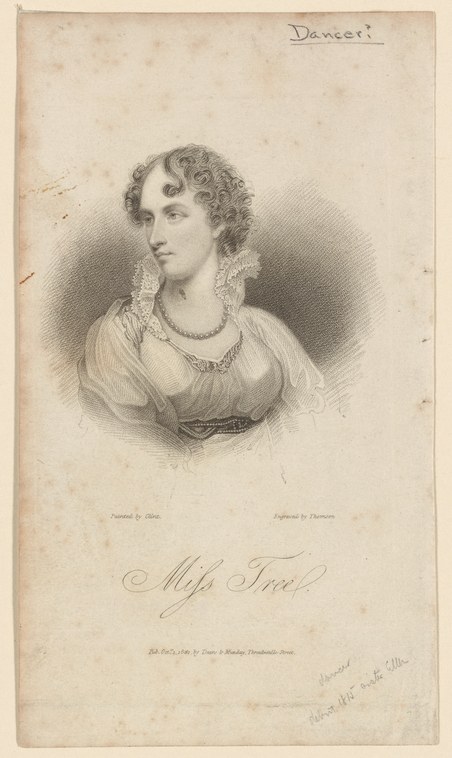
Miss Tree
Unknown artist
- Collection:
- Prints depicting dance
- Source:
- New York Public Library
- Rights:
- Public domain — free to use, share and adapt.
- Recorded as:
- Public Domain
This print is a primary document of how female dancers were commodified and celebrated in the Regency period—their faces and fashionable dress as much the product as their technique. It demonstrates the existence of a commercial market for theatrical portraiture and the status that a dancer like Miss Tree could command in London society.
What you are looking at
A half-length portrait of a young woman rendered in engraved line and stipple technique, set against a soft tonal background that deepens behind her shoulders. She is turned in three-quarter view, her face in profile gazing downward and to the left with a contemplative, refined expression. Her curled hair is arranged in the Regency fashion, swept up and back. She wears a high-waisted white muslin gown with short puffed sleeves and a low, square neckline trimmed with gathered lace. A simple chain or cord with a pendant rests at her throat. The drapery of her gown is rendered with soft, naturalistic folds across her bosom and shoulders. The background is left blank above, allowing the portrait to float on the page. The inscription below reads "Miss Tree" in flowing script, with publication information beneath.
The dancing
The figure is stationary, posed in the convention of a refined portrait rather than captured mid-movement. Her posture is upright but relaxed, shoulders back, one arm implied beneath the frame. The tilt of her head and downward gaze convey a moment of introspection or modest reserve—qualities valued in Regency female portraiture. There is no visible dance gesture or frame; this is a portrait of a person, not a depiction of dance action.
The dance depicted
No dance is depicted in this image. This is a commemorative portrait of an individual identified as Miss Tree. However, the label "Dancer" at the top of the page and the designation within a collection of "Prints depicting dance" suggests that Miss Tree was a professional dancer of the Regency era whose likeness was circulated in this form. Without visible choreographic content, we cannot determine her style or technique from the image alone, but the engraving's quality and circulation suggest she was a notable performer whose name and face warranted public distribution.
How it was made
This is an engraving, executed in line and stipple technique on paper. The artist has used fine parallel lines and small dots to build tone and volume, particularly in the hair, face, and drapery, while reserving clean line for contours. The technique is characteristic of reproductive portraiture of the early 19th century, a method suited to rapid circulation via prints and collection in portfolios. The skill and finish suggest a London workshop production, likely by a known hand in theatrical or social portraiture, though the engraver's name is not recorded in the catalogue.
About this work
This is a commemorative engraved portrait of Miss Tree, identified in contemporary inscription as a dancer, rendered in the refined Regency style of early 19th-century theatrical celebrity portraiture. The work belongs to a larger practice of circulating prints of notable performers—actors, dancers, singers—as collectible images that allowed the public to possess and display likenesses of stage personalities. The engraving's quality, publication information, and placement in a dance-focused collection all confirm that Tree held professional standing and that her image was considered worth reproducing and selling. The portrait format, with its emphasis on refined beauty and fashionable dress, documents how female dancers were presented to the public during this period: as cultivated, genteel subjects rather than primarily as bodies in motion.
How to look at it
Attend to what is not shown: there is no leap, no extension, no visible technique. The artist has chosen to present Miss Tree as a social subject—elegantly dressed, tastefully posed—rather than as a body in action. This reflects the Regency convention of theatrical portraiture, which emphasised the performer's place in fashionable society and their appeal to polite audiences, not their physicality or skill. The downward gaze and introspective quality suggest a moment of repose or private reflection, a convention that humanised performers and made them seem accessible to the viewer. The print's finish and publication format tell us that this was a mass-produced luxury—affordable enough to circulate widely, refined enough to hang in a lady's parlour.
The artist
The engraver is not recorded. The print was "Published by E. Orme" (visible in the publication line), a London printmaker and publisher active in the early 19th century known for theatrical and social portraiture. The quality of the engraving suggests a competent journeyman hand working in Orme's workshop, one of several producing fashionable celebrity prints during the Regency period.
The period
The Regency era (roughly 1811–1820, and by extension the broader early 19th century) was a high point of fashion-consciousness and celebrity culture in London. The period saw the rise of the commercial print market, with theatrical personalities—including dancers—becoming subjects of public fascination and commercial portraiture. Women dancers, particularly those performing in pantomime and ballet, gained unprecedented visibility and social interest. The publication of individual portrait prints allowed fans to collect and display images of their preferred performers; these prints were often bound into portfolios or albums. The Regency also saw the emergence of Romantic ballet and the cult of the dancer as an aesthetic ideal—ethereal, refined, fashionable. Miss Tree's portrait, with its emphasis on her fashionable dress and refined features, participates in this broader celebration of female performers as both stage artists and objects of contemporary taste.
Where it lives
The print is held in the New York Public Library's collection of "Prints depicting dance." It was likely one of many theatrical portraits collected in the 19th and 20th centuries as documents of performance history. The publication line indicates it was issued by E. Orme, a London publisher, and engraved by an unnamed hand; it may also carry a date or edition mark not legible in this image.
Questions about this work
Was Miss Tree a real dancer?
Yes. The presence of her portrait in a commercial print series, published by an established London printmaker, confirms that she was a known performer of the Regency era. The style and quality of the engraving suggest she held professional standing. However, specific records of her performances, roles, or career have not been located in this catalogue entry, and a fuller biography would require archival research.
Why is she not shown dancing?
Regency-era theatrical portraiture typically presented performers as elegant, fashionable social subjects rather than as bodies in motion. A portrait was a commodity meant to appeal to polite society and to circulate as a collectible; it emphasised the performer's place in the social world and their alignment with contemporary taste. A depiction of vigorous movement or technical display would have seemed coarse by comparison.
What does her dress tell us?
Her high-waisted white muslin gown, puffed sleeves, and lace trim were the height of Regency fashion, worn by genteel women of means. By dressing Miss Tree in this fashion, the engraver (or the theatrical producers who circulated her image) presented her as a cultivated, respectable woman rather than as an exotic or vulgar performer. This was strategic: it allowed middle-class audiences to admire her without compromising their own social standing.
More dance artwork





