49 works in this view — arrow keys or swipe to move between them.
Dance in Art
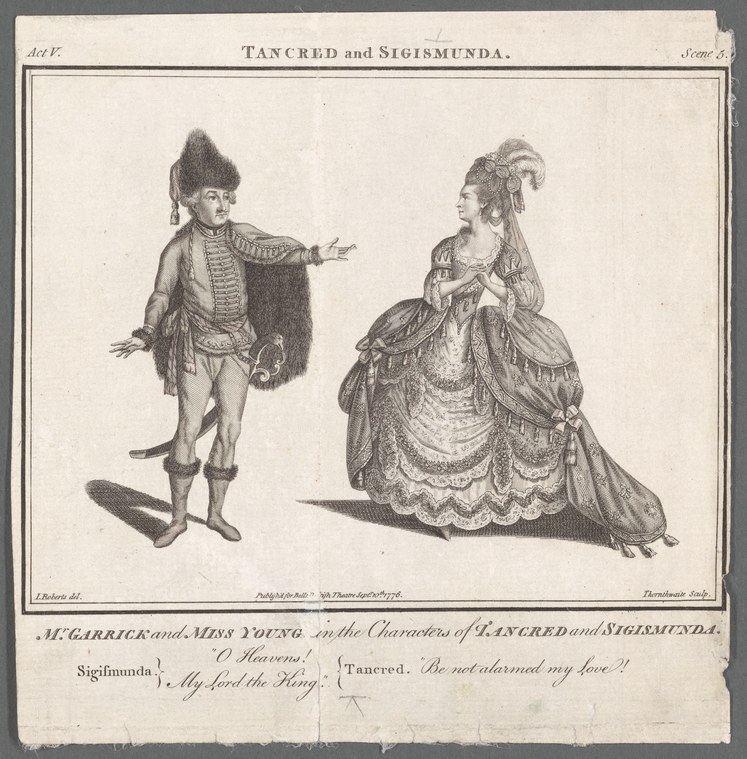
Mr. Garrick and Miss Young [i.e. Elizabeth Pope] in the characters of Tancred and Sigismunda; Tancred and Sigismunda, Act V, scene 5
Unknown artist
- Collection:
- Prints depicting dance
- Source:
- New York Public Library
- Rights:
- Public domain — free to use, share and adapt.
- Recorded as:
- Public Domain
David Garrick was the dominant figure in 18th-century English theatre, known for bringing naturalism and psychological depth to tragic roles; this print preserves the visual record of his performance style and the formal theatrical costume and gesture that defined tragic acting in the period. For dance historians, it documents the gestural vocabulary and bodily training that theatre actors deployed—a vocabulary distinct from but adjacent to theatrical dance, and essential to understanding the full physical culture of the 18th-century stage.
What you are looking at
This is an engraved theatrical print documenting a moment from a 18th-century stage production. Two figures are shown in full-length portraits against a plain background: on the left, a young man in military dress—a tight-fitting coat with ornate braiding across the chest, a tall plumed hat, and slim breeches—stands with one arm extended in an emphatic gesture of address or appeal, his weight slightly forward. On the right, a young woman in an elaborate ball gown sits or stands in profile, her dress a construction of layered skirts, lace decoration, and draped fabric caught up at the sides, her hair dressed high with feathers or ornamental plumes. The inscription below identifies them as "M. Garrick and Miss Young in the Characters of Tancred and Sigismunda" and provides a line of dialogue: Sigismunda says "O Heavens!" while Tancred responds "Be not alarmed my love!" The print is a documentary record of actors in character rather than a depiction of choreographed dance, but the theatrical gesture and formal presentation mode carry the vocabulary of 18th-century stage performance.
The dancing
The male figure (Tancred) occupies a posture of emotional urgency: one arm is raised and extended toward his companion in a gesture of reassurance or pleading, his body angled forward, his stance balanced but active. The female figure (Sigismunda) is composed and stationary, her body in three-quarter view, her arms held carefully at her sides or across her lap, her deportment formal and dignified. Neither figure displays the physical contact or partnered positioning that would characterize ballroom or social dance; instead, they embody the declamatory physical vocabulary of spoken-word theatre, where gesture and stance convey emotional narrative. The contrast between his animated appeal and her composed response reads as dramatic acting rather than dance partnering.
The dance depicted
This print does not depict dance in the modern sense, but documents theatrical acting in the 18th-century manner, when trained actors performed in elaborate costumes with formal, stylized gesture. The play *Tancred and Sigismunda* was a neoclassical tragedy written by James Thomson (1752), performed frequently in the 1750s–1760s at London theatres including Drury Lane and Covent Garden. David Garrick was the leading actor of his era, celebrated for his naturalistic yet passionate interpretation of tragic roles; Elizabeth Pope (known as Miss Young before marriage) was a prominent actress of the period. The 'dance' here is the dance of dramatic gesture—the formal, rehearsed movement vocabulary that tragic actors used to signal emotion and intention to an audience in a large theatre. The print captures a moment of heightened emotional expression within a spoken dramatic scene, not a choreographed dance.
How it was made
This is an engraving, a printmaking technique that produced fine lines through the incision of a metal plate. The artist's name does not appear on the visible surface. The technique allowed precise detail in the rendering of fabric texture, facial features, and the ornamental detail of 18th-century dress—elements essential to a theatrical print intended to document and promote a specific performance and its celebrated actors. Engravings were the principal medium for theatrical documentation in this period, circulated widely to theatre-going audiences and collectors, and therefore far more accessible than the original performance. The careful attention to costume detail and the formal presentation suggest this was a professional commission, likely sold as a theatrical souvenir.
About this work
This is an engraved print documenting a specific moment in James Thomson's tragic play *Tancred and Sigismunda* as performed by the celebrated actors David Garrick and Elizabeth Pope in the mid-18th century. While it shows theatrical figures in formal dramatic gesture rather than choreographed dance, it belongs in a dance archive as evidence of how trained bodies moved in the theatre of this era—the formal, emotion-laden gestural language that preceded and coexisted with theatrical dance proper. The print is a record of one of the most celebrated actors of the English stage performing a moment of heightened dramatic appeal, captured in a medium designed for wide distribution to theatre audiences. It illustrates the boundary between acted drama and theatrical dance, and demonstrates how 18th-century printmakers documented performance for audiences who might never see the production in person.
How to look at it
Attend to the contrast between the two figures' physical presence: Tancred's urgent, forward-leaning posture and extended arm convey emotional appeal, while Sigismunda's composed, vertical alignment and restrained gesture express dignified response. The print freezes a moment of dialogue—a moment when Tancred's urgent plea meets Sigismunda's controlled composure—and in doing so documents the formal 'language of gesture' that 18th-century actors used to communicate emotional states to audiences in large theatres. Notice also the meticulous rendering of costume detail: the military braiding on Tancred's coat and the elaborate construction of Sigismunda's gown are not merely decorative but central to the social and emotional meaning of the scene.
The artist
The engraver is not identified on the print. Theatrical prints of this type were produced by professional engravers working from drawings or paintings made after performances, often in rapid succession to capitalize on a production's popularity. The 'Prints depicting dance' collection at the New York Public Library includes many works by known and unknown engravers of this period, documenting London theatre productions from the mid-to-late 1700s.
The period
The mid-18th century was the age of David Garrick's theatrical dominance (1741–1776), a period when English tragedy was performed in elaborate neoclassical costume and with formal, oratorical gesture. Theatrical prints were a booming commercial genre—they served both as souvenirs for theatregoers and as advertisement for future productions. Simultaneously, theatrical dance was becoming an increasingly important element of stage spectacle; ballet d'action was developing in France and Italy, and dance interludes were common in spoken drama. This print captures a moment before ballet had fully established itself as an autonomous art form in English theatres, when actors' gestural language and dancers' technique were still relatively distinct domains.
Where it lives
This print is held in the 'Prints depicting dance' collection at the New York Public Library, indicating it was catalogued and preserved as a dance-related document. It is one of many theatrical prints from this period in institutional collections, surviving evidence of the commercial print industry that documented London theatre for contemporary and later audiences.
Questions about this work
Was this a dance performance?
No. This documents spoken dramatic theatre—a scene from a neoclassical tragedy. However, it shows the formal gestural vocabulary that trained actors used on the 18th-century stage, a physical language distinct from but related to theatrical dance. Both actors and dancers trained in formal bodily control and the use of gesture to communicate emotion.
Who were Garrick and Miss Young?
David Garrick (1717–1779) was the dominant English actor of his era, celebrated for bringing psychological depth and relative naturalism to tragic roles. Elizabeth Pope, known professionally as Miss Young, was a prominent actress who performed in London theatres from the 1750s onward. Both were among the most celebrated performers of their generation.
What is the play about?
*Tancred and Sigismunda* is a neoclassical tragedy by Scottish poet James Thomson, first performed in 1752. The play tells of two lovers separated by family obligation and honor. This scene captures a moment of emotional crisis between the title characters, with Tancred attempting to reassure Sigismunda in the face of tragedy.
Why would a dance archive hold this print?
Because it documents the physical training, gesture vocabulary, and formal presentation style of 18th-century theatrical performance. Understanding how actors moved and gestured is essential to understanding the full physical culture of the theatre, the adjacent but distinct world of theatrical dance, and how these two forms coexisted on the same stage.
More dance artwork





