49 works in this view — arrow keys or swipe to move between them.
Dance in Art
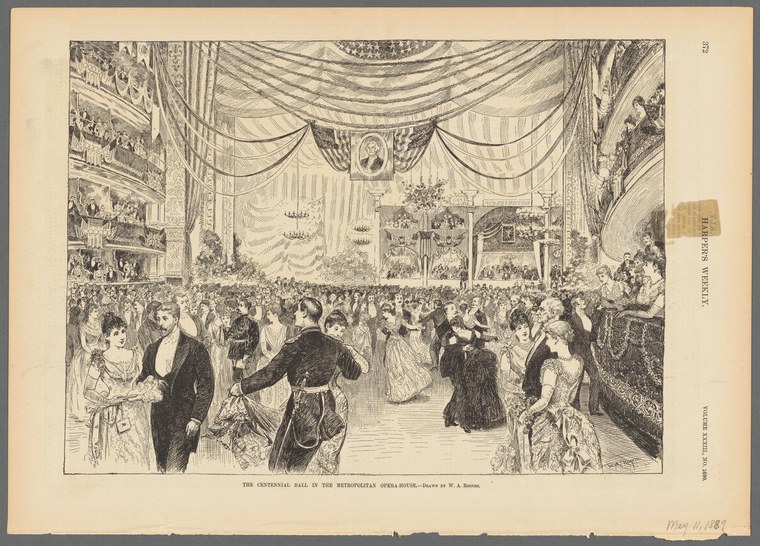
The centennial ball in the Metropolitan Opera House
Unknown artist
- Collection:
- Prints depicting dance
- Source:
- New York Public Library
- Rights:
- Public domain — free to use, share and adapt.
- Recorded as:
- Public Domain
For historians of American ballroom culture and social dance, this engraving is primary evidence of the setting and context in which Gilded Age dances were performed. It shows the relationship between architecture, spectacle, and social dancing in the period, and the ways that ballroom events functioned as public demonstrations of wealth and status.
What you are looking at
An engraved depiction of a grand ball in the Metropolitan Opera House, showing a vast assembly of formally dressed guests filling the main floor beneath a spectacular decorated ceiling. The interior is hung with swags of fabric and elaborate drapery, with multiple levels of boxes visible at left containing seated spectators. Crystal chandeliers hang throughout the space. The figures wear evening dress typical of the late 19th century—men in dark tailcoats, women in full-skirted gowns with trains. The crowd is densest in the center and foreground, with couples and groups visible throughout the depth of the hall. The style of dress, architectural detailing, and scale of the event suggest this depicts a significant social occasion, likely from the Gilded Age.
The dancing
Figures throughout the composition stand, promenade, and assume the upright posture expected of formal ballroom assembly. In the foreground, several couples are visible in close proximity; one couple at left shows a man and woman in formal evening wear standing near one another in the manner typical of ballroom introduction or conversation. The overall body language is formal and restrained, consistent with late-19th-century court and ballroom etiquette. No active dancing steps are clearly visible; the focus is on the social gathering itself rather than the execution of specific dance movements.
The dance depicted
This is a social ballroom scene rather than a depiction of dance technique. The Centennial Ball would have featured the ballroom dances standard to American high society in the period—waltz, quadrille, cotillion, and other formal dances—but the engraving captures the assembly and promenade rather than the actual execution of these dances. The work documents the scale and splendor of a major social event and the formal dress code expected, but does not show dancers in active movement or in the characteristic holds and frames of any specific ballroom style.
How it was made
This is an engraving, a printmaking technique that allows for fine detail and mass reproduction. The composition is rendered with the precise linear hatching characteristic of wood or steel engraving, and the scale of the interior space is suggested through careful perspective and the layering of figures in depth. Engravings of this kind were common as illustrations in newspapers and periodicals, and this work bears the characteristics of journalistic documentation—rapid execution, accessibility to a broad audience, and the capacity to circulate news of major civic events widely. The technique also enabled the artist to capture the crowded complexity of such a scene with clarity.
About this work
This engraving records a grand ball at the Metropolitan Opera House, likely commemorating a significant civic occasion ('Centennial' suggests the American Centennial of 1876). Rather than depicting dance technique, it documents the scale, setting, and social context of American ballroom culture in the Gilded Age—the architectural splendor, the formal dress, and the assembly of high society. For historians of dance, it is valuable as a window onto the occasions on which ballroom dances were performed and the social hierarchies and rituals that framed them.
The work sits at the intersection of social history and dance history. It shows us not the choreography or execution of the waltz, quadrille, or cotillion, but the world in which those dances took place: the opulent venues, the formal dress code, the public nature of even supposedly 'private' social events, and the role of dance in the self-presentation of the urban elite.
How to look at it
Attend to the architectural ambition of the Opera House interior: the soaring ceiling, the abundant drapery, and the multiple tiers of boxes that allowed for both participation and spectatorship. The engraver has used perspective and the density of figures to convey the scale and grandeur of the occasion. Look at the formal dress code—the uniformity of men's tailcoats and the elaborate gowns of the women—as evidence of the strict social conventions governing such events. The work captures not a moment of active dancing but the before or between, the social context in which dancing was embedded.
The period
This engraving dates to the Gilded Age, a period of rapid urban expansion, new wealth, and ambitious public architecture in American cities. The Metropolitan Opera House opened in 1883, and balls held there were major social events covered extensively in the press. The ballroom dances of this period—the waltz, quadrille, cotillion, and increasingly the polka and galop—were central to courtship and social advancement among the urban elite. Engraved illustrations of major social events were a standard form of journalism, allowing newspapers and periodicals to document and disseminate images of high-society life to a much broader audience.
Where it lives
This engraving is held in the New York Public Library's collection of prints depicting dance, which documents American social and theatrical dance through printed images. As a work of journalistic engraving from the Gilded Age, it belongs to the category of contemporary press documentation of major civic and social events.
Dance in this work
Questions about this work
What is the Centennial Ball?
The title suggests a ball held to commemorate an important centennial, most likely the American Centennial of 1876. The Metropolitan Opera House opened in 1883, so if this depicts an actual event, it would date to the 1880s or later. Balls held at the new Opera House were major social events in New York and were extensively illustrated in the press.
What dances would have been performed at such a ball?
Gilded Age ballrooms typically featured the waltz, quadrille, cotillion, polka, galop, and lancers. The engraving does not show dancing in progress, but rather the assembly and social context in which these dances would have taken place.
Why is this engraving valuable for understanding dance history?
It documents the venue, scale, and social context of American ballroom culture in the late 19th century. For historians interested in how dance functioned as a social practice—not just as technique—this kind of image is essential evidence of the world in which ballroom dances were performed.
More dance artwork





