49 works in this view — arrow keys or swipe to move between them.
Dance in Art
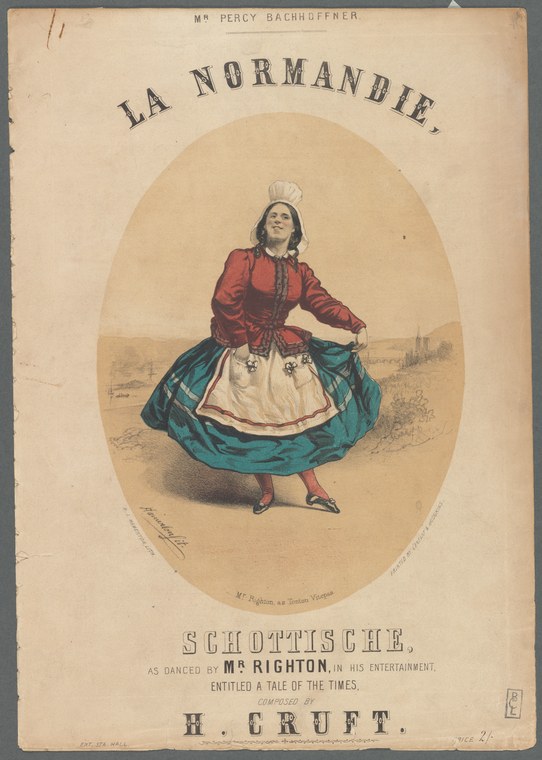
La Normandie: schottische, as danced by Mr. Righton, in his entertainment, entitled A tale of the times
Unknown artist
- Collection:
- Prints depicting dance
- Source:
- New York Public Library
- Rights:
- Public domain — free to use, share and adapt.
- Recorded as:
- Public Domain
The work documents a moment when 19th-century social dances were being absorbed into theatrical entertainment and distributed through visual media. It shows how a specific performer and production took the schottische—an already established couple dance—and reframed it as a character study, making the peasant woman as much a subject as the dance itself. The print is a primary artifact of how dance was promoted, imagined, and consumed in the Victorian theatre.
What you are looking at
A woman in peasant costume stands alone against a plain tan background, her body turned three-quarters toward the viewer. She wears a red velvet jacket with dark trim, a white apron, and a striking turquoise-blue skirt gathered at the waist. A white bonnet sits on her dark hair. Her left arm extends outward at shoulder height, palm open, while her right arm drops to her side; her weight appears centered and grounded. In the distant background, a small village with a church spire is sketched in pale tones. The figure is framed within a large oval vignette, the entire composition presented as a theatrical character study rather than an action scene. The artistic technique—hand-colored lithography or similar print medium—gives the work the appearance of a theatrical costume sheet or character portrait from a stage production.
The dancing
The dancer stands in an upright, dignified pose with weight evenly distributed. Her extended left arm suggests she is mid-gesture or about to move, though the pose is held and presentational. The stance is not the close partnered hold of ballroom dance, but rather a solo display of the character and costume. Her posture and the controlled extension of her arm suggest trained movement rather than folk naturalism, indicating a professional theatrical performer.
The dance depicted
The work is identified by its title as the Schottische, a couple dance popular in the 19th century, performed here as a character piece in a theatrical context. Mr. Righton danced this as part of the stage production 'A Tale of the Times.' The schottische was typically a moderately paced round dance in 2/4 time with a distinctive hop-step-step-hop pattern, popular in both social and theatrical settings from the 1840s onward. This image presents a character interpretation—a Normandy peasant woman performing the dance—rather than the dance itself in motion, suggesting the work functioned as promotional material or a character study for the theatre production.
How it was made
This is a hand-colored lithographic print or similar chromolithographic process, as evidenced by the soft washes of color, the gentle tonal gradations, and the oval vignette border. The technique allowed for mass reproduction and distribution, making such character studies affordable promotional materials for theatre. The crediting to 'H. Cruft' (visible at bottom) identifies the artistic execution; the credit to 'Percy Bachhüffner' (top) likely represents the theatrical producer or director. The print format and theatrical context indicate wide circulation among playgoers and dance enthusiasts of the period.
About this work
This is a theatrical character portrait from a 19th-century stage production, presenting the schottische—a popular European couple dance—through the figure of a Normandy peasant woman. Rather than depicting the dance in action, the work functions as a costume study and character advertisement for the production 'A Tale of the Times,' in which the actor Mr. Righton performed. The print exemplifies how dance was mediated through theatre and popular visual culture during the Gilded Age, when European regional dances were adapted for the stage and marketed to urban audiences through illustrated playbills and character prints.
The schottische itself was a trans-European phenomenon, performed in ballrooms and on stages from the 1840s onward. This theatrical version, tied to a specific production and performer, shows how popular dances were transformed into character pieces with narrative and regional costume context. The print survives as evidence of the theatrical apparatus that brought European social dances to public audiences and transformed them into spectacle.
How to look at it
The print is best understood not as a representation of the schottische in motion, but as a promotional still—the moment of presentation rather than execution. Observe how the dancer's pose is theatrical and composed: the extended arm invites the viewer's gaze, the costume is fully displayed, and the stance suggests dignity and refinement rather than the spirited hopping and turning the schottische required. The distant village in the background anchors the 'Normandy' setting announced in the title, while the oval vignette mimics the frame of a theatrical spotlight or portrait medallion. The work celebrates both the performer and the costume.
The artist
The lithographer 'H. Cruft' is credited at the lower right, but little is recorded about this artist's practice or biography. The work is part of a larger tradition of theatrical character prints—illustrated advertisements for stage productions that circulated among playgoers in the 19th century. Such prints were typically unsigned or credited to minor artists whose broader practice is now largely lost. The attribution to 'Percy Bachhüffner' at top suggests an impresario or producer responsible for the production.
The period
The schottische emerged as a couple dance in Central Europe in the early 1840s and spread rapidly across ballrooms and stages throughout the mid-to-late 19th century. It was part of the broader fashion for folk-derived and regional dances—mazurkas, polkas, and galopades—that offered variety and exoticism to urban middle-class dancers and audiences. On the theatrical stage, such dances were frequently costumed with regional dress and embedded in narrative contexts, allowing performers like Mr. Righton to present 'authentic' peasant characters while executing trained, stylized movement. 'A Tale of the Times' appears to have done precisely this, using the schottische as a vehicle for character portrayal and scenic spectacle.
Where it lives
This print is held in the New York Public Library's collection of prints depicting dance. It is one of many such theatrical character studies and costume sheets that survive from 19th-century stage productions, circulated as souvenirs and promotional materials. The holding collection recognizes the object's value as documentation of performance, costume, and the material culture of theatre.
Dance in this work
Questions about this work
What is the schottische, and why did it appear in a stage production?
The schottische was a moderately paced couple dance in 2/4 time, popular in ballrooms from the 1840s onward. It was characterized by a hop-step-step-hop pattern and was performed across Europe and America. Theatrical producers frequently adapted fashionable ballroom dances for stage by costuming them with regional dress and embedding them in narrative contexts. This made them accessible to audiences who did not attend ballrooms and turned the dances into character pieces.
Who was Mr. Righton?
The catalogue record identifies him only as the performer of this piece in the production 'A Tale of the Times.' He appears to have been a professional theatrical dancer or actor of sufficient reputation to warrant a character portrait, but further biographical information is not recorded.
Why is the dancer shown alone, not in a couple?
This is a character study and costume portrait rather than a representation of the dance itself. By presenting the figure alone, the print emphasizes costume, character, and the performer's presence rather than the partnered interaction the schottische required. This format was typical for theatrical promotional materials.
What technique was used to make this print?
Based on the visual evidence—soft color washes, gentle tonal gradations, and the oval vignette border—this appears to be a hand-colored lithograph or chromolithograph, a process that allowed theatrical prints to be produced and distributed at relatively low cost to promote stage productions.
More dance artwork





