49 works in this view — arrow keys or swipe to move between them.
Dance in Art
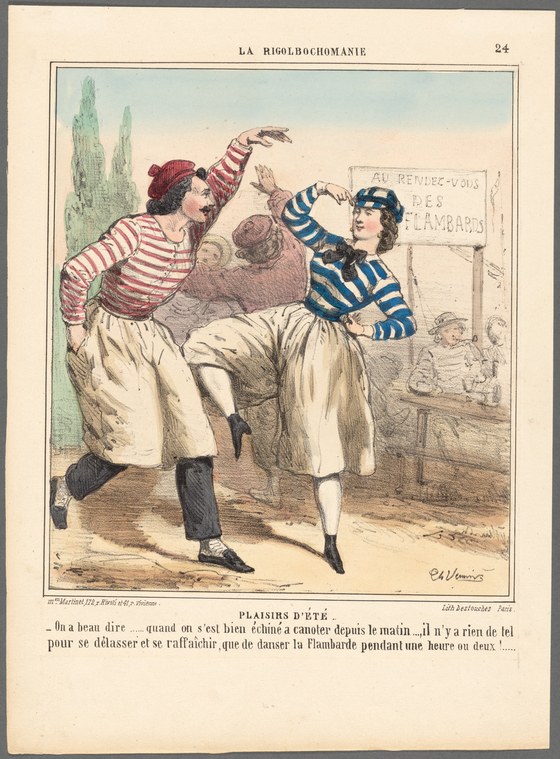
24. Plaisirs d'été. On a beau dire-- quand on s'est bien échiné a canoter depuis le matin-- , il n'y a rien de tel pour se délasser et se raffaîchir [i.e., rafraîchir?], que de danser la Flambarde pendant une heure ou deux.
Unknown artist
- Collection:
- Prints depicting dance
- Source:
- New York Public Library
- Rights:
- Public domain — free to use, share and adapt.
- Recorded as:
- Public Domain
The Flambarde is rarely documented in dance histories, and this image may be one of very few visual records of how it was performed, what it looked like, and who danced it. The work is valuable as evidence of non-ballroom, non-theatrical dance in the 19th century—the improvised, playful movement that ordinary people actually did. It also documents the role of women as autonomous dancers in leisure settings, not merely as partners in formal dances.
What you are looking at
Two young women in striped shirts dance together outdoors on a sunny day, their bodies animated and energetic. The woman on the left wears a red-and-white striped shirt and cream-colored skirt; the woman on the right wears a blue-and-white striped shirt and similar light skirt. Both wear black boots and hats—the left figure in a red cap, the right in a blue beret. They face each other with raised arms, their bodies arched and twisted in playful exertion. Behind them stands a wooden fence or gate bearing a notice (barely legible), and the background shows cypress trees and a rural or suburban setting. The artist has captured the women mid-movement, their skirts lifted by their own motion, against a soft cream sky. The hand-colored engraving technique gives the scene a lively, fresh quality, with careful attention to the pattern of their striped clothing and the play of light on their forms.
The dancing
Both dancers are depicted with high arm raises, torsos twisted away from each other despite their close proximity. Their weight appears to shift dynamically—the left figure leans back with one leg extended, while the right figure reaches upward and forward, creating a sense of rapid movement and play. The spacing between them suggests they are not in a closed partner hold but rather performing an energetic, playful interaction. Their leg positions and the lifted skirts indicate vigorous, possibly springing or bouncing movement rather than gliding steps.
The dance depicted
The caption identifies this as 'La Flambarde,' a 19th-century French popular dance. The text notes that after exerting themselves at canoeing all morning, these dancers refresh themselves by dancing the Flambarde for an hour or two. Flambarde appears to have been a lively, informal social dance of the gilded age, characterized by high energy and playful physical abandon. The image captures the dance as a leisure activity—impromptu, joyful, and socially mixed (young women dancing together without male partners), suggesting it was part of urban or semi-urban recreational culture rather than formal ballroom practice.
How it was made
This is a hand-colored engraving or lithograph from the 19th century, part of a series titled 'La Rigolo-Manie' (visible at the top of the page). The technique allows for fine detail in the figures and landscape while the hand coloring adds vibrancy to the striped costumes and sky. The presence of a page number and publication marks suggests this was part of a larger series of satirical or genre prints, likely circulated as a serial publication. This medium and format indicate a popular, mass-circulation audience rather than collectors of fine art.
About this work
This is a page from a 19th-century French satirical or humor-focused print series depicting contemporary leisure and social customs. It shows two young women dancing the Flambarde, a lively popular dance, in a semi-rural setting as a form of recreation and refreshment. The work documents not merely a dance style but an attitude toward dancing—as spontaneous, playful, and accessible to ordinary people, especially women, in the context of summer outings and boating parties. The Flambarde itself appears in this image as a vigorous, uninhibited dance of two-part or solo-pair repertoire, performed not in a ballroom but in the open air, dressed in contemporary (not formal) clothing. The print belongs to the tradition of genre imagery and social satire that flourished in 19th-century France, using everyday scenes and humor to comment on or simply record contemporary manners.
How to look at it
Notice the high, uncontrolled arm position and the twisted torsos—these are not the contained, formal gestures of ballroom dance. Observe how the artist has caught the skirts mid-lift, suggesting bouncing or springing action. The women are almost turned away from each other despite their physical proximity, which implies a dance involving turning, twisting, or facing alternately inward and outward. The outdoor setting and casual dress, and the caption's emphasis on refreshment and relief from exertion, all suggest this was understood as play rather than technique.
The artist
The artist's signature on the print reads 'Ed Morin' or similar (not entirely legible in reproduction). The work appears in a series titled 'La Rigolo-Manie,' suggesting the artist was working in the French satirical print tradition of the mid-to-late 19th century. Without fuller research into the publication and the artist's other work, more specific attribution cannot be made from the image alone.
The period
This print dates to an era of expansion in leisure activity, summer tourism, and recreational boating in France and Europe more broadly. The 1870s–1890s saw both an increase in illustrated press culture and a growing interest in capturing contemporary manners and customs. Dance, in this period, was becoming increasingly democratic and accessible to the middle and working classes through public gardens, outdoor venues, and commercial entertainment. The Flambarde sits outside the formal ballroom world of Waltz, Polka, and Quadrille that dominated polite society, suggesting it was either a folk survival or a newer popular creation of urban leisure culture.
Where it lives
This work is held by the New York Public Library in its collection of prints depicting dance. It is part of a series, suggesting it was one of many illustrations in a regular publication, likely a satirical or genre-focused periodical or album.
Dance in this work
Questions about this work
What is the Flambarde?
Based on this image and its caption, the Flambarde was a 19th-century French popular dance, informal and lively, performed in leisure settings by ordinary people—especially women—as a refreshing activity. The specific steps and music are not documented here, but the visual evidence suggests energetic, playful movement with high arms, twisting torsos, and an improvisational or non-codified character.
Why were these women dancing without male partners?
By the 19th century, women dancing together was becoming more socially acceptable in informal, recreational contexts, especially outside the ballroom. This image suggests the Flambarde was not a partnered dance in the formal sense, or at least could be performed by women together as a playful, autonomous activity.
What does the caption say?
The caption translates roughly as: 'Ha, there's a fine idea—when you've really exerted yourself canoeing since morning, there's nothing like it to relax and refresh yourself—dancing the Flambarde for an hour or two!' It frames the dance as a form of leisure recovery after physical activity.
Is this a unique record of the Flambarde?
It appears to be one of very few surviving visual documents of this dance. Dance historians have limited information about popular dances of the 19th century outside the ballroom, and prints like this are often the only evidence of how they looked and how they were understood by their practitioners.
More dance artwork





