49 works in this view — arrow keys or swipe to move between them.
Dance in Art
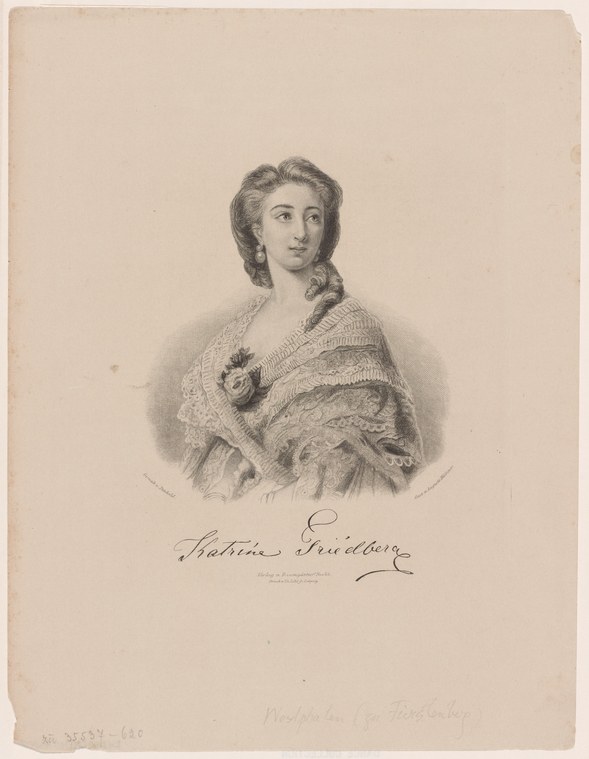
Katrine Friedberg (fac.sig.)
Unknown artist
- Collection:
- Prints depicting dance
- Source:
- New York Public Library
- Rights:
- Public domain — free to use, share and adapt.
- Recorded as:
- Public Domain
This portrait documents a named performer whose individual identity was important enough to circulate in engraved form, evidence of the celebrity and social position dancers could command in the nineteenth century. It also demonstrates the visual conventions by which female theatrical performers were presented to the public: refined, posed, and distanced from active labor. For dance historians, such portraits are primary documents of how dancers and their bodies were constructed as objects of public consumption.
What you are looking at
This is a portrait engraving of a woman identified by inscription as Katrine Friedberg, shown from the waist up against a plain background. She wears a shawl or wrap draped across her shoulders and torso, rendered with fine hatching to show its soft texture and deep folds. Her hair is styled in long waves pinned up in the manner of the mid-nineteenth century, and her gaze is directed slightly to the viewer's left. The engraving employs fine lines and subtle tonal variation to model her face and the fabric of her garment. Her left hand, visible at the lower right of the composition, holds what appears to be a small object, possibly a prop or fan. The work is executed in the formal portrait style typical of theatrical and performance publicity materials of the period.
The dancing
A single female figure, three-quarter length, is posed in a static, frontal composition typical of nineteenth-century theatrical portraiture. Her shoulders are relaxed and her posture upright but not stiff. The slight turn of her head and the thoughtful expression suggest a moment of repose rather than active movement. Her visible hand is delicate and refined, consistent with the conventions of genteel female portraiture. There is no indication of active dancing or choreographic movement; the figure is presented as a performer at rest.
The dance depicted
The inscription identifies this as Katrine Friedberg, a performer of the mid-nineteenth century. Without additional documentation, her specific dance practice cannot be determined from the image alone. The formal portrait style and the period costume suggest she was a theatrical performer of some standing, possibly a ballerina or stage dancer, but the engraving records her likeness rather than her performance. The work functions as a calling card or publicity image, documenting the appearance and social standing of a named performer rather than depicting a dance or dance movement.
How it was made
This is an engraving, likely a line engraving or possibly a steel engraving given the fine detail and quality of the rendering. The technique employs parallel lines and careful cross-hatching to create tone and volume, particularly evident in the modeling of the face and the drapery of the shawl. The inscription below the image is engraved in an elegant script. As a reproductive engraving, this work would have been printed in multiple copies and distributed as theatrical publicity, a common practice in the nineteenth century for promoting dancers and singers to the public.
About this work
This is a mid-nineteenth-century engraved portrait of a theatrical performer named Katrine Friedberg. The work is a documentary artifact of stage celebrity, recording the appearance and refined presentation of a named dancer or performer during a period when such portraits were essential tools of theatrical marketing. The engraving demonstrates the high technical standard of portrait reproduction available at the time and the importance placed on circulating images of popular performers to audiences beyond the theater itself.
The work belongs in a gallery of dance in art as evidence of how dancers were represented and consumed as public figures in the nineteenth century. Rather than depicting movement or choreography, it testifies to the status and visibility of performance as a profession and the role of portraiture in constructing and marketing the dancer's public identity.
How to look at it
Attend to the careful rendering of texture: the soft folds of the shawl, the delicate modeling of the face, the precision of the hair. The engraver has chosen to present the subject in a moment of stillness and introspection rather than in an attitude of movement or theatrical expression. Note the inscription below the image, which asserts the subject's identity and value as a named public figure. The composition—frontal, with minimal setting or context—is typical of celebrity portraiture and invites the viewer to contemplate the performer's face and bearing.
The artist
The engraver is not recorded in the catalogue. The signature visible in the lower left of the image (partially legible) may identify the printmaker, but this cannot be confirmed from the current documentation. Mid-nineteenth-century theatrical portraits were produced by specialized engravers working from original drawings or photographs, often for theatrical publishers or the performers themselves.
The period
In the mid-nineteenth century, engraved portraits were a principal means of promoting theatrical performers and building fan culture. The refinement of steel engraving techniques made it possible to produce large runs of high-quality prints at reasonable cost. Simultaneously, the emergence of photography in the 1840s and 1850s began to displace engraving as the medium of choice for theatrical portraits, though engraving remained in use for prestigious or artistic presentations. The formal conventions evident here—the contemplative pose, the refined dress, the emphasis on the performer's face and bearing—reflect the cultural work of such portraits in establishing the dancer as an object of refined aesthetic appreciation rather than as a laboring body.
Where it lives
This engraving is held in the New York Public Library's collection of prints depicting dance. It is part of a broader archive of theatrical and performance imagery documenting dance practice and performers across several centuries.
Questions about this work
Who was Katrine Friedberg?
The inscription identifies her by name, but biographical details are not available from the current record. She was clearly a theatrical performer significant enough to have been portrayed in an engraved print in the mid-nineteenth century, suggesting she held some prominence in performance circles, but her specific career, technique, and repertoire remain undocumented here.
Why is a portrait without any dance movement in it part of a dance collection?
Portraits of dancers are important primary sources for understanding how dancers were represented, valued, and marketed as public figures. This engraving documents the social status of a performer and the conventions by which female dancers were presented to audiences, making it valuable evidence of dance culture and celebrity in the nineteenth century.
Is this a photograph or an engraving?
It is an engraving, likely a line or steel engraving created by a skilled printmaker. You can see this in the parallel lines and cross-hatching used to create tone and texture, particularly in the face and drapery. The technique allows for fine detail and could be printed in multiple copies, making it an economical way to distribute theatrical publicity in this period.
More dance artwork





