49 works in this view — arrow keys or swipe to move between them.
Dance in Art
Hungarian folk costumes
Unknown artist
- Collection:
- Prints depicting dance
- Source:
- New York Public Library
- Rights:
- Public domain — free to use, share and adapt.
- Recorded as:
- Public Domain
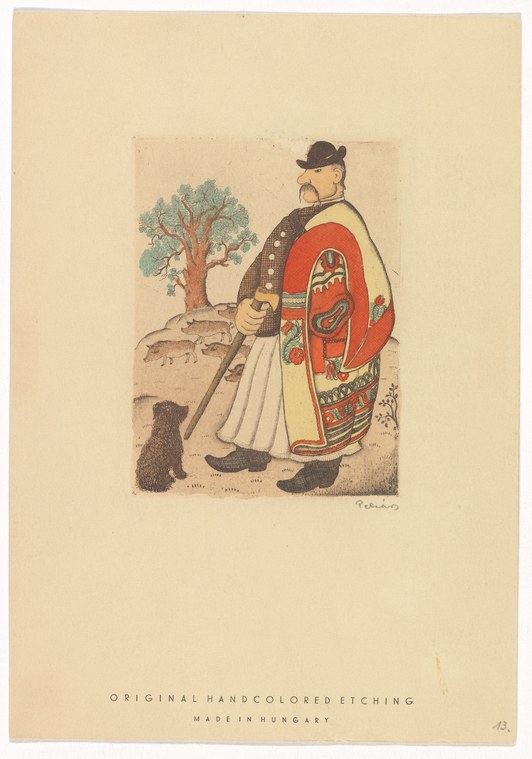
For historians of folk dance and traditional culture, this image provides precise evidence of what dancers wore, how garments were decorated, and how these visual markers communicated regional and social identity. The hand-coloring and the choice to emphasize the geometric embroidery suggest that the artist recognized the costume's artistic value independent of any wearer's body or movement. Understanding dance requires understanding the material world that surrounded it—the textiles, the tailoring, the ornament—and this print is a meticulous record of that world.
What you are looking at
A solitary figure in Hungarian folk costume stands in a spare landscape dominated by a gnarled, twisted tree. The costume is elaborate: a white linen undershirt and apron, a dark brown or black vest or jacket heavily decorated with embroidered or appliquéd geometric patterns in red and white, and a dark-brimmed hat. The figure holds a long wooden staff or walking stick in one hand, planted in the ground beside them. The posture is upright and dignified, neither actively dancing nor in repose—a portrait stance that presents the costume rather than capturing movement. The setting is rural, suggested by the sparse landscape and the ancient tree, which appears to be the only botanical element. The color palette is limited: greens and browns in the landscape, the dominant reds and whites of the embroidery, deep browns and blacks of the garments, and the pale cream of the paper itself. The overall effect is ethnographic rather than narrative—a document of material culture rendered with attention to textile detail and decorative tradition.
The dancing
A single standing figure, full-length, facing slightly three-quarter toward the viewer's right. The body is erect and symmetrical, with both feet planted firmly, suggesting stillness rather than motion. The left arm hangs at the side while the right grips a staff; neither arm position suggests active dance gesture. The figure's weight is centered and balanced. There is no dynamic line or tension in the body—no turn of the torso, no shift of weight to one leg, no lifted heel or pointed foot. The posture is that of a person being observed or documented, not a person in the act of dancing or about to dance.
The dance depicted
This is not a depiction of dance in the sense of movement or performance, but rather a documentation of the costume worn in Hungarian folk tradition. While Hungarian folk dance is vigorous and rhythmic, this image freezes the figure in a neutral stance that excludes the dynamic qualities of the dance. The costume itself—the embroidered vest, the apron, the hat—are authentic markers of Hungarian regional dress and would have been worn during folk celebrations and social dances, particularly in rural communities. The image functions as an ethnographic record rather than a capture of choreography or lived practice. Without visible movement, rhythm, or the presence of music or other dancers, this cannot be identified as a specific dance style.
How it was made
This is a hand-colored etching or engraving, as stated in the catalogue record. The fine linear work of the costume's geometric embroidery, executed with delicate parallel lines and cross-hatching, is characteristic of intaglio technique. The hand coloring—applied in flat washes of green, red, white, and brown—has aged to a warm cream tone, typical of early 20th-century hand-colored prints. The artist's signature or mark appears in the lower right corner. The technique allowed for precise documentation of costume details while remaining economical enough to circulate as an educational or ethnographic print, likely intended for a portfolio or collection on folk costume.
About this work
This is an ethnographic portrait of Hungarian folk costume rendered as a hand-colored etching. It documents the material markers of a particular regional tradition—the embroidered vest, the apron, the hat, the wooden staff—with precision and sensitivity to textile pattern. While the figure is posed in a context of folk culture and would have participated in social dances, the image itself does not depict dancing. Rather, it preserves the visual identity of a cultural costume at a moment when such traditions were being systematically recorded and archived. The work belongs in a gallery devoted to dance not because it shows movement, but because costume is an integral material dimension of dance practice, and because Hungarian folk dance held deep cultural significance in the period when this print was made.
How to look at it
Look closely at the embroidery on the vest—the geometric patterns of red and white set into dark cloth, rendered by the etcher with meticulous cross-hatching and line work. Observe how the hand-coloring follows and enhances these printed lines, creating the illusion of three-dimensional embroidered cloth. Notice the stance: the figure is not in a lunge, a turn, or any position that would suggest active movement. Instead, the pose is frontal and stable—a presentation of the garment as artifact. The inclusion of the gnarled tree and the sparse landscape places this costume in a rural context, anchoring it to a particular place and way of life. The overall composition privileges the costume's visual richness over any narrative of dance or celebration.
The artist
The artist is not recorded in the catalogue, but the signature in the lower right corner suggests a professional printmaker or illustrator working in the early-to-mid 20th century, likely in Hungary or Central Europe. The style and subject matter indicate engagement with ethnographic or folkloric documentation—a common practice among artists of the period who sought to preserve regional traditions at a moment of rapid cultural change. The note "Made in Hungary" on the print itself confirms the work's origin and likely indicates both its place of manufacture and its intended audience.
The period
This print was made during a period of intense interest in folk traditions across Central and Eastern Europe. In Hungary, the early 20th century saw systematic documentation of regional costumes, music, and dance as part of a broader nationalist and cultural preservation movement. Modernist artists and ethnographers were simultaneously discovering the aesthetic power of folk art and lamenting its disappearance under urbanization and industrial change. The hand-colored print was a democratic medium of circulation, allowing such documentation to reach educated audiences and collectors interested in folk culture. In the context of dance history, this period also saw the early stages of the folk dance revival movement, in which choreographers and cultural activists would draw on traditional costumes and music to create nationalist or modernist performance work.
Where it lives
The work is held in the New York Public Library's collection of prints depicting dance, catalogued as part of a broader ethnographic archive. The catalogue description "Hungarian folk costumes" suggests it was originally part of a portfolio or series on Central European folk dress, possibly issued by a publisher specializing in ethnographic or costume documentation.
Dance in this work
Questions about this work
Is this person actually dancing?
No. The figure is posed in a neutral standing position for the purpose of documenting the costume. While the garments shown would have been worn during folk celebrations and social dances, this image is a static portrait designed to display the embroidered vest, apron, and hat in clear view. The artist has chosen stillness over movement to make the costume details legible.
What is the staff or stick the figure is holding?
It appears to be a walking staff or stick, possibly a traditional element of Hungarian folk dress or rural life, held here as a prop that anchors the figure to the landscape and adds to the ethnographic character of the portrait. It may also simply serve a compositional function, adding vertical emphasis and stability to the standing pose.
Why is this in a dance gallery if no one is dancing?
Costume is an essential material dimension of dance. This print documents what dancers wore, how their garments were made and decorated, and what visual markers communicated cultural identity and regional tradition. Understanding historical dance requires understanding not just movement but the textiles, ornaments, and material culture that surrounded dancers. This print is a meticulous record of that material world.
What region of Hungary might this costume be from?
The catalogue record does not specify. The geometric embroidery patterns and the style of the vest suggest a rural Central European tradition, and the costume was likely regional to a particular area or ethnic group within Hungary. The print's title refers to Hungarian folk costumes in general rather than to a specific locality, though closer study of the embroidery patterns might allow specialists to narrow the origin.
More dance artwork





