49 works in this view — arrow keys or swipe to move between them.
Dance in Art
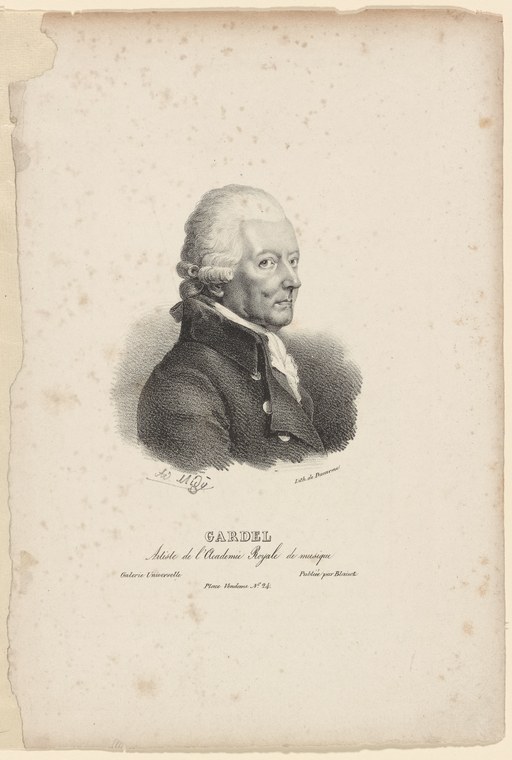
Gardel. Artiste de l'Academie Royale de Musique
Unknown artist
- Collection:
- Prints depicting dance
- Source:
- New York Public Library
- Rights:
- Public domain — free to use, share and adapt.
- Recorded as:
- Public Domain
This portrait records a key administrator and choreographer of the Paris Opéra at a moment when ballet was becoming a major artistic form in Europe. Gardel's tenure and his decisions directly shaped Romantic ballet's aesthetic. The work is also important as a historical record of how dancers and dance professionals were commemorated and circulated as public figures.
What you are looking at
A profile portrait of a man in early 19th-century dress, rendered as an engraving or lithograph. The subject is shown from the shoulders up, turned to the left, wearing a dark coat with a white shirt front visible at the neck. His hair is light-colored and styled in the period fashion, swept back from his forehead. The execution is precise and controlled, with fine hatching and cross-hatching used to model the face and create volume in the clothing. The background is plain, allowing the figure to dominate the composition. Below the portrait, a caption identifies the subject and provides institutional information. The work appears to be part of a series of theatrical or operatic personalities, given its formal presentation and the deliberate attention to capturing a recognizable likeness.
The dancing
The sitter is motionless and posed, presented in a three-quarter view that was conventional for theatrical portraiture of the period. There is no actual dancing depicted; the figure is static and dignified, with weight settled and shoulders squared. The pose is designed to present the subject as a serious professional rather than to convey movement or virtuosity.
The dance depicted
No dance is depicted in this image. This is a portrait of Gardel, identified in the caption as an artist of the Académie Royale de Musique, which housed the Paris Opéra. Gardel was a prominent figure in early 19th-century French dance—either Pierre Gardel (1758–1840), the renowned ballet master and choreographer, or a family member. The portrait documents a dance world figure rather than a dance event, and it belongs in dance archives as evidence of who held authority in the theater rather than how movement was executed or taught.
How it was made
This is an engraving or possibly a lithograph, a reproductive print technique that allowed mass distribution of theatrical celebrity portraits. The fine linear work and tonal modeling are consistent with intaglio engraving. The signature or mark visible in the lower left suggests it may be after a drawing or painting by another artist. Such prints were affordable and circulated widely in the 19th century as commercial goods, making them central to the cult of theatrical personality and to the documentation of the dance establishment.
About this work
This is a formal portrait print of Gardel, a figure of consequence in Paris Opera administration and choreography during the early 19th century. It documents not a performance or technique but the social and institutional position of dance professionals in the Romantic era. The work belongs in a dance archive as a record of institutional memory—a portrait of the people who governed and shaped theatrical dance, whose decisions and aesthetic judgments defined what was choreographed and performed. It is evidence of how the dance world saw itself: as a serious profession meriting formal portraiture and institutional documentation.
How to look at it
This is not a work meant to show you how to dance or what a dance looks like; it is meant to show you who was important. Attend to the formality of the pose and dress: this is how institutions represented authority. The plain background and careful modeling of the face direct your eye to the subject's identity and social standing rather than to any personal quirk or character detail. The print's purpose was recognition and circulation—a Paris opera-goer would have known this face from the stage.
The artist
The engraver is not identified in the available record. The work is after a drawing or painting by another artist, as was typical for reproductive prints of this period. Such portraits were usually executed by commercial print workshops and distributed through theatrical print publishers, making them collective enterprises rather than single-artist productions. The anonymity of the engraver is typical of 19th-century reproductive printmaking, where technical skill in translation was valued over individual artistic credit.
The period
This portrait dates from the height of Romantic ballet in France, a period when Paris Opera was the most prestigious dance institution in Europe and its ballet masters were international celebrities. Pierre Gardel (if this is he) directed ballet at the Opéra from 1787 to 1829, overseeing the transition from neoclassical to Romantic aesthetics and choreographing works that would define the period. The formal portrait print was the standard medium for circulating images of theatrical celebrities to an urban, middle-class audience hungry for images of opera and ballet stars.
Where it lives
The work is held in the New York Public Library's collection of prints depicting dance, where it is catalogued under the title 'Gardel. Artiste de l'Academie Royale de Musique.' It is a commercial theatrical print, one of thousands made and distributed in the 19th century to meet public demand for images of celebrated performers and administrators.
Questions about this work
Who was Gardel?
Gardel is most likely Pierre Gardel (1758–1840), the celebrated French ballet master and choreographer who directed ballet at the Paris Opéra from 1787 to 1829. He was a major figure in the history of ballet, overseeing the transition from 18th-century court dance to 19th-century Romantic ballet. He was also a dancer and teacher. The Paris Opéra was then and now the most prestigious dance institution in Europe.
Why is a portrait in a dance archive?
This portrait documents the institutional history of dance and the people who held power in the dance world. Understanding who Gardel was, how he was represented, and what respect was afforded to him tells us about how dance was valued, taught, and governed. Dance history is not only about performance; it is about the institutions, the decision-makers, and the circulation of artistic authority.
What was the Académie Royale de Musique?
The Académie Royale de Musique was the official royal opera house of France, founded in 1669. It later became known as the Paris Opéra. It was the center of European theatrical dance, and a position there was the highest professional achievement for dancers and choreographers of the era. Gardel's authority came from his position as ballet master there.
How were theatrical portraits printed and distributed?
This is an engraving or lithograph, a reproductive print that could be made in editions of hundreds or thousands. Such prints were inexpensive and widely circulated, sold at the theater, in print shops, and by subscription. They were the 19th-century equivalent of celebrity publicity—a way for fans to own an image of their favorites and for theaters to promote their stars and administrators.
More dance artwork





