49 works in this view — arrow keys or swipe to move between them.
Dance in Art
Hungarian folk costumes
Unknown artist
- Collection:
- Prints depicting dance
- Source:
- New York Public Library
- Rights:
- Public domain — free to use, share and adapt.
- Recorded as:
- Public Domain
This image documents the social context of Hungarian folk dance at a moment when such traditions were being recorded by printmakers, suggesting both that the dance had cultural significance worth depicting and that European audiences had appetite for such imagery. The emphasis on the woman's lead role and gestural expressiveness challenges assumptions about gender passivity in historical folk performance. For dance historians, it provides visual evidence of how folk dance was embedded in community celebration rather than staged performance—a distinction crucial to understanding the difference between dance as living practice and dance as representation.
What you are looking at
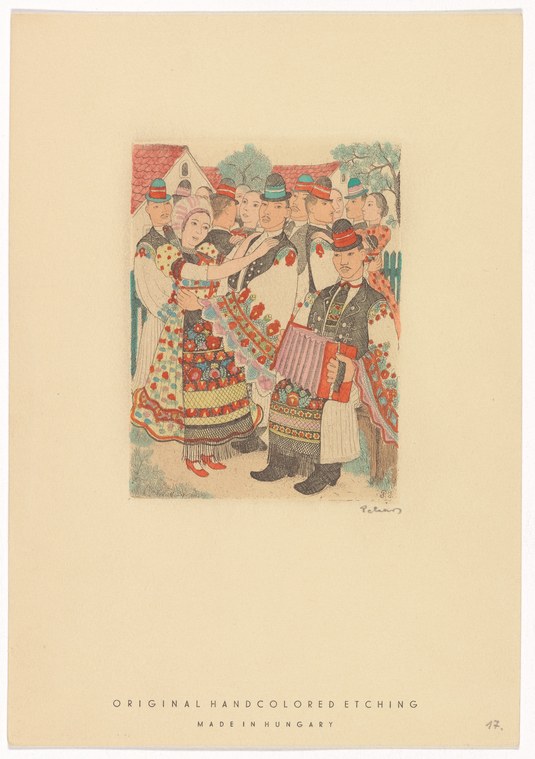
This hand-colored etching depicts a lively gathering of figures in Hungarian folk costume, arranged in a shallow interior space with architectural elements—a pitched roof and distant building—visible at top. The composition centers on a woman in an ornate embroidered dress with a patterned apron and decorative necklaces, positioned prominently in the left foreground, gesturing animatedly with her arms raised. Around her cluster at least six other figures, both men and women, wearing richly embroidered vests, decorative belts, embroidered shirts, and traditional hats. The color palette is warm and muted—ochres, reds, soft greens, and earth tones—applied by hand over the etched line work. The figures' poses suggest movement and interaction; several appear to be in conversation or observation, their bodies angled toward the central woman. The foreground figure on the right holds what appears to be a musical instrument, possibly an accordion or similar folk instrument, suggesting this may document a dance occasion or celebration.
The dancing
The central woman's raised arms and animated posture suggest she is performing or leading; her weight appears to shift, her body open and expressive. The surrounding figures maintain varying degrees of engagement—some leaning in, others standing at slight remove—creating a sense of audience and performer relationship rather than a unified group formation. The men's postures are more static and observational; their bodies remain relatively upright and grounded. The clothing is volumetric, allowing for the visibility of the dancers' engagement with their own garments—the woman's skirt and apron move with her gesture, and the embroidered vests and belts sit prominently on the men's frames. This is a moment of display and social interaction rather than a choreographed ensemble.
The dance depicted
This appears to document Hungarian folk dance, most likely from the 19th century based on the costume style and the etching medium. The woman's raised-arm position and animated bearing suggest a solo or lead role in a traditional Hungarian circle or couple dance, while the surrounding figures suggest both audience and potential participants. The presence of what appears to be a folk musician indicates this is a living social occasion—a csárdás, verbunk, or similar Hungarian traditional dance—rather than a theatrical representation. The composition suggests the informal, participatory nature of Hungarian folk dance, where spectators might become performers. Without clearer detail of footwork or a full ensemble in motion, the specific dance form cannot be determined with confidence.
How it was made
This is a hand-colored etching, evidenced by the linear hatching visible beneath the applied watercolor or gouache. The technique allowed for mass production of the printed line while permitting individual hand-coloring for circulation as a relatively affordable art object—typical of 19th-century European folk imagery. The etching process captures fine detail in the embroidered patterns and facial expressions, while the hand-coloring adds specificity to the regional costume, making this both a document and a decorative print. This mode of production suggests the work was intended for a broad audience interested in ethnographic or documentary imagery of European folk culture.
About this work
This hand-colored etching records a moment of Hungarian folk celebration, centered on a woman in dynamic motion surrounded by festively dressed companions. The work sits within a 19th-century European tradition of ethnographic prints that documented regional folk practices for audiences beyond the culture itself. It belongs in a dance archive as evidence of how Hungarian folk dance was both practiced and represented—how it moved through communities and how it was visualized for wider circulation. The etching captures not choreography but a social moment: the role of the performer, the presence of the musician, the gathered witnesses, and the ornate costume as an active part of the dance experience.
How to look at it
Note the woman's central position and raised arms—the artist has chosen the moment of maximum expressiveness and visibility, a moment of performance or display rather than a step in progress. Observe how the surrounding figures are distributed: some make eye contact with the performer, others look inward or toward the musician, creating a social space rather than a stage. Look closely at the embroidered patterns on the woman's dress and the men's vests—the etching technique renders these with precision, and the hand-coloring emphasizes their specificity, making costume a primary visual subject. The informality of the grouping—figures overlap, lean, gesture—conveys the participatory and improvisational character of the occasion rather than a formal staged scene.
The artist
The artist is not recorded. The signature on the lower right is illegible in reproduction. The print is marked "Made in Hungary," suggesting it was produced and likely distributed within or from Hungary, possibly for sale to tourists or for domestic documentation of national folk practice. The hand-coloring suggests production in a small workshop rather than a large commercial press. Such ethnographic prints were common in 19th-century Europe, produced by both professional artists and local craftspeople documenting regional dress and custom.
The period
This etching dates to an era when European folk dance was being actively collected, documented, and displayed as a marker of national or regional identity. The 19th century saw the rise of ethnographic illustration and the folk-as-spectacle movement, coinciding with nationalist movements across Europe and increased interest in "authentic" peasant culture among urban audiences. Hungarian folk culture in particular was being positioned as a distinct and valuable tradition. The costume detail and the presence of the folk musician suggest this was made during a period when such dances were still living practices, not yet confined to staged performance, though the decision to print and distribute it indicates its value as a cultural document had already been recognized.
Where it lives
This work is held in the New York Public Library's Prints collection, catalogued as depicting dance. It is marked as an original hand-colored etching made in Hungary. The cataloguing is minimal, suggesting the work may not have been individually researched; it sits within a broader collection of dance imagery spanning multiple cultures and periods.
Dance in this work
Questions about this work
Is this a real dance or an invented one?
This documents a real Hungarian folk dance tradition, not a fictional or theatrical invention. The presence of the folk musician, the informal grouping, and the specificity of the embroidered costume all suggest documentation of actual practice. However, the decision to print and hand-color it means it has been mediated—selected, composed, and circulated for an audience beyond the dancers themselves. It is both document and representation.
What dance is being performed?
The specific form cannot be determined from the image alone. The raised-arm position and animated posture could indicate a csárdás, a verbunk, or another Hungarian couple or circle dance, but without seeing the footwork or a full ensemble in formation, identification is uncertain. The presence of what appears to be an accordion suggests 19th-century practice, when such instruments became standard in Hungarian folk music.
Why is only one woman dancing while men stand around?
This reflects both the composition the artist chose and a real feature of many folk dance traditions: moments of solo or featured performance within participatory social dance. The woman's prominent role and animated gesture suggest she is leading or performing, while others wait their turn or enjoy her performance. This was a common structure in Hungarian folk dance.
When was this made?
The catalogue record gives no date. The etching technique, the costume style, the presence of what appears to be an accordion, and the hand-coloring method all suggest 19th-century production, most likely the second half. Without a signature or inscription visible in reproduction, or archival research, a precise date cannot be established.
More dance artwork





