49 works in this view — arrow keys or swipe to move between them.
Dance in Art
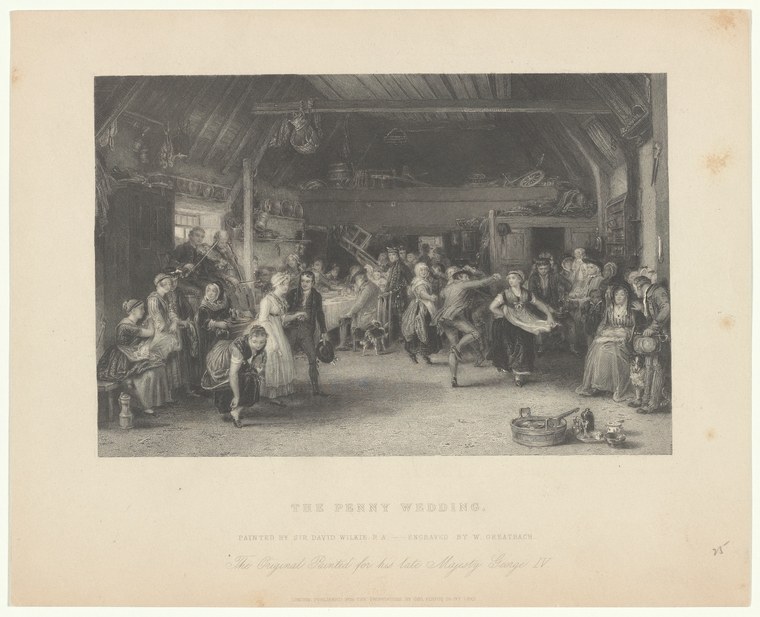
The penny wedding
Unknown artist
- Collection:
- Prints depicting dance
- Source:
- New York Public Library
- Rights:
- Public domain — free to use, share and adapt.
- Recorded as:
- Public Domain
Penny weddings are among the most documented folk celebrations in British visual culture, yet they are rarely examined as dance history. This print offers direct evidence of how rural people moved together, how mixed-gender and mixed-age groups organized themselves in space, and how dance functioned as a mechanism of community inclusion and social reproduction. It is also a valuable record of the moment when folkloric practices began to be aestheticized and collected by educated audiences as expressions of regional identity.
What you are looking at
A crowded interior scene of a festive rural gathering, likely a wedding celebration. The composition is deep and atmospheric, with figures distributed throughout a barn or large hall with exposed timber beams and rough walls. The space is filled with over thirty people in 19th-century dress—women in long skirts and bonnets, men in coats and hats—engaged in various activities: some dancing in the center, others standing in clusters, a few seated. The lighting is dramatic and warm, concentrated on the central figures and gradually darkening toward the shadowed corners and ceiling, creating a sense of intimate community despite the crowd. In the foreground, domestic objects (pots, vessels) are casually arranged on the ground, grounding the scene in rural domesticity. The mood is one of communal celebration and social mixing across generations.
The dancing
The dancing figures in the center occupy a relatively open floor space. Several couples and groups are visible, though no single dance formation dominates; instead, multiple simultaneous interactions suggest informal, social dancing rather than choreographed movement. Bodies are upright and engaged, with arms moving naturally—some extended, some held. The skirts of the women are full and would move with momentum; the postures suggest both energetic motion and the constraints of period costume. Spectators line the space, watching and conversing, indicating this is participatory community entertainment rather than performance art.
The dance depicted
This depicts a *penny wedding*, a Scottish and Northern English rural tradition in which a community gathered to celebrate a marriage, with guests contributing money or gifts rather than formal presents. The dancing would be a mix of regional folk dances—reels, jigs, and country dances—performed by participants rather than spectators. The print captures the egalitarian, inclusive nature of the event: all ages and social standings intermix, and dancing is concurrent with socializing, eating, and drinking. The scene shows dance as social ritual rather than entertainment, a function of community cohesion.
How it was made
This is an engraving, executed with fine parallel lines (hatching and cross-hatching) to model form and suggest texture and light. The technique allows considerable detail despite the monochromatic palette—individual faces are distinguishable, costume details are readable, and the spatial depth is achieved through diminution and overlap rather than perspective. Engravings of this kind were popular for book and periodical illustration in the 19th century and would have circulated widely as both independent prints and as reproductions in published accounts of regional customs. The inscription at the lower margin indicates this was a named, published work rather than a casual sketch.
About this work
This is a 19th-century engraved print depicting a penny wedding, a traditional Scottish and Northern English communal celebration combining marriage ritual, social dancing, and gift-giving. The image captures a specific moment in folk custom—the collaborative, egalitarian character of rural community life in which dance was embedded in everyday social practice rather than separated as a specialized performance. The engraving preserves a record of both the event and the artist's (or patron's) interest in documenting regional customs at a moment when such traditions were beginning to be regarded as culturally significant.
The work belongs in a gallery of dance in art because it documents not a professional or courtly dance, but the everyday dance of ordinary people—the primary context in which most people have ever danced. It shows dance as inseparable from social structure, economics (the penny contribution), kinship (the wedding), and community obligation. The composition prioritizes the dancing figures while acknowledging that they are embedded in a dense social fabric; no single dancer is heroic or separate.
How to look at it
Attend to the absence of a focal point: the artist chose not to isolate or highlight a single couple, but instead to distribute action and attention across the crowd. This compositional choice emphasizes community participation over individual performance. Look at the postures of the dancers—notably, how few are in the elegant, controlled positions of ballroom or theatrical dance; most are naturalistically engaged and relatively informal. Notice also the spectators: their presence and engagement structure the social space. The warm, concentrated light in the center and the shadowed periphery create an intimate interior despite the crowd, a quality essential to understanding the penny wedding as an enclosed, bounded community event.
The artist
The catalogue does not record the artist. The inscription cites only "Painted by Sir David Wilkie P.R.A.—Engraved by W. Greatbach." Wilkie (1785–1841) was a celebrated Scottish painter known for scenes of rural and domestic life, often with narrative or anecdotal content. He painted many scenes of Scottish customs and celebrations, and his work was frequently engraved for mass circulation. Greatbach was a professional engraver of the period. The partnership between painter and engraver was standard commercial practice, and the engraving would have been produced for publication and sale as a print, reaching an audience far beyond those who saw Wilkie's original painting.
The period
The penny wedding as a living tradition was already in decline by the early 19th century, particularly in Scotland, where it had been discouraged by the Church and disrupted by urbanization and economic change. Wilkie's painting (and its subsequent engraving) was part of a broader 19th-century Romantic interest in recovering and documenting folk customs as expressions of national or regional character. The print circulated at a moment when dance was increasingly professionalized and confined to theaters and ballrooms, making the informal, participatory dancing of rural communities visually and culturally novel to urban audiences. The careful documentation of dress, setting, and social interaction reflects an antiquarian and ethnographic impulse characteristic of the period.
Where it lives
The work is held in the New York Public Library's collection of prints depicting dance. It is catalogued as a print (engraving) but lacks a recorded date, medium confirmation, or artist attribution in the current record.
Dance in this work
Questions about this work
What exactly is a penny wedding?
A penny wedding was a traditional Scottish and Northern English celebration at which guests contributed a small fee or gift to help the newlyweds establish a household, rather than giving individual presents. The event was typically a communal feast and dance, open to the entire neighborhood, and served as a mechanism for wealth redistribution and community bonding. The practice was most common in rural areas during the 17th and 18th centuries and was largely extinct by the early 19th century, though it was documented and romanticized by antiquarians and artists of the period.
Who were the dancers at a penny wedding?
Penny weddings were participatory events attended by the entire local community—men, women, and children of all ages and social classes. Most participants danced at some point during the celebration; this was not a spectator event. The dances performed would have been regional folk dances such as reels, jigs, country dances, and cotillions, familiar to all participants and taught through participation rather than instruction. The dancing was concurrent with eating, drinking, socializing, and gift-giving, making it one element of a longer celebration rather than the primary focus.
Why did Sir David Wilkie paint this scene?
Wilkie was deeply interested in Scottish rural life and customs as subjects worthy of fine art. By the early 19th century, as urbanization and modernization were eroding traditional practices, artists and antiquarians began to document and collect images of folk customs as expressions of national or regional identity. Wilkie's painting of the penny wedding was part of this broader cultural moment—an effort to preserve the memory of a tradition already in decline and to present rural, egalitarian community life as aesthetically and morally significant to an urban, educated audience.
How do I know this is an engraving and not a painting?
The image is executed entirely in black and white using parallel lines and cross-hatching to create tonal values, texture, and the illusion of depth. This is the hallmark technique of engraving, in which lines are incised into a metal plate (usually copper) and filled with ink to print. A painting would show color, brushstrokes, and continuous tonal transitions. Engravings were a common method of reproducing and distributing images of paintings in the 19th century, making them more widely accessible than the original artwork.
More dance artwork





