49 works in this view — arrow keys or swipe to move between them.
Dance in Art
Hungarian folk costumes
Unknown artist
- Collection:
- Prints depicting dance
- Source:
- New York Public Library
- Rights:
- Public domain — free to use, share and adapt.
- Recorded as:
- Public Domain
For historians of Hungarian folk dance and costume, this image provides precise visual documentation of the specific garment structures, color combinations, and decorative embroidery patterns that defined regional folk dress in the early modern period. The formal presentation and careful hand-coloring indicate that this was created as a serious ethnographic or educational artifact, not a casual sketch, making it valuable evidence of how folk traditions were codified and displayed by cultural authorities of the time.
What you are looking at
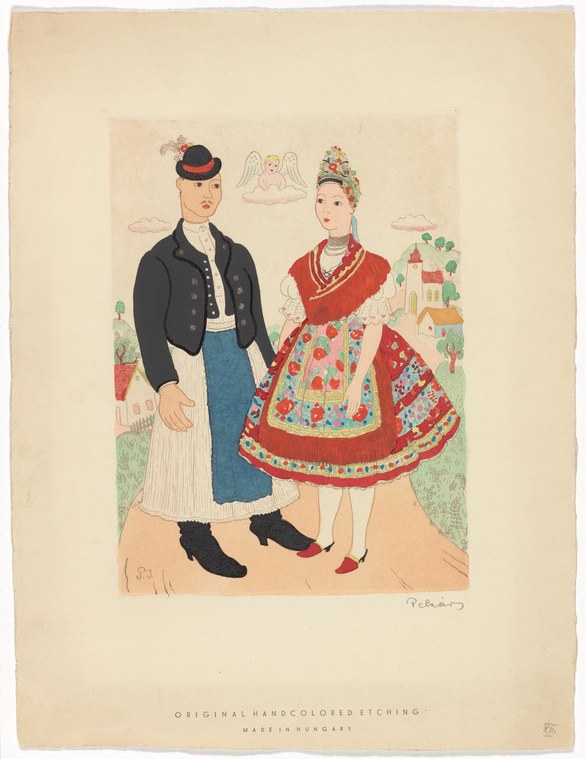
Two figures stand in a stylized landscape wearing traditional Hungarian folk costume. The man at left wears a black jacket with ornate buttons, a white shirt with a high collar, a blue skirt-like lower garment (likely a traditional apron or skirt), and a black hat with a red band; he holds one hand at his side. The woman wears a red shawl or cape draped over her shoulders, a white blouse, and a full skirt with a bold geometric pattern in red, white, and multicolored bands—the costume is precisely the kind of embroidered apron-skirt combination specific to Hungarian women's dress. Both figures are drawn with considerable attention to fabric weight and decorative detail. The background shows a pastoral setting with a small cottage, flowering plants in pots, and stylized clouds, rendered in soft watercolor tones that emphasize the folk-art tradition of the costumes themselves.
The dancing
Both figures are posed formally and frontally, neither actively dancing. The man's posture is relatively static, with weight distributed evenly and arms at rest. The woman stands with her body centered, her full skirt held out slightly to display the embroidered pattern—a pose that emphasizes the garment's construction and decorative value rather than movement. The figures do not touch or suggest interaction through gesture. There is no visible footwork or dynamic frame suggesting an active dance hold or partnership.
The dance depicted
This is a costume study rather than a dance scene. While Hungarian folk traditions include lively couple dances—particularly csárdás and various circle dances—neither the poses nor the physical relationship of these figures suggests active performance. The image functions as ethnographic documentation of traditional dress rather than as a record of dancing bodies. The formal, static presentation is consistent with early-to-mid 20th-century anthropological and folk-revival illustration, which often isolated costume elements from their performance context.
How it was made
The work is a hand-colored etching or engraving, as stated in the catalogue record. The delicate line work defining the figures' features and the fine parallel hatching used for shading are consistent with intaglio printing. Hand-coloring in watercolor or gouache has been applied to the printed impression, allowing for the soft gradient tones in the background and the careful rendering of the embroidered textile patterns. This labor-intensive technique was standard for ethnographic illustration and folk-revival publication in the early-to-mid 20th century, suggesting a work intended for a book, portfolio, or exhibition aimed at an educated middle-class audience interested in European folk traditions.
About this work
This is a hand-colored etching depicting male and female figures wearing Hungarian traditional costume, presented as a formal costume study rather than a dance scene. The artist has invested considerable care in the textile details—the man's ornate jacket and the woman's elaborately patterned apron-skirt—rendering them with ethnographic precision. The work belongs in a dance gallery not as a representation of dancing, but as visual documentation of the dress traditions associated with Hungarian folk performance; it offers material evidence of how folk costume functioned as both cultural marker and performance artifact in early-20th-century Europe.
The image sits within a wider practice of folk-revival illustration and ethnographic documentation that flourished as industrialized nations sought to preserve and display rural or "traditional" cultural material. Such costume studies often circulated in educational contexts, museum displays, and nationalist cultural projects, making dress itself a subject of scholarly attention alongside the dances it adorned.
How to look at it
Notice the artist's precision in rendering the embroidered textile patterns on the woman's skirt—the geometric designs in red, white, and multiple colors are not generic but specific to a regional Hungarian tradition. The man's costume is equally particular: the cut of the jacket, the style of the hat, the proportions of the skirt-apron all carry regional and temporal information. The formal, frontal poses and the pastoral background setting are typical of ethnographic illustration of the period, designed to present costume as a timeless cultural fact rather than as something worn by moving, working bodies. The soft watercolor wash and the careful line work suggest a work created for reproduction in a book or portfolio.
The artist
The artist is not recorded in the catalogue. The signature visible on the print is not clearly legible in reproduction. The work is marked as "Original Handcolored Etching" and "Made in Hungary," suggesting a Hungarian printmaker working in the folk-revival movement of the early-to-mid 20th century, a period of intense interest in national and regional folk traditions across Central and Eastern Europe.
The period
This work dates to an era of intense European folk-revival activity, particularly in Central Europe, where newly independent or nationalist movements sought to recover and celebrate pre-industrial cultural traditions. The early 20th century saw the rise of ethnographic museums, folk festivals, and illustrated publications devoted to documenting traditional dress and performance. Hungary's folk revival was particularly vigorous in the interwar and immediate postwar periods, driven by both scholarly interest and nationalist cultural politics. The careful ethnographic attention to costume detail reflects the period's conviction that folk dress carried essential cultural information worthy of preservation and study.
Where it lives
The work is held in the New York Public Library's print collection and is catalogued under "Prints depicting dance," indicating it has been collected as material related to dance history and practice. The inscription "Made in Hungary" and the artist's signature confirm Hungarian origin and production.
Questions about this work
Is this a depiction of an actual Hungarian dance?
No. This is a costume study presented as an ethnographic or educational illustration. The figures are posed formally and statically, not captured in the middle of dancing. However, these are the costumes worn during Hungarian folk dances, particularly circle dances and couple dances like the csárdás, making the image valuable documentation of what folk dancers wore.
What do the geometric patterns on the woman's skirt represent?
The embroidered geometric designs—the colorful bands and repeated motifs—are characteristic of Hungarian folk embroidery traditions, often specific to particular regions or villages. Such patterns were hand-embroidered and carried social and cultural meaning. The artist has rendered them with considerable precision, suggesting documentation of an actual regional costume tradition rather than invention.
Why would this be collected as dance material if nobody is dancing?
Costume is integral to dance history. Folk costumes carried meanings about regional identity, social status, and performance tradition. Museums and dance historians collect costume studies and ethnographic illustrations because they document the visual and material contexts in which dances were performed. This image is valuable precisely because it shows what a Hungarian folk dancer would have worn.
When was this made?
The catalogue record does not provide a date. Based on the style of the etching, the hand-coloring technique, and the approach to ethnographic illustration, it most likely dates to the early-to-mid 20th century, probably somewhere between the 1920s and 1950s.
More dance artwork





