49 works in this view — arrow keys or swipe to move between them.
Dance in Art
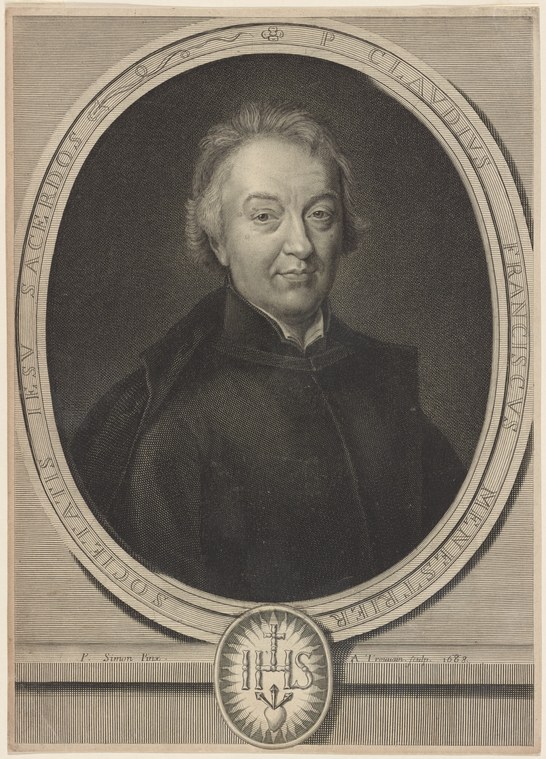
Societatis Iesu Sacerdos P. Claudius Franciscus Menestrier
Unknown artist
- Collection:
- Prints depicting dance
- Source:
- New York Public Library
- Rights:
- Public domain — free to use, share and adapt.
- Recorded as:
- Public Domain
This work does not document dance and does not belong on a dance gallery page. Its presence here reflects either an error in cataloging or a misunderstanding of the collection's scope. For those interested in the history of engraving, ecclesiastical portraiture, or the Jesuit order, it is a valuable primary document, but it contributes nothing to the study of dance in art.
What you are looking at
This is a portrait engraving of a man in three-quarter view, facing slightly right, set within a classical oval frame. The sitter wears dark clerical dress—a black cassock or soutane typical of a Catholic priest—and has gray or white hair swept back from his forehead. The background is a neutral dark tone that throws the pale face into relief. Below the oval portrait is a small circular emblem containing the IHS Christogram (the sacred monogram of Christ), symbol of the Society of Jesus. The surrounding oval frame is inscribed with text in Latin capitals, which appears to name the subject and his religious order. The engraving technique—fine parallel hatching in the background and face—creates a formal, dignified impression characteristic of 17th- or 18th-century academic portraiture. The work has the look of an official ecclesiastical portrait, likely created for circulation among the Jesuit order or as a commemorative image.
The dancing
A single static figure—a man in middle age or older, shown from the chest up. His posture is upright and composed, his gaze directed toward the viewer with a neutral, dignified expression. There is no gesture or body movement; this is a portrait of stillness and formal presence. His left shoulder is slightly advanced; his head is held erect. The hands are not visible in the frame.
The dance depicted
This is not a dance image. The subject is a portrait of a Catholic priest identified in the title as belonging to the Society of Jesus (Jesuits). There is no depiction of dance, dancers, movement, or choreographic activity. The work appears to have been misclassified or included in the dance prints collection in error, or the collection's scope extends beyond dance depiction to broader historical documentation.
How it was made
This is an engraving, executed in the formal portrait style of the 17th or 18th century. The technique employs fine parallel lines (hatching and cross-hatching) to model the face and create tonal gradation, with the darkened background achieved through closer hatching. Engravings of this type were created by incising lines into a metal plate (typically copper) and printing impressions from the inked surface—a labor-intensive process that made them relatively expensive and thus reserved for subjects of importance: scholars, clergy, nobility, or commemorated individuals. The technique allowed for multiple copies and wide distribution within educated circles.
About this work
This is a formal portrait engraving of a Jesuit priest, likely created in the 17th or 18th century as a commemorative or documentary image. The inscription identifies the subject as belonging to the Society of Jesus (Societatis Iesu). The work exemplifies the conventions of ecclesiastical portraiture: neutral background, formal three-quarter pose, dignified bearing, and the inclusion of a religious emblem (the IHS Christogram) to assert both personal identity and institutional affiliation. The engraving would have been intended for circulation among the Jesuit order, in scholarly collections, or as a memorial. Its inclusion in a dance collection is anomalous; it documents religious history and portraiture practice rather than dance or movement.
How to look at it
The viewer should attend to the formal conventions of ecclesiastical portraiture: the neutral pose, the composed expression, and the symbolic emblem below that declares institutional affiliation rather than individual achievement or character. The engraving technique itself—the patient accumulation of fine lines to create tone and volume—speaks to the value placed on the subject and the resources invested in his commemoration.
The artist
The artist is unknown. The engraving was executed in a formal academic style consistent with 17th- or 18th-century European print practice. The quality of execution and the care taken with the subject suggest a professional engraver working for an institutional or ecclesiastical patron.
The period
Portrait engravings were a dominant form of commemoration and circulation of images from the 16th through 19th centuries, especially in scholarly and religious contexts. The Jesuits, founded in the mid-16th century, became a major international intellectual force and were subjects of extensive portraiture during this period. The style and technique of this engraving place it within the mainstream of formal academic portraiture in Northern Europe, where engraving remained the primary reproductive medium until the advent of lithography and photography.
Where it lives
The work is held in the New York Public Library's collection of prints depicting dance. The catalogue record provides minimal information: no artist attribution, no date, and no recorded medium, though the image clearly shows an engraving.
Questions about this work
Why is this portrait in a dance collection?
This appears to be a cataloging error. The image does not depict dance or any related activity. The work is an ecclesiastical portrait engraving and belongs in collections documenting portraiture, the history of engraving, or the Jesuit order, not dance.
Who was Claudius Franciscus Menestrier?
The inscription identifies him as a member of the Society of Jesus (Jesuits). Without additional research beyond the image itself, the specific biographical details cannot be provided here. The Jesuits were an influential intellectual and missionary order, and such formal portraits were created to commemorate and honor their members.
When was this engraving made?
The catalogue record does not provide a date. Based on the style and technique, it appears to be from the 17th or 18th century, but precise dating cannot be established from the image alone.
More dance artwork





