49 works in this view — arrow keys or swipe to move between them.
Dance in Art
Paul Taglioni [facsimile signature]
Unknown artist
- Collection:
- Prints depicting dance
- Source:
- New York Public Library
- Rights:
- Public domain — free to use, share and adapt.
- Recorded as:
- Public Domain
Taglioni was a towering figure in Romantic ballet, celebrated as the male counterpart to his sister Marie; he choreographed works still performed today and fundamentally advanced male technique. This portrait is valuable not for what it shows of dance itself, but for what it reveals about how male ballet artists were fashioned, marketed, and remembered—and for its role in the archive of 19th-century theatrical celebrity.
What you are looking at
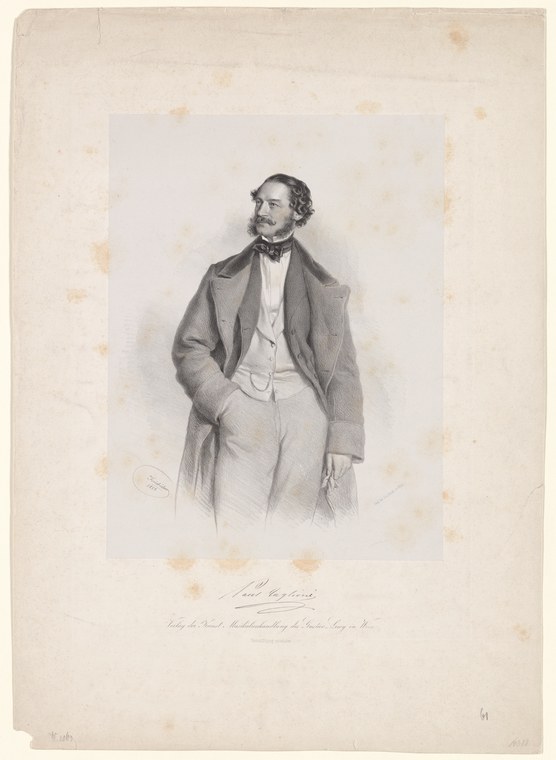
A three-quarter-length portrait of a man in Romantic-era formal dress, shown standing in a relaxed contrapposto stance against a plain background. He wears a dark brown or charcoal overcoat with wide lapels over a white shirt and black bow tie, with light-coloured trousers. The figure is rendered in fine graphite with careful attention to the drape of fabric and the modelling of face and form. The signature at the base reads "Paul Taglioni" in cursive script, identifying the subject. This is a formal studio portrait—likely a lithograph or engraving—in the style of mid-19th-century celebrity portraiture, the kind that would have been sold or distributed to theatre patrons and enthusiasts.
The dancing
The figure stands with weight primarily on one leg, the other relaxed, in a pose that conveys ease and confidence rather than active dance. The arms hang naturally; one hand rests near the torso while the other is visible at the side. There is no closed or open dance hold, no frame suggesting partnering, and no foot position or body alignment characteristic of any particular dance technique. This is a clothed gentleman in street dress, not a dancer in action or demonstrating movement.
The dance depicted
Paul Taglioni (1808–1884) was one of the most celebrated male ballet dancers and choreographers of the Romantic era, renowned across Europe for his roles in narrative ballets and his choreographic innovations. This portrait documents him as a public figure and theatrical celebrity, but it does not depict him dancing. It is a celebrity portrait of a dancer, not a dance image—a distinction that matters for classification. The work captures the social status and formal presentation of a major theatrical artist, reflecting how male ballet stars were marketed and remembered in the 19th century.
How it was made
This is a lithograph or fine engraving, executed with meticulous attention to tonal gradation and linear detail. The technique allowed for mass production and affordable distribution, which explains its circulation as a souvenir or promotional image. The refined draughtsmanship and the careful modelling of light and shadow suggest professional studio work aimed at a cultured audience—theatre-goers and collectors of theatrical ephemera who would have recognized Taglioni's face and paid for a portrait to keep.
About this work
This is a formal portrait of Paul Taglioni, one of Romantic ballet's greatest male dancers and a prolific choreographer, rendered in the refined graphic style of mid-19th-century European portraiture. It documents the celebrity status of a major theatrical artist at the height of his fame, when lithographic and engraved portraits of celebrated performers were a standard form of theatrical merchandise and memento. The work belongs in a dance collection because Taglioni's career shaped how male ballet was performed and because it illustrates the intersection of dance history and visual culture—how dancers were presented to the public and how their image was commodified and circulated.
How to look at it
This is not a dance image but a portrait, and should be read as such: attend to the conventions of formal 19th-century male portraiture—the pose, the clothing, the framing—and to what they communicate about Taglioni's status and self-presentation. The relaxed contrapposto and the fine tailoring emphasize his position as a celebrated artist and gentleman, not as a performer in motion. The work is valuable precisely because it steps away from the theatrical moment and into the social world inhabited by celebrated dancers as public figures.
The artist
The artist is not recorded in the catalogue. The work is a professional lithograph or engraving produced for commercial distribution, typical of the theatrical print industry that flourished in London, Paris, and other European capitals in the 1830s–1850s. Such portraits were often created by specialized theatrical print makers working from life sittings or from photographs, and they were sold individually or as part of collected series. The quality and finish suggest a skilled practitioner working for a commercial publisher or theatrical establishment.
The period
This portrait was made during the height of Romantic ballet, when male dancers still held significant stage presence and celebrity, even as the ballerina began to dominate the visual imagination of the period. Taglioni's career spanned the 1820s–1860s, and he was celebrated internationally for his dramatic intensity and technical prowess. Lithographic portraiture was at its commercial peak in this era—a form of popular visual media preceding photography but coexisting with early photographic practice. Celebrity actors and dancers were among the most frequently portrayed subjects, and the collecting of theatrical portraits was a widespread middle-class pastime.
Where it lives
The work is held in the New York Public Library's collection of prints depicting dance. It is a loose print—lithograph or engraving—produced for distribution and sale, not a unique artwork. Such prints were typically sold individually at theatre doors, bookshops, and print sellers, making them ephemeral objects that often did not survive. Its survival here is itself notable; it documents the visual archive through which 19th-century dancers were known.
Questions about this work
Is Paul Taglioni the same as Marie Taglioni?
No. Paul Taglioni (1808–1884) was Marie Taglioni's younger brother. While Marie became legendary as the first dancer to dance en pointe in a Romantic ballet (La Sylphide, 1832), Paul was a celebrated male dancer and choreographer in his own right. He created important works including Sylvia (1876) and was celebrated for his dramatic roles and his advancement of male technique across Europe.
Why doesn't this portrait show him dancing?
Celebrity portraits of dancers in the 19th century typically showed them in formal dress, not in performance costume or action. This was the standard convention: the portrait documented the celebrity as a social figure and gentleman (or gentlewoman), separating the public person from the theatrical role. Dance-specific imagery—costumes, partnering, the moment of performance—appeared in playbills, narrative prints of specific ballets, and later in photograph documentation of choreography.
What kind of object is this?
This is a lithograph or fine engraving—a printed work produced for mass circulation and affordable sale. It would have been sold at the theatre, in print shops, or through subscription, and collected by theatre patrons and dance enthusiasts. It is a form of theatrical ephemera and popular visual media, comparable to modern playbill photographs or poster art, but produced through the lithographic or engraving process rather than photography.
Where can I see Taglioni's actual dancing preserved?
Taglioni's performances exist now only through notation (Labanotation and Benesh notation were not developed until the 20th century), written accounts, and visual documentation such as playbills, costume designs, and portraits of him in character. No film or video exists. His influence on dance is documented through the choreographies he created—some of which survive in the repertory—and through the testimony of his contemporaries.
More dance artwork





