49 works in this view — arrow keys or swipe to move between them.
Dance in Art
Salvatore Taglioni [facsimile signature]
Unknown artist
- Collection:
- Prints depicting dance
- Source:
- New York Public Library
- Rights:
- Public domain — free to use, share and adapt.
- Recorded as:
- Public Domain
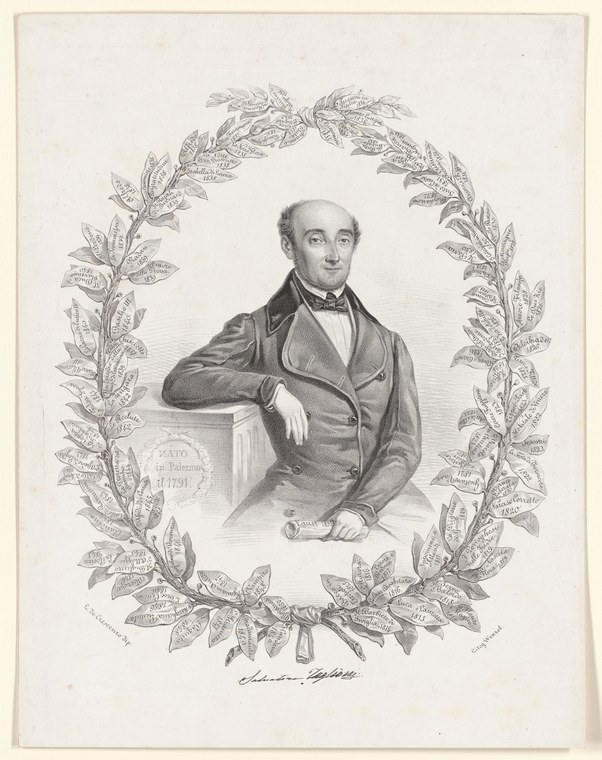
Salvatore Taglioni trained and choreographed for many of the great dancers of the Romantic ballet era, including his own daughter Marie Taglioni, one of the most celebrated ballerinas of the 19th century. This portrait is a rare visual record of a male dance professional from a period when most published dance imagery focused on female performers, offering evidence of the men who built the institutional and artistic structures of Romantic ballet.
What you are looking at
A three-quarter-length portrait of a man in early 19th-century dress, facing slightly left and leaning with his right elbow resting on what appears to be a pedestal or block. He wears a dark coat with a high collar, a white shirt front, and a bow tie, with his hair receding at the temples in the style of the period. The figure is framed by an ornamental laurel wreath, which loops above his head and descends symmetrically on either side—a classical motif denoting honor or achievement. The background is plain and light, focusing attention entirely on the sitter. At the base of the image is a signature line reading 'Salvatore Taglioni,' establishing the subject's identity. The engraving technique and formal framing suggest this is a commemorative portrait, likely from a published series celebrating notable figures.
The dancing
The man's posture is one of ease and authority: his body is turned slightly away from the viewer while his face addresses them, and his right arm is bent and supported, a pose common in Regency-era portraiture that suggests both relaxation and confidence. The gesture is static and observational rather than kinetic—there is no suggestion of movement or dance in the body itself. The positioning follows conventions of gallery or publication portraiture rather than depicting an active moment.
The dance depicted
The subject, Salvatore Taglioni, was a notable Italian ballet master and choreographer of the early 19th century, part of a prominent dancing family. His reputation and the formal commemorative treatment here suggest this is a recognition portrait rather than a depiction of him dancing. No dance movement or costume is visible; the image documents the man in street dress, not the work. The presence of the classical laurel wreath indicates his status as a serious artist rather than an entertainer.
How it was made
This is a steel or copper engraving, executed in fine parallel lines and cross-hatching to render tone and modeling. The even, controlled linework is characteristic of high-quality reproductive engraving from the early-to-mid 19th century, suggesting this was made for publication and broad circulation—likely as an illustration in a book, magazine, or portfolio of portraits. The technique allowed for multiple impressions and ensured the image would be legible at small sizes.
About this work
This is a commemorative portrait engraving of Salvatore Taglioni, a leading figure in early Romantic-era ballet choreography and pedagogy. The work documents not a dance moment but the man himself, presented in the formal conventions of Regency portraiture and framed with classical honors. It belongs in a dance gallery not because it depicts movement, but because it preserves the face and status of a crucial figure in ballet history—one of the generation that shaped Romantic ballet's technical and artistic standards, and patriarch of a dynasty of dancers. The formal engraving acknowledges Taglioni as a serious artist worthy of commemorative publication.
How to look at it
Attend to the formality of the presentation: the classical laurel wreath, the elegant restrained pose, the quality of the engraving itself. These choices signal that Taglioni was being honored as a serious artistic figure rather than presented as a virtuoso performer. Note too that this is a man—a reminder that while the Romantic era is often visualized through ethereal images of women in tutus, the dance was built and directed by men like Taglioni whose own images are much rarer in the historical record.
The artist
The artist is not recorded in the catalogue. The engraving style and quality suggest a professional reproductive engraver working in the early-to-mid 19th century, likely in Italy or a major European art center. The signature line is a printed reproduction of Salvatore Taglioni's own hand, not the engraver's mark.
The period
This portrait was made during or shortly after the height of Romantic ballet, a period (roughly 1830–1850) when ballet underwent radical transformation in both technique and aesthetic. The Romantic era celebrated ethereal female dancers in roles drawn from literature, fairy tale, and the exotic; technical innovation—particularly the development of pointe work—accelerated rapidly. Male dancers and choreographers remained essential to the form but received far less public attention and fewer publication portraits. Salvatore Taglioni's career spanned the transition from the Classical (court and theater ballet of the 18th century) into the Romantic period, making him a bridge figure between two eras.
Where it lives
This engraving comes from the New York Public Library's prints collection depicting dance. It is a reproductive engraving, likely from a published portfolio or periodical, designed for circulation and collection rather than as a unique work of art. The facsimile signature in the title identifies the subject, a common practice in commemorative portrait series.
Questions about this work
Was Salvatore Taglioni a famous dancer?
Salvatore Taglioni (1790–1868) was a renowned ballet master and choreographer rather than a celebrated dancer-performer. He is best known as the teacher and choreographer of his daughter Marie Taglioni, one of the greatest ballerinas of the Romantic era. His influence on ballet technique and artistic direction was substantial, though he worked largely behind the scenes as a mentor and creator rather than on stage as a performer.
Why is a portrait of a male dance figure so rare?
Romantic-era ballet promotion was overwhelmingly focused on female dancers, particularly the ballerina prima donna. Male dancers, while technically essential, received little public lionization in prints and publications. This portrait's existence and formal commemorative treatment thus makes it an unusual and valuable historical document of a male artist's recognized status.
What do the laurel wreaths mean?
Laurel wreaths are a classical motif signifying honor, achievement, and immortal fame. Their presence here elevates Taglioni's status from entertainer to serious artist and cultural figure—a claim reinforced by the formal engraving technique and publication format. The wreath places him in the company of poets, statesmen, and great historical figures.
More dance artwork





