49 works in this view — arrow keys or swipe to move between them.
Dance in Art
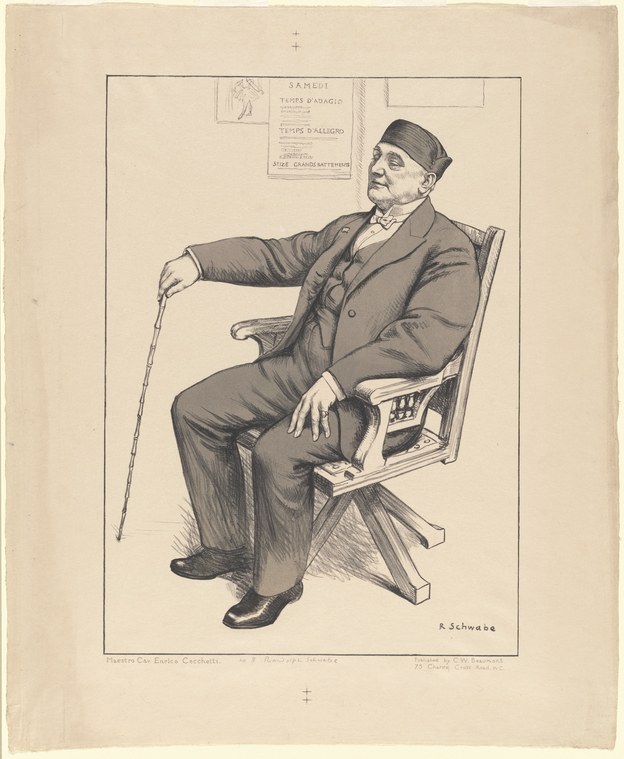
Maestro Cav. Enrico Cecchetti
Unknown artist
- Collection:
- Prints depicting dance
- Source:
- New York Public Library
- Rights:
- Public domain — free to use, share and adapt.
- Recorded as:
- Public Domain
Enrico Cecchetti shaped how millions of ballet dancers have been trained; the method bearing his name remains in use today. This portrait is a record of the man behind the system—a historical document of dance pedagogy at a pivotal moment in its professionalization and internationalization.
What you are looking at
A distinguished older gentleman sits in a wooden chair with his body angled toward the viewer's right, his posture conveying ease and authority. He wears a dark three-piece suit with a vest and white shirt, and a dark cap or fez on his head. His right arm extends downward, holding a walking stick or cane with a curved handle; his left hand rests on his thigh. The figure is rendered in pen and ink with careful cross-hatching to model form and fabric texture. The background is plain, with only a few faint rectangular shapes suggesting framed documents or certificates on the wall above—the sparse setting emphasizes the subject's dignified presence. The signature "R Schwabe" appears in the lower right. The work is a portrait study: the sitter gazes slightly downward, calm and reflective, captured in a moment of repose.
The dancing
A single seated male figure, the body settled into the chair with weight distributed evenly. The extended right arm, holding the cane, creates a gentle diagonal line across the composition; the left arm rests naturally, anchoring the figure to the seat. The posture suggests a man of mature years, physically secure but perhaps weary—the shoulders are relaxed, the face lined and contemplative. There is no indication of active movement or dance; this is a portrait of stillness.
The dance depicted
The image depicts no active dance. However, the title 'Maestro Cav. Enrico Cecchetti' identifies the subject as a legendary ballet pedagogue and master choreographer, founder of the Cecchetti Method—one of the most influential codified systems of classical ballet training. The portrait captures Cecchetti in repose, as a venerable teacher rather than a performer in motion. The work documents a figure of immense historical importance to dance, even though the image itself shows no dancing.
How it was made
This is a pen-and-ink drawing, rendered with fine line-work and cross-hatching to create volume and tonal gradation. The technique allows for sharp definition of detail—the fabric weave of the suit, the texture of age in the face—and was well-suited to reproduction via photomechanical processes for distribution as a portrait print. The careful modeling and formal composition suggest this was a significant commission, executed for circulation among the cultural elite or within the theatrical profession.
About this work
This is a formal portrait drawing of Enrico Cecchetti (1850–1928), the Italian ballet master who revolutionized classical ballet pedagogy through the systematic Cecchetti Method. The image captures him in old age, seated with composed dignity, a living monument to his influence. Although he is shown at rest rather than dancing, Cecchetti's centrality to early twentieth-century ballet makes this work essential to any history of how classical technique was codified, transmitted, and standardized across European and North American ballet schools. The portrait documents not a moment of performance but the authority and gravitas of a foundational teacher.
How to look at it
Attend to the artist's choice to show Cecchetti seated and at rest: this is not a portrait of physical prowess but of intellectual authority and earned repose. The cane, which might suggest infirmity, is held with ease and becomes an accessory of patriarchal dignity rather than necessity. The fine, controlled line-work and the absence of any theatrical setting or costume piece emphasize that Cecchetti's power lay not in his own body but in his mind and his influence over the bodies of others.
The artist
R. Schwabe (likely Randolph Schwabe, 1885–1962) was a British etcher, draftsman, and painter known for portrait studies and figure work. He was associated with the London Group and worked extensively in pen, ink, and etching. His portrait work often focused on figures from the arts and letters, executed with careful attention to character and dignity.
The period
This portrait was made during the height of Cecchetti's international prestige, when his method had spread from Russia to Western Europe and beyond. The early twentieth century saw a professionalization of ballet training, and Cecchetti's systematic approach to technique codification—emphasizing precise positions, turnout, and vocabulary—became a rival to the Russian Imperial School method and later coexisted with it. The formal, reverential treatment of Cecchetti as a venerable sage reflects the cultural status accorded to him by the dancing world of his era.
Where it lives
The work is held in the New York Public Library's print collection devoted to dance imagery, where it is catalogued under the title 'Maestro Cav. Enrico Cecchetti.' It appears to be a published portrait print, circulated within dance circles and cultural institutions.
Questions about this work
Who was Enrico Cecchetti?
Enrico Cecchetti (1850–1928) was an Italian ballet master, choreographer, and pedagogue who developed the Cecchetti Method, a systematic approach to classical ballet training that emphasized precise positions, turnout, and codified vocabulary. He danced in major European opera houses, taught at the Imperial Ballet School in St. Petersburg, and his method became one of the most influential pedagogical systems in the history of ballet, taught worldwide to this day.
What is the Cecchetti Method?
The Cecchetti Method is a comprehensive system for teaching classical ballet, codified by Enrico Cecchetti. It emphasizes strict positions of the body, specific terminology, and a structured progression of exercises (enchaînements). The method standardized ballet training across schools and national traditions, making technique portable and teachable in a consistent form.
Why does this portrait show Cecchetti seated rather than dancing?
By the time this portrait was made, Cecchetti was an elderly man (he died in 1928 at age 78) and his significance lay in his role as a master teacher and pedagogue rather than a performer. The seated pose conveys dignified authority and intellectual stature—the portrait honors him as a sage and founder, not as a moving body.
Who created this portrait?
The portrait is signed 'R Schwabe,' likely referring to Randolph Schwabe, a British etcher and draftsman of the early twentieth century. Schwabe was known for portrait studies of cultural figures and executed this work in pen and ink with careful cross-hatching to model form.
More dance artwork





