49 works in this view — arrow keys or swipe to move between them.
Dance in Art
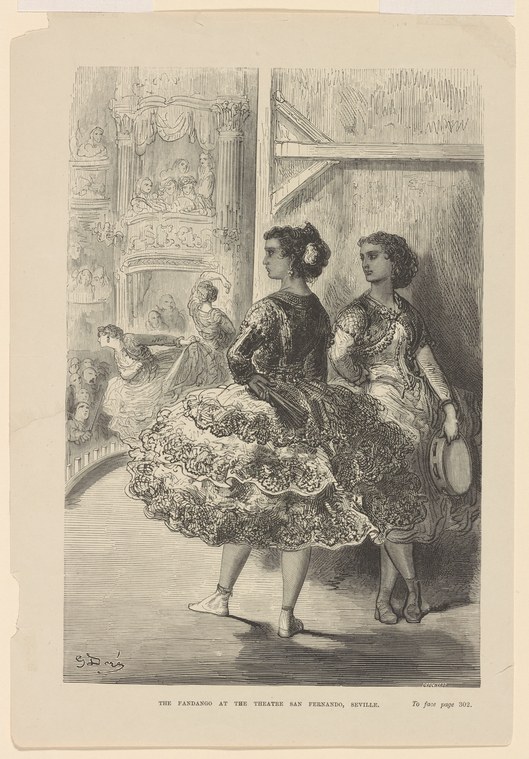
The fandango at the Theatre San Fernando, Seville
Unknown artist
- Collection:
- Prints depicting dance
- Source:
- New York Public Library
- Rights:
- Public domain — free to use, share and adapt.
- Recorded as:
- Public Domain
This work documents the theatrical fandango as a staged spectacle in 19th-century Seville, recording both the dance itself and the specific venue where it was performed. It provides visual evidence of how a Spanish folk dance was adapted, costumed, and presented to theatre audiences, and of the role of engraving in circulating such images across Europe. For scholars of 19th-century dance, it is one of the few precise, dated representations of this dance in a specific theatrical context.
What you are looking at
A theatrical or ballroom scene in which a woman in an elaborate lace skirt performs a solo dance while two other women watch from the right. The dancer wears a dark corseted bodice with a voluminous skirt of densely patterned lace or embroidered fabric that extends nearly to the floor, her posture upright and composed. To the left, the interior is rendered in architectural detail—a columned doorway with draped swags and ornamental panels suggests a grand room or theatre lobby. The two spectators on the right wear simpler dark dresses and observe with apparent interest. The composition uses atmospheric perspective and fine cross-hatching to create depth, with the architectural elements softly rendered against the foreground figures. A placard at the bottom identifies this as occurring at the Theatre San Fernando in Seville.
The dancing
The dancer stands in a poised, frontal stance with weight centered, arms held at a natural, controlled height. Her body shows no exaggerated extension or extreme turnout; the posture is upright but not rigid, suggesting a folkloric social dance rather than ballet technique. The two women to the right are stationary, one turned three-quarter to the viewer, the other in profile, both facing the dancer. Their stance and dress mark them as observers rather than participants. The dancer's skirt dominates the visual field—its bulk and texture suggest the dance involves the lower body and that the garment itself is integral to the aesthetic.
The dance depicted
The title identifies this as a fandango, the Spanish folk dance with Andalusian roots that was popular across Europe as a theatrical curiosity in the 19th century. The fandango was typically performed by a couple, but solo versions existed and were popular in theatrical contexts, particularly in Seville and other Andalusian cities where it remained a living social tradition. The dancer's upright carriage, frontal presentation, and restraint suggest the formal theatrical rendering of the dance rather than the more improvised social version. The lace skirt is characteristic of 19th-century European theatrical costume derived from Spanish dress. The setting—a grand interior identified as a specific Seville theatre—confirms this as a professional or semi-professional performance rather than a street or tavern scene.
How it was made
This is a steel or copper engraving or etching, executed with fine parallel lines to create tonal gradation and texture. The artist has used crosshatching extensively to render the architectural background, the dancers' clothing, and the spatial atmosphere. The technique allows for precise detail—the architectural ornament, the pattern of the lace, the folds of fabric—and fine distinction between lit and shadowed areas. The print shows signs of being carefully composed and executed, with considerable labour invested in rendering surface texture and spatial recession. This level of finish suggests a work intended for a periodical or art collection rather than a mass-market illustration, though engraving was the dominant print medium of the period and allowed significant circulation.
About this work
This engraving documents a theatrical performance of the Spanish fandango at a named venue—the Theatre San Fernando in Seville—in the 19th century. It captures a moment of social or theatrical display in which the dance, the dancer's costume, and the performance space are all equally important to the composition. The work sits at the intersection of three concerns: the European fascination with Spanish and Andalusian culture (orientalism and hispanismo), the circulation of folk and national dances through theatrical channels, and the role of engraving as a medium for recording and distributing images of contemporary performance and fashion. For historians of Spanish dance, this image is valuable evidence of how the fandango was presented in the urban theatrical context of the period.
How to look at it
Attend to the dancer's bodily restraint and the frontal, presentational stance—this is not a wild or improvisatory moment, but a composed theatrical display. The lace skirt, rendered with meticulous detail, occupies nearly a third of the composition, signalling that the visual spectacle of the costume is as important as the movement. The architectural setting is not mere backdrop but integral to the scene's meaning: this is a professional performance in a named theatre, not a street scene. The placard at the bottom anchors the image to a specific place and moment, transforming it from a generic 'Spanish dance' into evidence of a particular historical performance.
The artist
The artist is not recorded. The technique and finish suggest a professional engraver working for a periodical or art publisher in the mid-to-late 19th century. The inscription at the bottom ('To face page 302') indicates this was a book or periodical illustration, possibly from a travel narrative, theatrical review, or illustrated newspaper.
The period
The 19th century saw sustained European interest in Spanish culture, music, and dance, intensified by the Romantic movement's attraction to the exotic and the folkloric. The fandango, which had circulated in aristocratic European contexts since the 18th century, was reinvented in the 19th-century theatre as a symbol of Spanish authenticity and Andalusian passion. Simultaneously, Seville itself was becoming a centre for the professionalization and theatricalization of flamenco and other Andalusian dances. The engraving as a medium was at its height of prestige and circulation in this period, widely used to illustrate periodicals, travel books, and art publications for middle-class audiences.
Where it lives
Held by the New York Public Library as part of its collection of prints depicting dance. The inscription 'To face page 302' and the printing technique indicate this was a book or periodical illustration, suggesting it originated as part of a larger publication, now unknown.
Dance in this work
Questions about this work
Was the fandango danced solo or in couples?
Traditionally the fandango was a couple dance performed by a man and woman. However, solo versions were performed in theatrical contexts, especially by professional female dancers in 19th-century Europe. This image shows a solo performance, which was a theatricalized adaptation. The name 'Theatre San Fernando' confirms this is a professional venue rather than a social dance.
Is this the same as flamenco?
The fandango is distinct from but related to flamenco. It is an older Andalusian dance form that predates the codification of flamenco in the late 19th century. By the time this print was made, the fandango and flamenco were often conflated in European theatrical contexts, but they represent different dance traditions and regional practices.
Why is the skirt so elaborate?
The lace skirt is characteristic of 19th-century European theatrical costume derived from Spanish dress. It is not necessarily historically authentic to earlier Spanish dance; rather, it reflects what European audiences expected Spanish costume to look like, and what European dressmakers could produce. The skirt's visual impact was central to the theatrical presentation of the dance.
Who is the artist?
The artist is not recorded in the catalogue. The inscription 'To face page 302' indicates this was a book or periodical illustration. The technique and style suggest a professional mid-to-late 19th-century engraver working for a major publisher, but without additional information the attribution cannot be determined.
More dance artwork





