49 works in this view — arrow keys or swipe to move between them.
Dance in Art
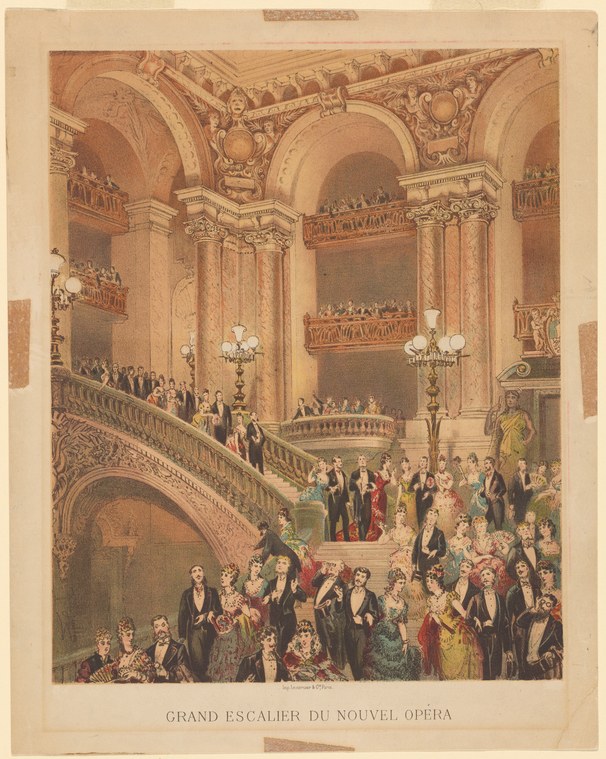
Grand escalier du nouvel opéra.
Unknown artist
- Collection:
- Prints depicting dance
- Source:
- New York Public Library
- Rights:
- Public domain — free to use, share and adapt.
- Recorded as:
- Public Domain
For dance historians, this image documents the architectural and social context in which late-nineteenth-century ballet was created, premiered, and received. The building itself—its scale, its sight lines, its organization of public and private space—shaped what choreographers could compose and how audiences experienced movement. Understanding the Palais Garnier and the ritual of the opera evening is essential to understanding the dance of Delibes, Petipa, and the fin-de-siècle ballet tradition.
What you are looking at
This is a hand-colored engraving depicting the grand staircase of the Palais Garnier (the new Opéra of Paris) filled with an elegant social gathering. The monumental neoclassical architecture dominates the composition: a soaring barrel-vaulted ceiling with coffered decoration, massive fluted columns, and multiple tiers of balconies receding into shadow. The staircase itself, with its grand sweep and ornamental railings, occupies the center and foreground. Dozens of fashionably dressed figures in dark formal evening wear—men in tailcoats, women in bustled gowns in jewel tones and metallics—are distributed across the stairs, landings, and balconies. The lighting is warm and theatrical, with gas lamps visible, creating a golden-amber tonality throughout. The figures are caught in poses of promenade and social interaction rather than active dance, suggesting this is a moment of intermission or the social ritual of the evening's display.
The dancing
The figures are uniformly upright and in postures of formal repose or slow movement typical of nineteenth-century social behavior. No couple is in a closed dance hold; instead, the guests are standing, walking, or pausing on the stairs in small clusters. The women's voluminous skirts and the men's formal silhouettes create vertical accents throughout the scene. Body language is restrained and decorous—this is a moment of social promenade rather than active partnered movement. The distribution of figures across multiple levels and depths emphasizes the architectural grandeur rather than any choreography.
The dance depicted
This is not a depiction of dance itself, but rather a social scene within a theatrical venue where dance would occur. The Palais Garnier, which opened in 1875, was the preeminent opera house of the Gilded Age and the setting for performances of ballet and opera. The image captures the social ritual—the foyer or staircase promenade—that was an integral part of the evening's experience for the opera-going public. Audiences would gather, be seen, and conduct social business before and between performances. This promenade itself was a kind of bodily performance, governed by strict codes of posture and movement, but it is not the theatrical dance being performed on stage.
How it was made
This is a hand-colored engraving or possibly a lithograph with hand coloring, executed in the commercial architectural and topographical tradition of mid-nineteenth-century Paris. The precision of the architectural detail—the perspective of the vault, the proportions of the columns, the ornamental moldings—suggests engraving. The warm, unifying color palette applied in broad translucent washes is characteristic of hand-colored prints intended for a middle-class market: tourists, architecture enthusiasts, and opera-goers. This technique allowed for wide circulation of images celebrating Haussmann's Paris and its modern civic monuments. The soft modeling and the tonal coherence typical of colored prints of this era distinguish it from both oil painting and from the harder linearity of uncolored engraving.
About this work
This is a commercial print documenting the interior of the Palais Garnier and the social world of opera-going in Gilded Age Paris. It belongs in a gallery of dance because the opera house and its foyer were central to the performance and social reception of ballet in the nineteenth century. The work captures not the art of dance itself, but the theater of being an audience—the elaborate social choreography that framed the theatrical experience. The Palais Garnier was the stage for the great Romantic and Classical ballet works of the era, and this image of its public spaces is a window into how ballet was consumed, displayed, and understood as a marker of bourgeois respectability and aesthetic refinement.
How to look at it
Look first at the architectural envelope: the print's real subject is the building's grand soaring space, rendered with careful attention to perspective and classical proportion. Then trace the distribution of figures—notice how they occupy the stairs and balconies without forming any dynamic grouping or narrative. The figures are dressed in the fashion of the 1875–1890 period; their poses reflect the era's rigid codes of social deportment: upright, still, formal. The artist has chosen a moment of social stasis, not movement. This choice is itself significant: the print is about the social institution of the opera, not about the spectacle of the stage. The warm, theatrical light suggests the building's gaslit interior and creates an atmosphere of elegant leisure.
The period
The Palais Garnier opened on 5 January 1875, and its architectural grandeur became a symbol of French republican confidence and aesthetic ambition. The building was designed by Charles Garnier and represented the apotheosis of Beaux-Arts architecture. In this period, ballet in Paris was transitioning from the Romantic era (which had largely concluded with the deaths of Marie Taglioni and Fanny Elssler) into the so-called classical age, exemplified by the works of Léo Delibes and the Petipa-imported Russian system. The Palais Garnier became the temple of this classical ballet aesthetic. The social rituals documented in this print—the elaborate dress codes, the promenade, the hierarchies of seating and visibility—were an essential part of how ballet was positioned as an art form for elite and aspiring-to-elite audiences in the Third Republic.
Where it lives
The work is held in the New York Public Library's prints collection on dance. It is a commercial print, likely issued in multiple impressions, and represents a widespread nineteenth-century genre of architectural and topographical prints celebrating Haussmann's Paris and its modern civic institutions.
Questions about this work
Is anyone actually dancing in this image?
No. This depicts the foyer or grand staircase of the opera house during a social pause—the promenade where the audience gathered between acts or before the performance. The actual ballet or opera would have been happening on stage, elsewhere in the building. This image captures the social ritual that framed the theatrical experience.
When did the Palais Garnier open?
The Palais Garnier, designed by Charles Garnier, opened on 5 January 1875 in Paris. It became the preeminent venue for ballet and opera in France and remains one of the most architecturally significant opera houses in the world. The building's scale and grandeur reflected the ambitions of the Third Republic and shaped how ballet was performed and received for generations.
Why does this matter for dance history?
The Palais Garnier was the primary stage for classical ballet in the late nineteenth century. The building's architecture, sightlines, acoustic properties, and social organization directly influenced what choreographers could create and how audiences experienced dance. Understanding the opera house and the social ritual surrounding it is essential to understanding the ballet of Delibes, Petipa, and this era.
What is this print's historical context?
Commercial prints of Parisian monuments and public buildings were hugely popular in the late nineteenth century. They were sold to tourists, architects, and the aspiring bourgeoisie as souvenirs and documents of modern Paris. This print celebrated both the architectural achievement and the social world—the fashionable crowds—that made the Palais Garnier a symbol of French culture.
More dance artwork





