49 works in this view — arrow keys or swipe to move between them.
Dance in Art
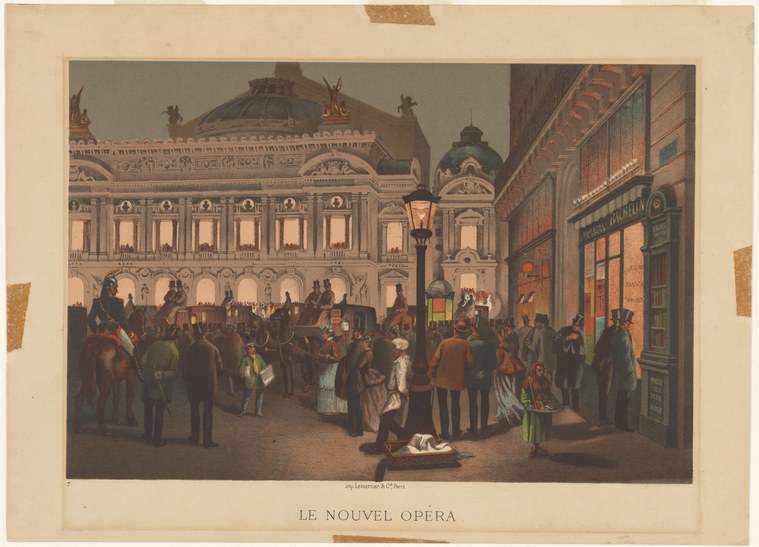
Le nouvel opéra
Unknown artist
- Collection:
- Prints depicting dance
- Source:
- New York Public Library
- Rights:
- Public domain — free to use, share and adapt.
- Recorded as:
- Public Domain
For historians of dance and performance, this work is crucial evidence of theatrical architecture, audience composition, and the social geography of the operahouse in the Belle Époque. It shows the primacy of the foyer as a stage for fashionable society and demonstrates how theatrical dance was embedded in a much larger ritual of urban display and leisure. The image also documents gender, class, and sartorial norms in the audience that consumed ballet and opera.
What you are looking at
A crowded foyer or entrance hall of a grand theatre, the Opéra Garnier in Paris, depicted in this hand-coloured lithograph. The composition is dominated by the ornate architecture—a vast barrel-vaulted ceiling with coffered panels, decorated pilasters, and arched windows that flood the space with warm light. In the foreground and middle ground, dozens of figures in mid-19th-century evening dress mill about in loose clusters and conversational groups. Women wear long dark skirts with fitted bodices, many carrying fans or wraps; men are in tailcoats and top hats. A large green-shaded lamp hangs from the ceiling, and on the right edge a shop front is visible. The crowd is animated but restrained—this is a social scene of promenade and greeting rather than formal assembly, and the gathering space is presented as theatre itself: a place of display, encounter, and leisure. The rendering captures the bustle and architectural magnificence of modern urban leisure culture.
The dancing
The figures are upright, static, or in slow ambulatory movement—no dance postures or positions are evident. Most stand in closed conversational clusters of two to four people, their posture formal and vertical. Arms hang at sides or gesture expressively during conversation; there is no partnering, no weight-sharing, and no frame of any kind. The few figures in motion drift across the space rather than move with purpose. This is a social gathering in repose, documenting how people inhabited and displayed themselves in public theatrical space, not how they danced.
The dance depicted
This work does not depict dance. It records the social life of the theatre—the promenade, the lobby, the space before and after performance where audiences of the 1860s–1880s gathered, saw, and were seen. The title *Le nouvel opéra* (The New Opera) refers to the newly completed Palais Garnier, opened in 1875. The image documents the architectural novelty and the fashionable crowd it attracted, making it a historical record of 19th-century theatrical leisure culture rather than a document of performance or choreography.
How it was made
This is a hand-coloured lithograph, a printmaking technique that allowed for multiple copies and broad distribution. Lithography was the dominant medium for theatrical ephemera, architecture documentation, and social scene-setting in the 19th century. The hand-colouring—applied after printing—creates the warm stone tones, flesh tones, and fabric colours, and the precision of the lithographic line holds fine architectural detail while the colouring adds depth and atmosphere. The technique was swift and economical, suited to the production of tourist and commemorative views, and the presence of hand-colouring indicates this was aimed at a middle-class or affluent audience buying images of the new building.
About this work
This lithograph records the interior social life of the Palais Garnier, Paris's new opera house completed in 1875, documenting the fashionable crowd in the foyer rather than the spectacle onstage. It belongs in a dance archive not as a document of choreography or bodily technique, but as historical evidence of the spaces, audiences, and leisured urban culture that shaped where and how theatrical dance was encountered. The image records the theatre as a social institution and an architectural marvel, showing how the newly rebuilt Paris presented itself to itself in the decades after the Franco-Prussian War.
How to look at it
Attend to the architecture first: the vault, the ornament, the light—these are what the lithograph was created to celebrate. Then read the crowd as a social document: the density of figures, their fixed positions, the slow circulatory movement. Notice how women dominate the visual field and how dress—the silhouettes, the fabrics, the jewellery suggested by hand-colouring—is a primary subject. Finally, observe the asymmetries: the activity on the right (the shop, the busier clusters) versus the more open left side, which gives depth and a sense of the vast space. This is a crowd scene designed to flatter both architecture and viewer.
The artist
The artist is not recorded. The work was produced as a commercial lithograph, likely by the Parisian publishing house that produced many such views of new buildings and public spaces. The technique and subject matter are typical of mid-to-late 19th-century French architectural and social documentation, aimed at tourists and collectors seeking souvenirs of modern Paris.
The period
The Palais Garnier opened in 1875, after nearly fifteen years of construction, and was immediately celebrated as the architectural marvel of the Third Republic. It was the largest theatre in Europe and symbolized both the republic's cultural ambitions and its capacity for grandeur. In the 1870s and 1880s, the opéra was at the height of its social prestige: ballet was a major attraction, particularly the work of choreographers like Saint-Léon and later Mérante. The foyer, as depicted here, was as much a gallery for the display of fashionable Paris as a waiting space for performance. This lithograph captures a moment when the opéra house was not yet superseded by newer entertainment forms and when attendance remained a ritual of elite and upper-middle-class life.
Where it lives
The work is held in the New York Public Library as part of its collection of prints depicting dance and theatrical life. It is catalogued as a print of unknown artist and date, though the architecture and style of dress date it firmly to the 1875–1895 period. It represents the kind of commemorative and tourist lithograph produced in large numbers in Paris.
Questions about this work
Is this a ballet scene?
No. This is a foyer or lobby scene—the social space of the theatre rather than the stage. No one is dancing or in dance costume. The work documents how audiences in the 1870s–1880s inhabited the opéra house before or after performance.
Why is this in a dance collection?
Because the theatre, its architecture, and its audiences are inseparable from the history of dance. Ballet was a central attraction at the Palais Garnier, and understanding the foyer, the social expectations of the audience, and the urban culture of the opéra is essential to understanding the context in which dancers performed and were seen.
Can you identify the artist?
No. The cataloguing record does not name an artist, and the work shows no signature. It was produced as a commercial lithograph by a Parisian publishing house, part of a series of views of the new opéra house.
What is the building depicted?
The Palais Garnier (Opéra House), designed by Charles Garnier and completed in 1875. It was the largest theatre in Europe and remained the principal opera and ballet venue in Paris until the late 20th century.
More dance artwork





