49 works in this view — arrow keys or swipe to move between them.
Dance in Art
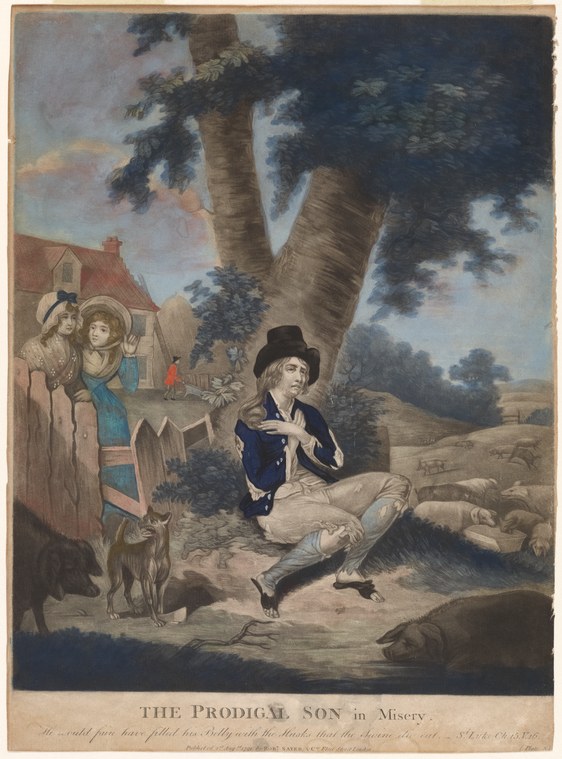
The prodigal son in misery
Unknown artist
- Collection:
- Prints depicting dance
- Source:
- New York Public Library
- Rights:
- Public domain — free to use, share and adapt.
- Recorded as:
- Public Domain
Dancers and historians of movement should notice how 18th-century printmakers used extreme bodily posture to signal emotional and moral states—how the body's collapse or distortion could carry narrative weight in an era before photography. The image documents a moment when theatrical gesture and physical extremity were primary languages for telling stories in visual form, and shows how fully the period understood the body as a readable text.
What you are looking at
A young man in fashionable late 18th-century dress—dark coat, pale breeches, and black hat—stumbles or falls in a posture of physical distress in the foreground, his body tilted sharply backward with one leg extended. Behind him stands a modest rural cottage with a thatched roof; to the left, two figures gesture from near a fence, their body language suggesting concern or alarm. A massive, gnarled tree dominates the composition, its trunk split vertically and its canopy heavy with dark foliage, framing the scene with baroque drama. The setting is a country lane or farmyard, rendered in muted tones with stormy light breaking through clouds. The print is inscribed below with the title and a date line reading 'Engraved on March 8th 1787.'
The dancing
The central figure's body is in an extreme state of physical collapse or distress—his weight thrown backward, one leg extended, arms akimbo in a gesture of surrender or despair. His posture is neither balletic nor controlled; it reads as abandonment or loss of composure. The two figures in the background stand upright, their arms raised in what appears to be gestural exclamation rather than any dance movement. There is no closed hold, no frame, no evidence of step or footwork discipline. The movement is expressive and narrative rather than choreographed.
The dance depicted
This is not a depiction of formal dance but of dramatic gesture and physical distress used as narrative illustration. The figure's fallen posture belongs to the tradition of theatrical gesture—the language of melodrama and pantomime popular in late 18th-century British printmaking—rather than to any recognisable dance form. The inscription 'The Prodigal Son in Misery' signals this is a biblical narrative illustration, and the collapsed body is theatrical emotion rendered through exaggerated physical language. Dance terminology does not apply here; this is gestural drama.
How it was made
This is a hand-colored engraving from 1787, as stated in the inscription. The composition and style—the narrative clarity, the theatrical staging, the print quality—indicate a commercial print probably intended for a broad middle-class audience familiar with biblical subject matter and sentimental narrative art. Engraving allowed fine detail in the figure's dress and in the landscape, and the hand coloring has added tonal subtlety to the sky and foliage. The technique and subject place it within the tradition of moral and religious illustration that dominated British printmaking in this period.
About this work
This is a 1787 engraving illustrating a moment from the biblical parable of the prodigal son—specifically his moment of despair and physical destitution in exile. The image uses theatrical gesture and physical extremity—the young man's collapsed posture—as the primary language of emotional and spiritual crisis. While the figure's body is in motion and distress, the image belongs to the history of moral narrative art and theatrical illustration rather than to dance per se; it uses the body's expressiveness for dramatic effect within a story, not as the subject of choreographed movement. The inscription and date mark it as a commercial print from the era of Georgian moral and sentimental art.
How to look at it
Notice the extreme backward tilt of the central figure's body and the extension of his leg—these are not natural postures of repose or balance but rather an artist's exaggeration of emotional and physical collapse. This is the language of late 18th-century theatrical gesture, where the body's distortion was understood immediately as a sign of internal distress. The composition frames this collapse against the solid cottage and massive tree, emphasizing the contrast between the figure's loss of stability and the permanence of the world around him. The moment chosen is one of crisis—neither the beginning of the story nor its resolution, but the darkest point of the parable.
The artist
The artist is not recorded in the catalogue. The style, engraving technique, subject matter, and date all place it within the commercial printmaking tradition of late 18th-century London, likely created for a market of middle-class collectors interested in biblical narrative and moral tales. The inscription indicates it was made in March 1787 specifically for print circulation.
The period
This print was created near the end of the 18th century, when British printmaking was at its height as a medium for moral, sentimental, and narrative art. The 1780s saw an enormous appetite for moralizing tales illustrated through theatrical gesture and emotional extremity. This was also the era of sensibility, when the body's visible suffering and emotional expressiveness were valued as signs of virtue and moral seriousness. Meanwhile, in formal dance, the 1780s were witnessing the transition from the stiff conventions of the minuet and baroque court dance toward the more emotionally expressive movement of romantic ballet—a shift reflected in this print's privileging of bodily distress and collapse as a primary mode of expression.
Where it lives
The print is held in the New York Public Library's collection of prints depicting dance. It is a hand-colored engraving from 1787, and the inscription on the plate provides both title and date of creation.
Questions about this work
Is this actually a dance print?
Not in the strict sense. It is a narrative illustration using theatrical gesture and bodily expressiveness to tell a story. It belongs in a collection of dance-related prints because it documents how bodies were used to convey emotion and meaning in visual narrative, and because it shows the relationship between theatrical movement and printmaking in the 18th century. But the movement depicted is emotional and dramatic rather than choreographed or patterned.
What is the subject of the parable?
The Prodigal Son is a New Testament parable about a young man who abandons his father, squanders his inheritance, and is reduced to poverty and despair before returning home to forgiveness. This print shows the moment of his deepest degradation—his collapse into misery in a foreign land.
Why is the figure's posture so exaggerated?
In 18th-century theatrical convention and printmaking, extreme bodily posture was the primary language for expressing internal emotional states. The backward tilt, the extended leg, the loss of composure—these were immediately readable to contemporary audiences as signs of despair, moral crisis, and the body's breakdown under emotional weight.
More dance artwork





