49 works in this view — arrow keys or swipe to move between them.
Dance in Art
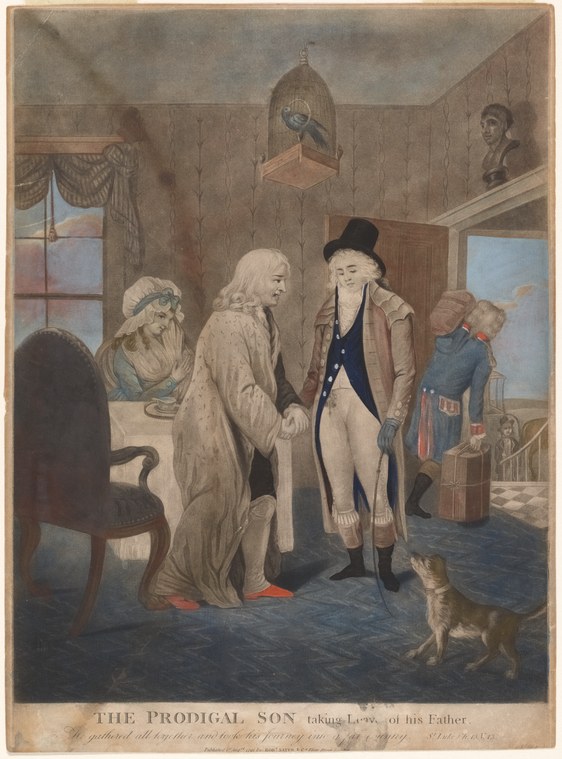
The prodigal son taking leave of his father
Unknown artist
- Collection:
- Prints depicting dance
- Source:
- New York Public Library
- Rights:
- Public domain — free to use, share and adapt.
- Recorded as:
- Public Domain
This work shows how gesture and posture functioned as a language of emotional narrative in 18th-century visual culture, before modern dance and theatre formalized the vocabulary of expressive movement. It is also an example of how the Prodigal Son—one of the most frequently illustrated narratives in Western art—was staged in the domestic rather than the courtly or religious sphere, reflecting changing attitudes toward family, morality, and sentiment.
What you are looking at
An interior domestic scene depicting the moment of departure in the biblical story of the Prodigal Son. A young man in fashionable late 18th-century dress—coat, breeches, and top hat—stands at the center, conversing with his elderly father who wears a long coat and cap. The father, seated or leaning heavily, extends his hand in what appears to be blessing or farewell. To the left, an older woman (likely the mother) in a white bonnet and long dress gestures toward the departing son with visible distress. On the right, a younger figure in military dress stands near the doorway, and a small dog occupies the lower right corner. The room is rendered in muted browns and grays, with wood paneling visible on the walls. A window on the left admits pale light; the overall tone is one of emotional gravity rather than theatrical drama—this is domestic sorrow, not stage spectacle.
The dancing
The composition is organized around the central male figure, who stands in a relaxed contrapposto stance, his weight shifted, turning slightly to address his father. The father's gesture is one of aged resignation—arm extended, palm open—suggesting blessing mixed with sorrow. The mother's posture conveys agitation: her body leans forward, her hands raised in expressive supplication or protest. No dancers are in contact; all gesture is gestural rather than choreographic, the bodies separated in space by emotional distance rather than arranged in a dance formation. The small dog at lower right provides a note of domestic intimacy and potential foreshadowing (animals often symbolize loyalty or abandonment in this narrative).
The dance depicted
This image does not depict dance in the technical sense. It is a narrative illustration of a biblical or literary moment—the farewell of the Prodigal Son—rendered as a scene of domestic theatre. The gestures are expressive and intentional, but they belong to the vocabulary of sentimental melodrama and moral narrative rather than to any recognized dance style or social dance practice. The work belongs to the visual tradition of moralizing scenes from 18th-century popular literature, where gesture and posture carry narrative and emotional weight without constituting choreography.
How it was made
This is a hand-colored engraving or etching, recognizable from the fine parallel lines (hatching) that model form and shadow, the delicate tonal gradations achieved through line density, and the subtle hand-coloring in warm ochres and cool grays that has been selectively applied to enhance form and atmosphere. The technique allows for fine detail in faces and fabric and permits wide circulation through printing; the hand-coloring indicates either an expensive commissioned example or a later enhancement. The printed inscription at the bottom confirms this is a popular print, likely issued for a broad audience rather than a fine-art collector.
About this work
This is a hand-colored engraving illustrating a moment of family separation and moral consequence from the Prodigal Son narrative, a story popular in 18th-century visual culture as a subject for moralizing domestic scenes. The work sits at the intersection of narrative print culture, sentimental domestic theatre, and the visual language of social gesture—a moment of high emotional register rendered without physical contact or choreographic form. It belongs in a gallery about dance in part because gesture and bodily expression are central to how the narrative is told, and in part because it documents how the body was used to convey emotion and moral meaning in the visual culture of its period.
How to look at it
Attend to the hands and faces: the father's extended palm, the mother's raised hands, the son's slight turn—these are the syntax of 18th-century emotional expression. The composition isolates each figure in a separate emotional register: the son deliberate and resolved, the parents grief-stricken, the military figure at the margin suggesting worldly adventure or corruption. Notice the window in the background: it opens the domestic interior to the world beyond, the direction from which temptation or ambition comes. The dog, often a symbol of loyalty or abandonment, occupies the threshold.
The period
The print was made during a period of intense interest in narrative and sentiment in both visual art and theatre. The late 18th century saw the rise of domestic melodrama and the increasing popularity of moral tales aimed at middle-class audiences. Gesture and expression became central to theatrical performance during this period, influenced by theorists like Johann Jakob Engel (whose Ideen zu einer Mimik was published in 1785–1786) who systematized the language of bodily expression. The Prodigal Son was a particularly popular subject because it combined moral instruction with emotional appeal, making it ideal for popular prints intended for domestic display or moral instruction.
Where it lives
The print is held in the New York Public Library's collection of prints depicting dance. It was catalogued within that collection, though it does not depict dancers or choreographed movement; it likely entered the collection because its subject matter involves bodily expression, gesture, and the performance of emotion—categories that overlap with but extend beyond technical dance.
Questions about this work
Is this actually a dance image?
Not in the technical sense. It illustrates a narrative moment using expressive gesture and bodily posture, but the figures are not choreographed and no recognizable dance style is being performed. It belongs in dance collections because it documents how gesture and the body conveyed emotion and meaning in 18th-century visual culture—a language that influenced how dance was later understood and represented.
What is the Prodigal Son story?
A biblical parable (Luke 15:11–32) about a son who demands his inheritance, squanders it in dissolute living, and returns home repentant to find his father's forgiveness. It was a favorite subject in 18th-century moral and sentimental literature because it combines moral instruction, family drama, and emotional resolution—perfect for prints aimed at domestic audiences.
Who is the artist?
The record does not identify the artist. The print appears to be a commercial production from the late 18th century, likely engraved by a professional printmaker for a publisher. The style and subject matter suggest it was made for a broad popular market rather than commissioned by a wealthy patron.
Why is a small dog in the picture?
Dogs often appear in 18th-century domestic scenes as symbols of loyalty, fidelity, or (conversely) abandonment. Here, the dog's position near the threshold and lower margin may reinforce the themes of departure and the crossing of boundaries that define the Prodigal Son narrative.
More dance artwork





