49 works in this view — arrow keys or swipe to move between them.
Dance in Art
Viva carnevale.
Unknown artist
- Collection:
- Prints depicting dance
- Source:
- New York Public Library
- Rights:
- Public domain — free to use, share and adapt.
- Recorded as:
- Public Domain
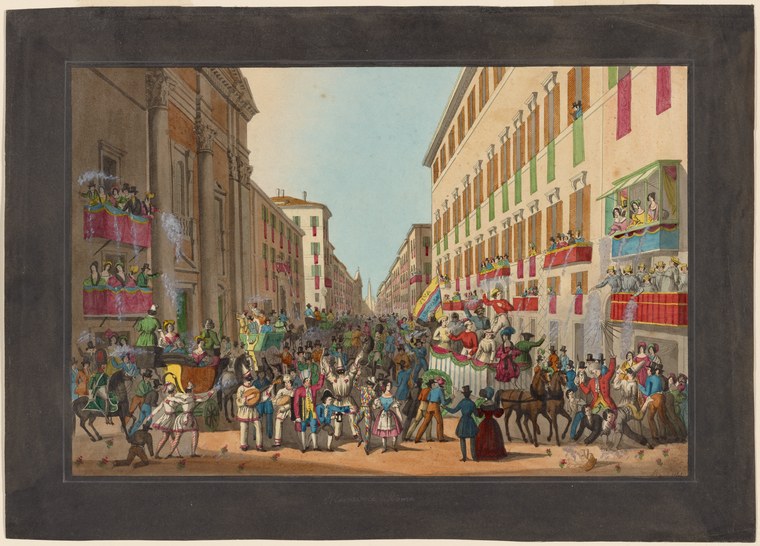
Carnival prints are among the few visual documents of social dance before photography, and they show a form of dance—festive, improvised, public—that has almost no other surviving record. The image also captures the visual spectacle and political meaning of Carnival: a temporary inversion of social hierarchy in which masks and costume allowed ordinary people to perform alongside nobility. For dancers and historians, this is evidence of how dance functioned as social practice before the dominance of theatrical and competitive forms.
What you are looking at
A crowded street carnival scene in an Italian city, viewed down a long perspective street lined with five- and six-story buildings. The buildings are decorated with elaborate fabric hangings in red, white, and green—the Italian colours—and with wooden viewing stands and loges packed with spectators at every level. The street itself is thronged with costumed revellers, musicians, and celebrants. In the middle distance, a large decorated float or platform structure is visible, drawn by horses and surrounded by dancers and attendants. The sky is clear and pale blue. The artist has rendered the scene with meticulous attention to the dress and behaviour of hundreds of figures: masked revellers in harlequin costumes, women in elaborate gowns, musicians with brass instruments, soldiers or guards in uniform, children, and clergy. The overall impression is of controlled chaos—a festival frozen in a single moment of maximum revelry.
The dancing
The dancers and revellers move in small groups and clusters rather than in formal lines. Some figures are in partnered positions—couples linked arm-in-arm or hand-in-hand—while others gesture expansively or strike attitudes of celebration. The costumes include elaborate masks, feathered headdresses, and full skirts that sweep or billow. The bodies are upright and animated rather than balletic; the energy is social and processional. The scale of the crowd—hundreds of figures—suggests a public celebration rather than a formal performance, though professional dancers and musicians are clearly present among the revellers.
The dance depicted
This is a depiction of Italian Carnival (Carnevale), the pre-Lenten festival tradition that dates to medieval times. Carnival is not a single codified dance but a festival context in which multiple forms of social dance, procession, and performance occur. The image shows the characteristic costumes (masks, harlequin dress), the street occupation, the viewing stands, and the mixture of classes and roles that defined Carnival as a social phenomenon. The dances themselves appear to be improvised or socially danced rather than choreographed theatrical pieces—couples moving to music in the street, the natural motion of celebration rather than technique. The presence of musicians and the sheer number of participants confirms this is public festive dance.
How it was made
This appears to be a hand-coloured engraving or etching, executed with the precision and linear clarity typical of 18th- or early 19th-century printmaking. The artist has achieved remarkable detail despite the medium: the architecture is rendered with mathematical perspective, and individual figures are legible even in the crowd. Hand-colouring in reds, greens, blues, and flesh tones has been applied after printing. The technique allowed for mass production and wide circulation; carnival prints were popular souvenirs and documents of festival culture. The composition is panoramic and crowded, a format suited to the engraver's ability to render intricate line and texture.
About this work
This is a hand-coloured engraving depicting the Carnival celebration in an Italian city, likely Venice or Rome, in the 18th or 19th century. It is a document of festive street dance and social choreography: not a performance for an audience, but a public occupation of urban space by masked revellers, musicians, and dancers. The work captures the visual and social intensity of Carnival—the costumes, the crowds, the occupation of the city by festival—and records how dance functioned in pre-modern carnival as improvised social movement rather than formal technique. It belongs in a gallery of dance art because it shows dance as a public, democratic, embodied practice embedded in ritual time and collective celebration.
How to look at it
The viewer should trace the eye down the receding street to understand the scale and organisation of the scene, then allow it to settle on the clusters and pairs of dancing figures at different depths. The composition is deliberately crowded; the artist has rendered the visual chaos of festival as itself a kind of order. Attend to the costumes and masks—the harlequin diamonds, the feathered caps, the fabric of gowns—which are as much a language of celebration as the movement. The presence of musicians, viewing stands, and processional floats reveals carnival as a multi-day urban occupation, not a moment of dance but a context in which dance could occur.
The period
Italian Carnival was suppressed in many cities during the Napoleonic period and the early 19th century, and prints like this often documented the festival retrospectively or nostalgically. Carnival prints were a popular commercial genre, produced in large numbers for sale to tourists and as mementos. The late 18th and 19th centuries saw increasing documentation of folk and festive practices by prints and paintings, reflecting both antiquarian interest in tradition and anxiety about the loss of older social forms. The image belongs to a large category of European carnival and festival prints that circulated widely and shaped urban audiences' understanding of celebration and dance.
Where it lives
This work is held in the Prints collection of the New York Public Library, which houses one of the largest collections of historical prints and ephemera in North America. The collection includes extensive holdings of carnival prints, city views, and festival documents from the 17th through 19th centuries.
Questions about this work
Is this a specific Carnival—Venice, Rome, Naples?
The image does not include identifying inscriptions or features that uniquely locate it. The architectural style and scale suggest a major Italian city, possibly Venice, but the catalogue record does not confirm the location. Many carnival prints were generic or composite views created for commercial circulation rather than documents of a specific year or place.
What are the masks and costumes?
The dominant costume is the harlequin or commedia dell'arte style: fitted jackets with diamond patterns, masks covering the eyes, feathered or plumed headdresses. These were the emblematic dress of Carnival, worn by performers and revellers alike. The masks and costumes served a social function: they allowed temporary anonymity and the performance of alternative identities. Noble and common dress are mixed in the crowd, reflecting carnival's temporary inversion of social order.
Are these real dancers or just revellers?
The distinction is not sharp in carnival. The couples dancing in the street are revellers participating in public festival, but they are also performing for one another and for the watching crowds. Professional musicians and dancers were certainly present, but the image emphasises the participatory and social character of carnival dance—movement shared by the crowd rather than presented to it.
When was Carnival celebrated?
Carnival is the Christian festival period before Lent, culminating on Shrove Tuesday (Mardi Gras). It traditionally lasted several weeks and involved daily processions, masked balls, street dancing, and feasting. Italian Carnival, especially in Venice, was famous throughout Europe. The festival was suppressed in many Italian cities in the late 18th and early 19th centuries, making prints like this valuable documents of a suppressed tradition.
More dance artwork





