49 works in this view — arrow keys or swipe to move between them.
Dance in Art
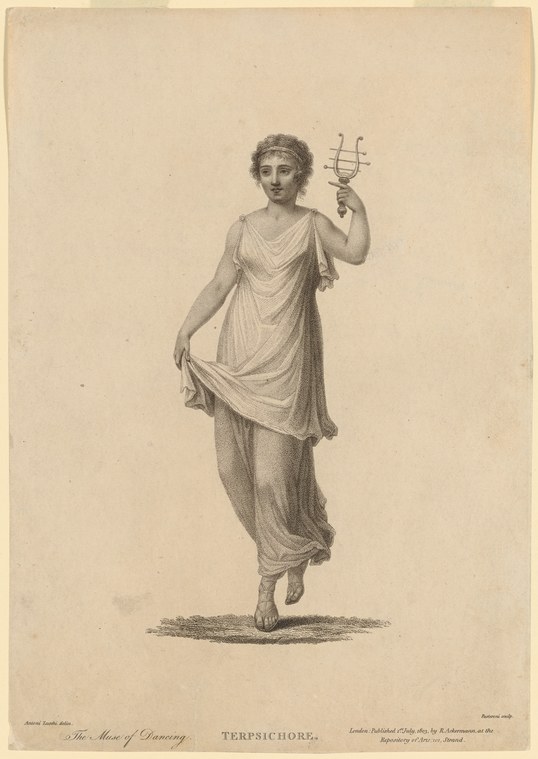
Terpsichore: the muse of dancing
Unknown artist
- Collection:
- Prints depicting dance
- Source:
- New York Public Library
- Rights:
- Public domain — free to use, share and adapt.
- Recorded as:
- Public Domain
This print is a window into how dance was understood as an idea rather than a practice in the late 18th century: not as embodied technique or social interaction, but as a classical abstraction to be studied, collected, and contemplated. For historians of dance imagery, it reveals the visual conventions by which dance was made respectable and learned—placed within the pantheon of the classical Muses and rendered suitable for polite domestic or educational display. The print also exemplifies the mass circulation of classical imagery during this period, showing how neoclassical aesthetics democratized access to high art.
What you are looking at
A single female figure stands in a classical contrapposto pose against a plain background, her weight shifted onto her left leg with the right leg relaxed and slightly advanced. She wears a draped white chiton in the Greco-Roman manner, the fabric falling loosely to her ankles with one end pulled up and held at her hip, leaving her right leg partly exposed. Her left arm hangs naturally at her side while her right arm is raised to shoulder height, holding a small lyre—the traditional attribute of Terpsichore, muse of dance and lyric poetry. Her hair is bound with a fillet or crown, and her gaze is directed outward with a calm, idealized expression. The figure floats slightly above a simple ground line, rendered in a soft, even light that creates subtle modeling in the drapery and figure without harsh shadows. The composition is entirely frontal and symmetrical, presented as a study or allegorical portrait rather than a scene of action.
The dancing
The single figure is rendered in an idealized classical manner with no actual dance movement captured. The contrapposto stance—weight on the left leg, right leg relaxed—is a standard pose for antique statuary and was used in neoclassical art to suggest nobility and repose rather than dynamism. The arm holding the lyre is raised but extended, not in a dance position but in a manner of presentation. There is no indication of footwork, turn-out, or any of the physical vocabulary of dance as it was practiced in any era; this is an emblematic portrait of the concept of dance rather than its depiction.
The dance depicted
This is not a depiction of dance practice or performance, but rather an allegorical representation of Terpsichore herself, one of the nine Muses in Greek and Roman tradition. Terpsichore was the muse of dance, lyric poetry, and song, and is conventionally identified by the lyre she carries. The image presents her as a static, idealized classical figure rather than as a dancer in action. The work belongs to the tradition of neoclassical emblem prints in which the Muses and other classical abstractions were rendered as graceful female figures in Greco-Roman dress, often for educational or decorative circulation. This particular print appears to be from the 18th or early 19th century and reflects the taste for allegorical subject matter and classical revival aesthetics of that period.
How it was made
This is a black-and-white engraving or etching, identified as such from the fine parallel hatching visible in the shadows, the precision of the line work, and the overall tonal range characteristic of reproductive prints from the 18th and 19th centuries. The technique allowed for wide distribution as an affordable print—likely sold individually or bound in volumes of classical reference material. The formal, didactic presentation and the inscription at the bottom (naming the figure and, presumably, the artist and publisher) confirm this as a print intended for educational or domestic display, circulating among the growing middle-class audience for neoclassical imagery. The print shows the refinement of line typical of London printing houses of the period.
About this work
This is an allegorical engraving of Terpsichore, the classical Muse of Dance, presented in the formal manner of 18th-century neoclassical prints. The figure is rendered in graceful contrapposto, dressed in Greco-Roman drapery, and identified by her attribute, the lyre. The work is not a document of dance practice or movement, but rather a static emblem—a visual definition of the concept of dance as understood through classical mythology and artistic convention. It belongs in a gallery of dance in art not because it shows dance being performed, but because it represents how dance itself was conceptualized, visualized, and circulated in educated European culture during the period of neoclassical revival.
How to look at it
Attend to the figure's pose: the contrapposto stance and the raised arm holding the lyre are not gestures of dance but of classical statuary and idealized beauty. This is the neoclassical convention for representing abstract concepts—the figure is calm, frontal, and self-contained, inviting contemplation rather than showing action. Notice the precision and delicacy of the engraving technique: the fine lines in the drapery, the subtle modeling of the face and limbs, and the overall refinement suggest this was a prestigious object, made for circulation among people with leisure time and classical education. The plainness of the background emphasizes the figure as a pure study of form.
The artist
Unknown. The inscription at the bottom of the print would typically credit the artist, engraver, and publisher, but this information is not legible in the available image. The style is consistent with London printing houses of the late 18th century, where reproductive engravings of classical subjects were a major commercial enterprise. Such prints were often made by journeyman engravers working from designs by more famous artists or from classical sculpture, rather than by individual named artists of major reputation.
The period
This print belongs to the neoclassical period, roughly 1760–1830, when European high culture was captivated by the aesthetics and moral ideals of ancient Greece and Rome. During this same period, ballet was undergoing its own classical codification (the development of the vocabulary and technique that would define ballet as a theatrical form), while dance itself was being professionalized and systematized. The allegorical representation of Terpsichore as a static, graceful figure reflects Enlightenment values: the idea that dance could be understood as a rational, teachable discipline connected to classical learning. At the same time, Romantic ballet was beginning to emerge, which would recover the idea of dance as emotional, ethereal, and otherworldly—though still deeply indebted to neoclassical ideals of line and form.
Where it lives
The work is held in the New York Public Library's collection of prints depicting dance. The inscription at the bottom would provide the artist's, engraver's, and publisher's names, as well as the print's date and place of publication, but these are not legible in the available image. Such prints were typically sold individually or bound into volumes of classical reference material for use by artists, students, or educated collectors.
Questions about this work
Is this woman actually dancing?
No. This is an allegorical portrait of Terpsichore, the classical Muse of Dance, presented in a static, idealized pose. She is not shown performing any dance; rather, she is shown as the embodiment or abstract concept of dance itself. The contrapposto stance and raised arm with lyre are the visual language of neoclassical art, not of dance practice.
What is the lyre for?
The lyre is the traditional attribute or emblem of Terpsichore in classical tradition. It identifies her as the Muse of Dance and Lyric Poetry—song and dance were closely linked in Greek culture, and the lyre was the instrument of Apollo, god of music and poetry. By holding the lyre, the figure announces her identity and function within the classical pantheon.
When and where was this made?
The print is from the collection of the New York Public Library, and the style is consistent with late-18th-century London printing, when neoclassical engravings were produced in large numbers for middle-class collectors. The specific date and publisher are recorded in the inscription at the bottom of the print, but this information is not legible in the current image.
Why would this be in a gallery of dance in art?
Because it documents how dance was understood, represented, and circulated in educated European culture. Rather than showing dance as a practice, it shows dance as an idea—a classical abstraction connected to learning, beauty, and refinement. For historians of dance imagery and aesthetics, it is invaluable evidence of how dance was visualized and made respectable during the neoclassical period.
More dance artwork





