49 works in this view — arrow keys or swipe to move between them.
Dance in Art
Ulysse et Penelope
Unknown artist
- Collection:
- Prints depicting dance
- Source:
- New York Public Library
- Rights:
- Public domain — free to use, share and adapt.
- Recorded as:
- Public Domain
Though not a dance work per se, this engraving documents the visual and allegorical conventions that shaped the development of court ballet and theatrical spectacle in the Renaissance and Baroque periods, when classical narrative was the primary vehicle for both dance and drama. The divided composition—celestial and terrestrial realms, divine intervention and human action—became a standard framework for theatrical spectacle including danced works. Understanding how classical subjects like this were visualized in prints is essential to understanding the visual culture that informed the emergence of ballet as a courtly art form.
What you are looking at
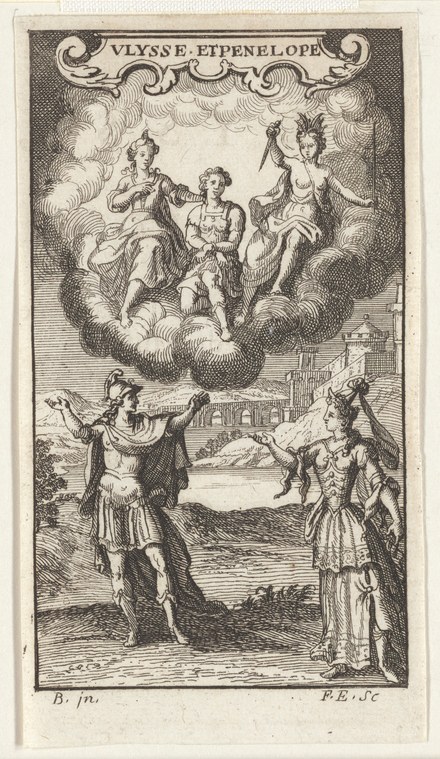
This engraving depicts a scene from the classical story of Ulysses and Penelope, divided into two registers. In the upper half, framed within billowing clouds, three figures appear in a celestial or divine realm: a standing man in classical drapery gestures toward a seated woman in the center, while a third figure (likely a deity or allegorical personage) stands to the right in partial undress. Below, in a terrestrial setting with architectural elements visible in the distance, two figures in classical Roman military dress and flowing garments face each other across a body of water or shore. The left figure, a man in armor and cape, reaches toward the right figure, a woman in long drapery. The composition creates a visual dialogue between divine intervention above and earthly reunion below, the classical subject matter rendered in the linear, high-contrast language of Renaissance or early Baroque engraving.
The dancing
The figures throughout are posed in attitudes of classical restraint and formal gesture rather than active dance movement. The celestial figures display the raised arms, inclined heads, and contemplative stance of mythological tableau. The terrestrial pair communicate through extended arms and body inclination—the man leans forward in supplication or greeting, the woman's posture suggests reciprocal attention, but neither is in motion. The poses are those of formal encounter and recognition rather than choreographed steps, with the drapery and musculature rendered to suggest classical sculpture.
The dance depicted
This engraving does not depict dance in the sense of choreographed movement. Rather, it illustrates a moment from classical narrative—the recognition or reunion of Ulysses and Penelope, possibly after his long return from Troy. The title and composition invoke classical drama and allegory, genres in which formal gesture, stance, and symbolic positioning served the functions that dance might serve in a different context. The figures occupy attitudes of pathos and recognition familiar from classical theater and baroque court spectacle, but the work documents narrative encounter rather than social or theatrical dance practice.
How it was made
This is an engraving, a print made by incising lines into a metal plate (likely copper), the technique evident from the fine linear hatching used throughout to model form and create tonal gradation. The initials visible at lower left ("B. pinx" and "F.E.") suggest the work was drawn by one hand (pinx. = pinxit, painted/drawn) and engraved by another. The technique allowed wide circulation of the image and suggests it was made for a educated audience familiar with classical literature and allegory. The high finish and fine detail indicate a professional workshop practice, likely 16th or 17th century.
About this work
This engraving illustrates a moment from the classical story of Ulysses and Penelope, presenting it as a vision divided between divine and earthly realms. The work belongs to the tradition of classical history engraving—a genre that dominated European printmaking from the Renaissance onward—in which narrative moments from ancient texts and mythology were translated into formal visual language. The composition privileges allegorical and narrative content over the representation of actual movement, yet the work offers important evidence of how classical subjects were visualized and circulated in early modern Europe, and of the formal conventions governing the representation of heroic and divine encounter.
How to look at it
This engraving asks you to read it as a two-level narrative: attend first to the architectural and compositional division between the cloud-framed upper realm and the earthly lower setting, which signals a movement between divine will and human action. Notice how the gestures of the figures—the extended arms, the inclined bodies—are posed rather than dynamic, using the formal vocabulary of classical sculpture and relief to convey emotion and narrative significance. The fineness of the engraved line and the precise hatching demonstrate the high technical skill required to execute such works; this level of finish was both a mark of prestige and an aid to circulation—the image could be reproduced and distributed across Europe.
The artist
The initials suggest this is a print after a drawing by an artist whose name began with B, engraved by someone with initials F.E. or signing as F.E. Without more specific information, the artist cannot be securely identified. The style and execution are consistent with professional Renaissance or early Baroque printmaking workshops active in northern Europe or Italy in the 16th–17th centuries, periods when classical narrative engraving was a dominant and highly valued form of artistic production and knowledge circulation.
The period
This engraving was made during a period when classical texts and images were central to elite European visual and performative culture. The 16th and 17th centuries saw intense interest in recovering and reinterpreting classical subjects, driven by the Renaissance recovery of ancient texts and the authority those texts carried in humanist education. In the same period, court ballet was emerging in Italy and France, initially as a vehicle for classical narrative allegory. Engraved prints like this one were primary tools for disseminating classical imagery and narrative across Europe, shaping how educated audiences understood and imagined classical subjects in all media, including dance.
Where it lives
This engraving is part of the Prints depicting dance collection held by the New York Public Library, indicating it was catalogued as a dance-related work, likely because of its subject matter (classical narrative involving figures) or its significance to the visual history of theatrical representation. The attribution and dating remain uncertain based on the available record.
Questions about this work
Is this actually a dance image?
Not in the sense of depicting choreographed movement. However, it illustrates a classical narrative in the formal visual language that shaped early modern theatrical spectacle, including court ballet. The engraving documents how classical subjects were visualized and circulated, providing important context for understanding the visual culture in which ballet emerged as a courtly art form.
What is the story being shown here?
The title indicates this is the recognition or reunion of Ulysses (Odysseus) and Penelope. In Homer's Odyssey, Penelope waited faithfully for Ulysses during his ten-year journey home from Troy. The engraving's two-register composition suggests both divine sanction of their reunion (above) and the earthly moment of recognition (below).
Why was this printed and for whom?
Classical history engravings like this were made for educated audiences—collectors, scholars, artists—who valued classical learning and could afford prints. They served multiple purposes: as illustrations of classical texts, as models for artists working in other media, as objects of aesthetic appreciation, and as tools for understanding and remembering classical narratives.
What technique was used to make this?
This is an engraving—a print made by cutting lines into a copper plate and filling those lines with ink. The technique required great skill and allowed the image to be printed many times from the same plate, making it an effective tool for circulating imagery across Europe.
More dance artwork





