49 works in this view — arrow keys or swipe to move between them.
Dance in Art
La Siamoise
Unknown artist
- Collection:
- Prints depicting dance
- Source:
- New York Public Library
- Rights:
- Public domain — free to use, share and adapt.
- Recorded as:
- Public Domain
This print documents the European fascination with Asian dance and costume in the 18th century, a moment when contact with distant courts shaped artistic taste and theatrical fashion. It shows how European artists translated the unfamiliar geometry and ornament of Southeast Asian dress into their own engraving conventions, creating an image legible to their audience even if not faithful to its source. For historians of orientalism and the global circulation of dance imagery, it is a primary record of how performance and costume became instruments of cultural exchange and exoticization.
What you are looking at
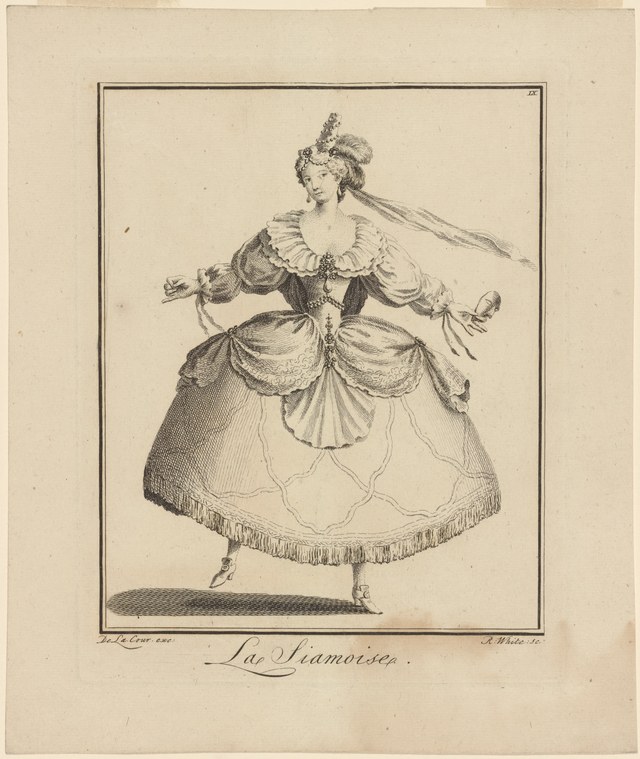
A single female dancer in Siamese dress stands in a three-quarter pose against a plain background. She wears an elaborate costume consisting of a fitted bodice with a large, standing collar of sheer fabric that frames her shoulders, and a voluminous skirt gathered at the waist with pronounced draped swags at the sides. The skirt is gathered at the hem with what appears to be a deep border or fringe. Her hair is swept up in an ornamental style topped with a feathered or plumed headdress. She holds small objects—possibly castanets or finger cymbals—in both raised hands at shoulder height, and her pose suggests a moment of controlled movement or readiness to perform. The composition is frontal and theatrical, designed to display both the dancer's figure and the particulars of Siamese court dress to European viewers unfamiliar with it.
The dancing
The dancer stands in a vertical, frontal pose with weight evenly distributed. Both arms are raised to shoulder height with elbows slightly bent, hands turned outward as if holding small percussion instruments. The posture is upright and formal rather than naturalistic, suggesting a presentation stance common to 18th-century dance notation and theatrical portraiture. There is no suggestion of a partner or group; the figure occupies the frame alone. The lifted arms and forward-facing orientation project dignity and display rather than dynamic movement through space.
The dance depicted
This work depicts a Siamese court dancer as understood and imagined by 18th-century European audiences. The costume—the stiffened collar, gathered skirt with dramatic swags, and ornamental headdress—represents Siamese royal or ceremonial dress rather than European fashion. The raised arms with what appear to be hand instruments suggest a style of movement emphasizing hand and arm gesture in the upper body, which aligns with Southeast Asian dance forms where hand positions carry narrative and symbolic meaning. The image is more likely an ethnographic or decorative print meant to satisfy European curiosity about distant courts than a record of actual Siamese performance practice. The title *La Siamoise* (The Siamese Woman) confirms the subject is identified by origin rather than by a specific dance name.
How it was made
This is a line engraving, characteristic of 18th-century print production. The fine parallel hatching visible in the shaded areas of the skirt and bodice, and the precise control of line throughout, are typical of engraving technique. The composition is framed within a ruled rectangular border, standard for prints meant for bound collections, portfolios, or albums of costumes and types. Engravings circulated widely and inexpensively among educated and leisured audiences across Europe, making this a mass medium for disseminating images of fashion, dance, and exotic peoples. The technique's clarity and replicability meant such prints shaped European ideas of distant cultures, often more through imagination than accurate observation.
About this work
This is an 18th-century engraved print depicting a Siamese court dancer as a figure of exotic fascination for European viewers. The dancer wears elaborate Siamese ceremonial dress and stands in a formal, presentational pose with raised arms and hand instruments, a posture that emphasizes display and ornament over motion through space. The print belongs to a long European tradition of costume prints and representations of foreign dancers and courtly types—documents of both actual performance practice and European fantasy about the wider world. As a work of dance imagery, it sits at the intersection of ethnography, fashion, and theatrical entertainment, capturing not how Siamese dancers actually performed but how 18th-century European printmakers and their audiences imagined them.
How to look at it
Attend to the costume first: every element—the standing collar, the gathered skirt with swags, the headdress—is rendered with precision and ornamental detail, more carefully observed than the dancer's body beneath it. The pose is hieratic and frontal, designed to display rather than to move. Notice how the small objects in the dancer's hands—probably percussion instruments—are her only means of gesture and action; all movement is concentrated in the upper body and the hands, consistent with Southeast Asian dance forms where hand shapes carry meaning. The engraver has frozen a moment of stillness and presentation rather than capturing motion, treating the dancer as a figure of display for European consumption.
The period
The 18th century saw an explosion of European interest in non-European dress, dance, and manners. Traveling companies of Asian and African performers appeared in European cities; prints and written accounts of their performances circulated widely. The rococo appetite for ornament, exoticism, and the picturesque made foreign dancers—especially women—fashionable subjects for prints, paintings, and theatrical spectacle. At the same time, ballet was developing in Europe as a professional art form with its own aesthetic conventions: the turned-out legs, lifted carriage, and formalized gesture visible in European dance prints of the period. This *Siamoise* sits between these worlds—it uses European print conventions and poses to represent an Asian dancer, but without the balletic turnout or the specific narrative context of European theatrical dance. The costume is treated as the principal subject, reflecting contemporary interest in what foreign dress revealed about foreign character and sensibility.
Where it lives
The print is held in the New York Public Library's collection of prints depicting dance. It represents the type of circulating engraved costume or character print typical of 18th-century European art production and collection.
Dance in this work
Questions about this work
Is this a record of an actual Siamese dancer or a European fantasy?
Likely both. The costume details are specific and ornamental enough to suggest acquaintance with actual Siamese court dress, but the frontal pose, the formal presentation, and the emphasis on exotic display reflect European aesthetic conventions and interests. Europeans of the period saw foreign dancers as embodiments of cultural types rather than as individuals, and prints like this shaped European ideas about Asia as much as they recorded real performances.
Why are her arms raised and what is she holding?
The raised arms and hand instruments suggest a performance style emphasizing arm and hand movement, typical of Southeast Asian dance where hand positions carry symbolic meaning. The objects in her hands are probably finger cymbals or similar percussion instruments used to mark rhythm. The pose freezes her in a moment of readiness or presentation rather than in active motion.
What was this print for?
Engravings of exotic dancers and costume types circulated in 18th-century Europe as parts of bound collections, albums of prints, and books about foreign manners and dress. They served purposes both ethnographic and entertaining—they satisfied curiosity about distant courts and peoples while also feeding European taste for ornament, exoticism, and theatrical fashion.
More dance artwork





