49 works in this view — arrow keys or swipe to move between them.
Dance in Art
Petrouchka
Unknown artist
- Collection:
- Prints depicting dance
- Source:
- New York Public Library
- Rights:
- Public domain — free to use, share and adapt.
- Recorded as:
- Public Domain
The work documents the intersection of Russian folk culture and modernist printmaking, and the role of traditional costume and carnival in early 20th-century theatrical and artistic imagination. For dancers and historians, it illustrates how folk and peasant dress functioned as a resource for experimental theater and visual culture in Russia.
What you are looking at
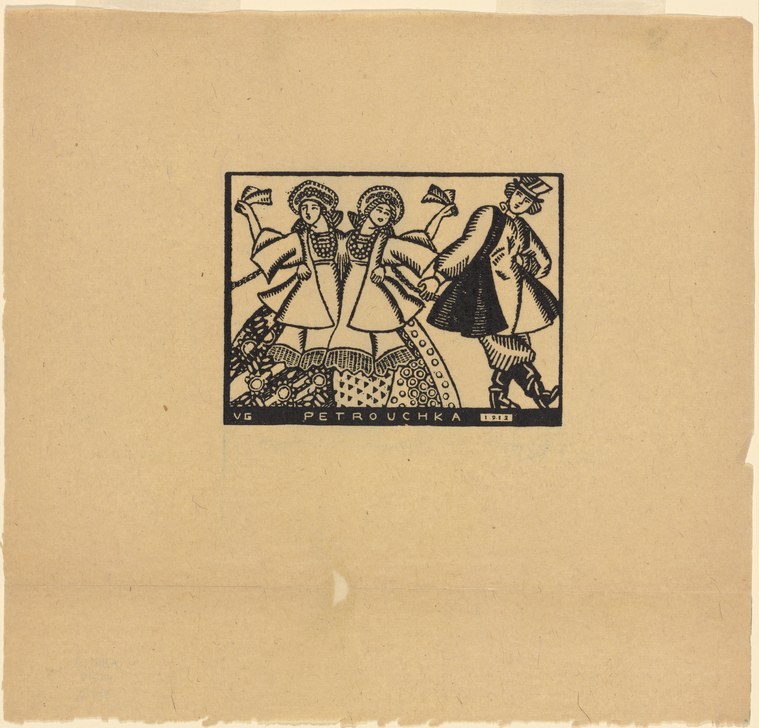
A woodcut or linocut in bold black line depicts a scene of Russian folk revelry, titled *Petrouchka* (visible in the lower margin). Four figures dominate the composition: two women in the center wear richly patterned traditional dress with ornate headdresses (kokoshniki), their bodies angled toward each other in animated conversation or greeting. To the left, a man in a cap holds aloft what appears to be a toy or puppet; to the right, another figure in darker clothing and a hat gestures dynamically. The ground is scattered with decorative elements—coins or sequins suggesting festivity and abundance. The style is expressionist and energetic, with strong linear hatching and decorative patterning throughout the garments and background. The composition radiates outward energy, capturing a moment of folk celebration or theatrical performance.
The dancing
The two central women are upright and frontal, their bodies turned slightly toward each other in a pose suggesting mutual regard or social exchange rather than partnered dance movement. Their arms are raised or extended in open gestures. The flanking figures employ more dynamic postures: the left figure lunges forward with raised arm, while the right figure twists or pivots. None of the poses suggests a closed ballroom hold or the sustained frame of classical dance; instead, the bodies read as loose, gestural, and expressive—more theatrical than technically trained.
The dance depicted
The work almost certainly depicts Russian folk dance or the theatrical representation of it. *Petrouchka*—the Russian puppet character—and the traditional costumes (kokoshniki headdresses, patterned kaftans) identify this as rooted in Russian folk culture. The style of representation is consistent with early 20th-century Russian avant-garde engagement with folk material, when artists drew on peasant dress, carnival, and street performance. However, this is likely a scene of folk festivity or carnival play rather than a codified folk dance form; the gestural freedom and theatrical framing suggest performance or celebration rather than structured movement.
How it was made
This is a woodcut or linocut, identified by the bold, high-contrast black-and-white composition and the linear hatching technique visible in the shaded areas. The medium is suited to bold graphic impact and was favored by Russian and Northern European printmakers of the early 20th century for its directness and capacity for social or cultural commentary. The technique allows flat fields of pattern and strong silhouettes, which here emphasize the decorative richness of folk dress and the energetic gesture of the figures. The bold outline and simplified forms suggest an aesthetic aligned with German Expressionism or Russian Constructivism.
About this work
This is a Russian folk celebration scene captured in woodcut, depicting figures in traditional costume engaged in animated social and performative interaction. The work belongs to early 20th-century artistic engagement with Russian peasant culture and carnival—a period when avant-garde artists mined folk traditions for authenticity, energy, and visual spectacle. The print's graphic boldness and expressionist handling mark it as a work of artistic modernism invested in folk material, rather than a documentary record of actual dance practice.
How to look at it
Observe the composition as a burst of outward energy: the two central figures provide stability and frontality, while the flanking figures pull the eye leftward and rightward, creating a sense of festive dispersal. Notice how the artist uses patterning—the decorative fields of the dresses, the scattered coins or sequins on the ground—to emphasize abundance and celebration rather than to create spatial recession. The bold outline and simplified forms flatten the figures, making them read as social types or characters rather than individuals, in the manner of folk art or theater design. The raised arms and open gestures suggest joy and abandon, but also the theatricality of performance—this is folk culture as artistic subject, not naive documentation.
The artist
The artist is unknown, but the style and subject matter locate the work within Russian Expressionism or early Soviet graphic art (roughly 1910–1930). The aesthetic—bold outline, expressionist gesture, engagement with folk material—is consistent with the Mir iskusstva (World of Art) movement or the work of Russian woodcut artists influenced by German Expressionism. The confident, economical line and the decision to depict Russian folk festivity suggest an artist with training in modern printmaking and cultural investment in peasant and carnival traditions.
The period
This print was made during a period of intense Russian artistic and political ferment. Early 20th-century Russian avant-garde artists—Kandinsky, Goncharova, Larionov, and many printmakers—drew heavily on Russian folk art, peasant costume, and carnival as sources of authenticity, color, and spiritual or revolutionary energy. Ballet Russes productions like *Petroushka* (1911, Stravinsky/Fokine) had recently made Russian folk spectacle internationally famous. Simultaneously, woodcut and linocut—techniques with roots in folk and popular practice—were being revived as media of modernist expression. This convergence of folk subject matter, modernist technique, and Russian cultural nationalism is central to understanding the work.
Where it lives
The work is held in the Prints depicting dance collection of the New York Public Library. It belongs to a category of early 20th-century European prints engaging with folk culture, costume, and performance.
Dance in this work
Questions about this work
What is Petrouchka?
Petrouchka is a Russian folk puppet character, central to Russian carnival and peasant performance traditions. The character became internationally famous through the Ballets Russes production *Petroushka* (1911), choreographed by Michel Fokine to music by Stravinsky. This print appears to reference that theatrical tradition rather than depict the ballet itself.
Are these people dancing?
They are engaged in animated social and performative interaction in a festive setting, but the gestures are more theatrical and gestural than technically codified dance movement. This is more likely a scene of folk celebration, carnival, or theatrical performance than a representation of a specific dance form.
Why is this a woodcut?
Woodcut was a popular medium for Russian and German artists in the early 20th century because it was associated with folk and popular tradition, was cheap to produce, and created bold, graphic images ideal for social and cultural commentary. The technique's simplification and strong contrasts also suited modernist aesthetics.
More dance artwork





