49 works in this view — arrow keys or swipe to move between them.
Dance in Art
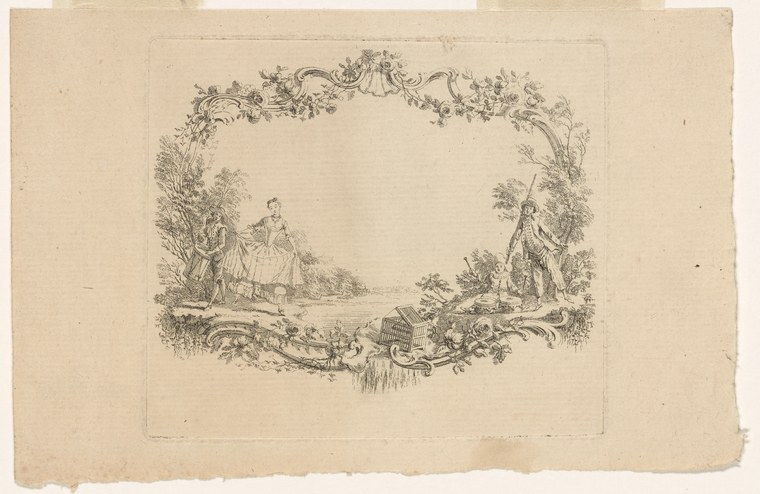
Country scene
Unknown artist
- Collection:
- Prints depicting dance
- Source:
- New York Public Library
- Rights:
- Public domain — free to use, share and adapt.
- Recorded as:
- Public Domain
While this print does not show a dance in progress, it documents the visual and social codes through which the 18th century imagined courtship and entertainment in pastoral settings. For the dance historian, it is valuable as evidence of how dances were situated within the wider culture of sociability and courtship, and what poses and attitudes were read as romantic or invitational in this period. The print's existence and circulation also tells us what kind of images were produced and consumed by cultivated audiences of the time.
What you are looking at
A rural or pastoral scene framed by an ornate baroque cartouche of flowering vines and ribbons. Two figures occupy a landscape: on the left, a woman in a long dress with what appears to be a companion or attendant; on the right, a man in period coat and breeches, posed with one arm raised in a theatrical gesture. Between them lies a spacious meadow or garden. The composition is fundamentally symmetrical, the two figures balanced across the frame as if in conversation or courtship. The ornamental border is densely detailed with rococo flourishes—swags, bows, botanical ornament—which dominates the visual weight of the print and suggests this is a decorative or allegorical image rather than a scene of active motion. The figures are rendered in fine linear detail characteristic of 18th-century engraving; the landscape recedes simply, with trees and distant forms suggested by light hatching.
The dancing
The male figure on the right stands in a clear contrapposto pose, one leg straight, the other bent, with his raised arm extended in an attitude of address or invitation—a formal courtly gesture. The female figure on the left stands in profile or three-quarter view, her body upright and composed. Neither figure is in active motion, and neither shows the flexion, turnout, or dynamic weight distribution of ballroom or theatrical dance. The poses are those of conversation or formal presentation rather than the execution of steps.
The dance depicted
This does not depict an active dance. The two figures are posed in attitudes of courtship or social address conventional to 18th-century pastoral allegory and rococo print design. While the setting and the male figure's invitational gesture invoke the social world in which courtship dances such as minuets and country dances occurred, there is no visible choreography, no closed or open hold, no footwork, and no indication of a dance in progress. This is a scene of courtship or entertainment in a space where dance might occur, not a depiction of dance itself.
How it was made
This is an engraving or etching, worked in fine parallel lines and cross-hatching on a copperplate. The technique allows for precise detail in the baroque ornamental frame while keeping the figures and landscape relatively spare. The delicate linear quality and the formal cartouche suggest this is a print meant for circulation as a decorative print, perhaps part of a series or a chapter heading in a literary or theatrical work. Engravings of this kind were produced in quantity and distributed to a cultivated audience with means to collect printed designs.
About this work
This is an 18th-century engraved or etched print depicting two figures in a pastoral landscape within an ornamental rococo frame. The composition invokes the social and amorous world of the period—a world in which dance played a crucial role in courtship and entertainment—but the image itself is not a depiction of dance in action. Rather, it shows a moment of formal social address or courtship, posed in the language of rococo allegorical print design. The ornamental frame is as visually significant as the figures and landscape it contains, and the whole functions as a design object as much as a narrative image.
How to look at it
Attend first to the ornamental frame, which is rococo at its most exuberant—the composition is as much about the design as about the figures. Then focus on the two figures' poses: the male figure's raised arm and contrapposto stance read as courtly and invitational, while the female figure maintains an upright, composed deportment. The empty space between them is charged with social meaning—it is the space of courtship, not action. The landscape is simplified and secondary, a backdrop to the human encounter.
The artist
The artist is unknown. The style and technique are consistent with mid-18th-century rococo printmaking, a period in which such decorative allegorical engravings were produced in great quantity, often unsigned or attributed only to the publisher. The work may have been executed in France, Germany, Italy, or the Netherlands, where rococo aesthetics and engraving technique flourished.
The period
The image dates to the height of rococo taste in the 18th century, when pastoral allegory, courtship imagery, and ornamental fancy dominated the decorative arts. This is the period of the minuet as the central social dance, and of the country dance's increasing popularity. The theatrical world of this era prized grace, delicacy, and romantic sentiment—qualities the print evokes through its careful pose and landscape. Engravings and etchings of this kind were collected as prints to be framed and displayed, and also incorporated into books, playing cards, and other ephemera.
Where it lives
The print is held by the New York Public Library as part of the Prints collection on dance. It is catalogued as 'Country scene' with the era label 'unknown' and the attribution 'not recorded.' No date, medium (in the current record), or artist is specified.
Questions about this work
Is this a picture of a dance?
No, not in the strict sense. The two figures are posed in attitudes of courtship or social address, but they are not executing choreography or showing the footwork, hold, or dynamic movement of an actual dance. The image evokes the social world in which dances occurred, but it depicts a moment of courtship rather than the dance itself.
What kind of print is this?
This is an engraving or etching, a technique that allows for fine linear detail and was the primary method of reproductive printmaking in the 18th century. The ornamental rococo frame and the careful, delicate handling of line suggest this was made for distribution to a cultivated audience—it may have been part of a series, a book illustration, or a standalone decorative print.
Why is it in the dance collection?
Although it does not show active dance, the print belongs in a dance archive because it documents the visual and social language of courtship and entertainment in an era when dance was central to social life. It shows us how the 18th century visualized the spaces and poses associated with courtship, and by extension, with the social dances through which courtship was conducted.
More dance artwork





