49 works in this view — arrow keys or swipe to move between them.
Dance in Art
Jean Etienne Despréaux
Unknown artist
- Collection:
- Prints depicting dance
- Source:
- New York Public Library
- Rights:
- Public domain — free to use, share and adapt.
- Recorded as:
- Public Domain
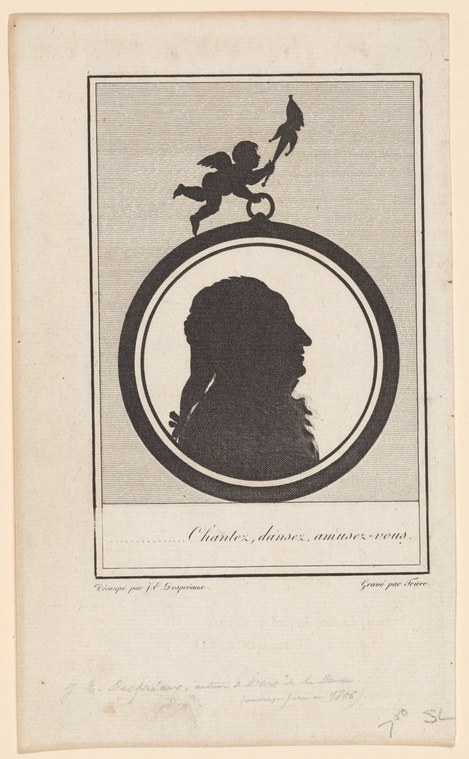
The work demonstrates how dance functioned in 18th-century artistic and social imagination as a symbol of happiness and freedom. The pairing of a formal portrait with an exuberant dancing figure reflects broader Enlightenment values—the balance between reason (the dignified silhouette) and sensibility (the joyful putti). For historians of dance culture, it shows how dance was invoked symbolically in domestic and personal contexts, not only in theatrical or aristocratic settings.
What you are looking at
A silhouette portrait shows a man in profile facing right, enclosed within a circular frame. Above the circular frame, a small putti or winged cherub figure dances or floats in a dynamic pose, one arm raised, holding what appears to be a garland or wreath. The composition is rendered in black silhouette against a cream background, a format characteristic of late 18th-century portraiture. The engraving is framed by a thin rectangular border. Below the image is an inscription in French script reading "Chante, danse, amuses-vous" (Sing, dance, amuse yourself).
The dancing
The primary figure is a static portrait silhouette with no visible dance movement. The putti above, however, is animated—one leg extended behind, torso angled, one arm raised overhead in a gesture of joy or celebration. This small figure embodies movement and levity in contrast to the formal stillness of the portrait below. The visual relationship is allegorical rather than literal: the portrait subject is dignified and contemplative, while the putti dances in liberation.
The dance depicted
The work is not depicting an actual dance but rather using the image of a dancing putti as an emblem or allegory of the pleasures of music, dance, and entertainment. The inscription 'Chante, danse, amuses-vous' frames dancing as a social good and personal happiness. This is a common motif in 18th-century prints: the dancing figure represents an ideal of carefree joy rather than a specific dance form or practice. The gesture and lightness suggest a playful, unrestricted movement rather than any formal choreography.
How it was made
This is an engraving, identifiable by the fine parallel hatching lines creating tonal gradation in the silhouette and the precision of the line work. The technique of silhouette portraiture was fashionable in Europe during the mid-to-late 18th century, offering an economical alternative to painted portraits while maintaining clear legibility and elegant simplicity. The engraved format allowed for multiple impressions and wider distribution among educated patrons. The notation at bottom indicates the artist of the engraving (left) and the artist of the design or original (right), a standard format for reproductive prints of the period.
About this work
This is an 18th-century engraved silhouette portrait combined with an allegorical image of a dancing putti. The work uses the figure of dance not to document an actual choreography but to convey an ideal—that singing, dancing, and amusement are worthy pursuits and signs of a good life. The portrait format suggests this may commemorate a specific person, but the inscription and the dancing cherub above universalize the sentiment. It belongs in a dance gallery not as a record of dance practice but as evidence of how dance was imagined and valued in 18th-century culture: as an expression of joy, liberty, and the pleasures of living.
How to look at it
Notice the stark contrast between the still portrait and the active putti: the composition uses visual hierarchy and scale to suggest that dance and amusement are aspirations or ideals that accompany (or elevate) the individual being portrayed. The silhouette technique strips away all detail except contour and profile, forcing the viewer to read meaning through pose and gesture alone. The French inscription should be read as a caption or motto, a piece of advice or encouragement, rather than a description of what is shown.
The artist
The engraving credits appear at the bottom. The left credit indicates the engraver; the right credit indicates the designer of the original composition. Without clearer visibility or documentation of these signatures, the broader context of the artists' practices cannot be firmly established. Silhouette portraiture was practiced by many European engravers during the 18th century, often as a commercial and accessible form of portraiture.
The period
The silhouette was a fashionable form of portraiture in Europe from the 1760s through the early 19th century, prized for its economy, elegance, and psychological clarity. The 18th century saw dance shifting in cultural status: formal courtly dances (minuets, gavottes) coexisted with emerging social dances, and dance was increasingly celebrated in Enlightenment discourse as a natural expression of human feeling and sociability. The inscription 'Chante, danse, amuses-vous' reflects this climate—an encouragement to pleasure and self-expression rather than a directive to courtly decorum.
Where it lives
The work is held in the Prints collection at the New York Public Library under the general category 'Prints depicting dance.' It is a reproductive print of unknown date and uncertain artist attribution, typical of 18th-century commercial engraving production.
Questions about this work
Is this a specific person's portrait?
The silhouette may commemorate an individual—that was the primary function of silhouette portraiture—but the engraving provides no identifying information beyond the profile itself. The universal inscription suggests the work may also have been marketed more broadly as an emblematic image of happiness and amusement.
What is the putti doing?
The putti is dancing or floating in a celebratory pose, with one leg extended, one arm raised, and the body in a dynamic diagonal line. It holds or trails a garland, adding to the festive impression. This is allegorical imagery: the dancing cherub represents the pleasures of music, dance, and gaiety.
What does 'Chante, danse, amuses-vous' mean?
It translates to 'Sing, dance, amuse yourself.' It is an encouragement or invitation to joy and social pleasure—a reflection of 18th-century attitudes toward dance as an expression of freedom and happiness rather than merely courtly obligation.
More dance artwork





