49 works in this view — arrow keys or swipe to move between them.
Dance in Art
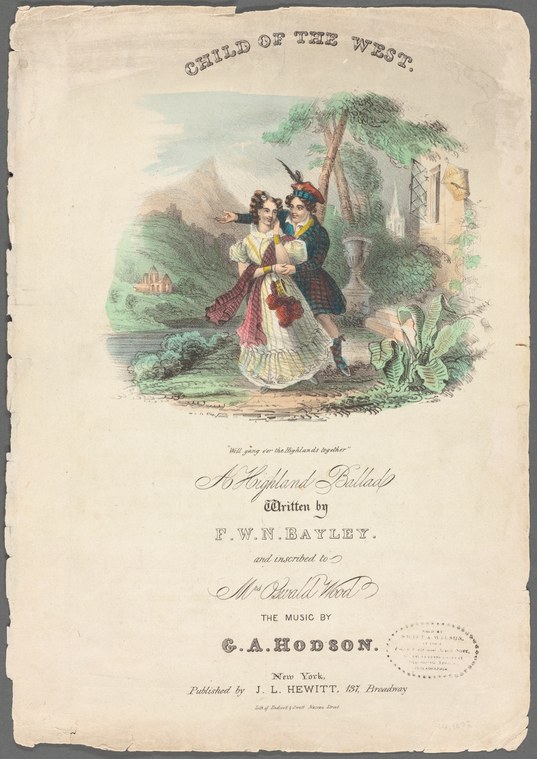
Child of the west, a Highland ballad written by F.W.N. Bayley ... the music by G.A. Hodson
Unknown artist
- Collection:
- Prints depicting dance
- Source:
- New York Public Library
- Rights:
- Public domain — free to use, share and adapt.
- Recorded as:
- Public Domain
This work documents the visual and emotional language of early 19th-century social dance and Scottish identity at a moment when Highland culture was being intensely romanticized and commodified for British and American audiences. For dance historians, it is evidence of how folk and social dance were experienced outside the theater—in narrative, in courtship, in national imagination. For those studying popular print culture, it exemplifies the mass production of sentiment and nationalism through illustrated music and literature.
What you are looking at
A hand-colored engraving depicts a couple in an intimate moment beneath a spreading tree on a rocky Highland landscape. The woman wears a white muslin dress with a deep red or crimson shawl draped across her shoulders; the man is dressed in Highland costume including a dark jacket and tartan. They stand close together in three-quarter view, the woman turned slightly toward the man, her posture suggesting both engagement and reserve. In the middle distance, a ruined stone structure—possibly a tower or fortification—is visible against mountains. The composition is Romantic in sensibility: the wild landscape, the ruins, the emotional intensity of the two figures, and the careful rendering of the woman's delicate dress and the man's proud bearing all work to create a scene of Highland courtship or declaration. The light is soft and diffused, creating atmospheric depth.
The dancing
The couple's proximity and body language suggest social dancing or courtship rather than theatrical performance. The woman's weight appears to rest easily on her feet; her right arm hangs at her side while her left arm is bent, possibly held by or near the man's arm. The man stands at a slight angle to her, his posture upright and attentive. Neither figure is in a formal dance position—there is no closed hold, no raised arms, no balletic frame. Their stance suggests a moment of social interaction, perhaps a Highland reel or country dance, or a pause within one.
The dance depicted
This is a Scottish or Highland-themed narrative ballad illustration rather than a depiction of formal theatrical dance. The title 'Child of the West: A Highland Ballad' and the costume place the work in the tradition of Scottish Romanticism. The two figures appear to be engaged in the kind of social dancing or courtship ritual that would have been familiar in Highland folk tradition—country dances, reels, or the cotillion-style dances popular in early 19th-century society. The image captures a moment of human connection within a dance or courtship scene rather than a moment of virtuosic performance. The music was composed by G.A. Hodson, and the ballad text by F.W.N. Bayley suggests this was part of the broader market for sentimental, nationalism-inflected popular entertainment.
How it was made
This is a hand-colored engraving, a reproductive print technique that allowed wide circulation of literary and theatrical scenes in the early 19th century. The fine lines and delicate shading characteristic of engraving are visible in the rendering of the landscape and figures. Hand coloring—applied by brush after printing—explains the soft, sometimes variable quality of the color; the woman's dress white is luminous against the darker tones of the landscape, while the red shawl provides a warm accent. Engraving was the dominant technique for illustrating published ballads, songs, and popular theatrical works, making this object part of a mass market for illustrated literature and music.
About this work
This engraving illustrates 'Child of the West,' a sentimental Scottish ballad with music by G.A. Hodson, published in New York in the early 19th century. It shows a man and woman in Highland dress in an intimate moment of courtship or social dance in a romantic landscape. The work belongs to a significant but now largely overlooked genre: the illustrated popular ballad and song sheet, which merged visual narrative, music, and literary sentiment for a broad middle-class audience. These objects tell us how dance, emotion, and national identity were entangled in the culture of their time.
The image is valuable precisely because it is not a performance—it shows social dance as it was lived, not as it was staged. The couple's relaxed posture, the absence of virtuosity, the integration of the dance into a narrative of courtship and Highland identity all reflect how dance functioned in everyday life and in the sentimental imagination of the era.
How to look at it
The viewer should attend to the almost complete absence of action. This is not a moment of dynamic movement but of intimate proximity and mutual regard. The artist has chosen to freeze a pause—a moment of connection between two dancers, or between courtship and dance, when movement momentarily ceases. This reflects a broader convention of Romantic visual narrative: the heightened moment of feeling is more important than the dance itself. The Highland landscape and ruins frame the couple as figures in a story larger than themselves, which is the point—the image sells not dance virtuosity but the romance of national identity and emotional authenticity.
The artist
The artists are named in the publication: F.W.N. Bayley wrote the ballad text, and G.A. Hodson composed the music. The engraving itself is unsigned, which was standard practice for reproductive prints of this period—the engraver's labor was typically uncredited. The object was published by J.L. Hewitt of New York, suggesting it was produced for an American market in which Scottish Romanticism and nationalist sentiment were commercially successful.
The period
This work dates to the early 19th century, a period in which Scottish identity, Highland culture, and Romantic nationalism were being aggressively marketed to English and American audiences. Walter Scott's novels (Waverley 1814 onwards) had created enormous appetite for Highland sentiment; King George IV's 1822 visit to Edinburgh in full Highland dress cemented tartan and Highland imagery as fashionable symbols of British identity. At the same time, social dancing was undergoing transformation: country dances, cotillions, and quadrilles were becoming standardized and formalized, while folk and regional traditions were being collected, sentimentalized, and republished as national cultural treasures. This ballad participates in both trends: it sells Highland identity through sentimental narrative and music, and it frames social dance as an emotionally charged act of courtship and national belonging.
Where it lives
The work is held in the New York Public Library's Prints collection, catalogued as a depiction of dance. It is a published music-sheet illustration, part of the commercial circulation of sentimental ballads and songs in early 19th-century America.
Dance in this work
Questions about this work
What kind of dance is this?
The image suggests social dancing in a Highland or Scottish folk tradition—possibly a reel, country dance, or cotillion—rather than formal theatrical ballet. The couple's relaxed posture and informal setting indicate this is meant to represent courtship and social dancing in everyday life, not performance technique. The ballad narrative and Romantic landscape frame the dance as an emotional and cultural act.
Who were the artists?
F.W.N. Bayley wrote the ballad text and G.A. Hodson composed the music. The engraver is unnamed, which was standard for reproductive prints of this period. The work was published by J.L. Hewitt in New York, indicating it was produced for an American market.
Why is the Highland costume important?
Highland dress and tartan were symbols of Scottish national identity and Romantic authenticity in the early 19th century. By 1814–1830, Highland culture had been intensely romanticized through Scott's novels and the British royal family's embrace of tartan. This image participates in that commercialization, selling Highland identity and emotion to middle-class audiences.
What is a hand-colored engraving?
An engraving is made by incising lines into a metal plate; the printed result is then hand-colored with watercolor or similar media. This technique allowed for relatively inexpensive mass production while maintaining the fine detail of engraved line work. It was the dominant method for illustrating popular songs, ballads, and theatrical scenes in the early 19th century.
More dance artwork





