49 works in this view — arrow keys or swipe to move between them.
Dance in Art
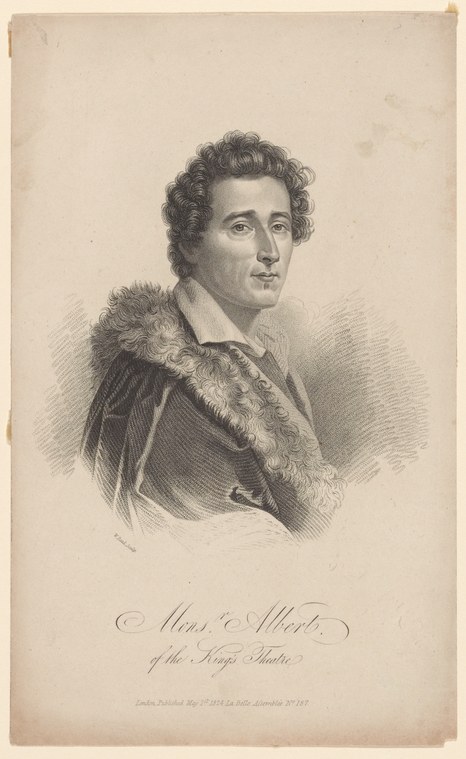
Monsr. Albert of the King's Theatre
Unknown artist
- Collection:
- Prints depicting dance
- Source:
- New York Public Library
- Rights:
- Public domain — free to use, share and adapt.
- Recorded as:
- Public Domain
For historians of early 19th-century dance and theatre, this portrait serves as documentary evidence of a named performer and the visual conventions used to market dancers to the public. It shows how dancers were commodified as celebrities through the production and sale of engraved portraits—a major form of theatrical publicity in the Regency era.
What you are looking at
A three-quarter-length portrait of a young man in early 19th-century dress, shown against a plain background. He wears a dark coat with a fur-trimmed collar or shoulder cape, and his curled hair is styled in the fashion of the Regency period. His gaze is directed slightly to the left, and his posture is upright and composed. The engraving technique—with fine parallel lines creating tone and shadow—suggests this is a formal portrait print made for distribution, likely a theatrical publicity image given the inscription below.
The dancing
A single figure, stationary and formally posed rather than in motion. The sitter faces three-quarters to the viewer's left, with shoulders squared and head held level. There is no indication of dance movement, gesture, or physical exertion. The pose is one of dignified repose typical of early 19th-century portraiture—suitable for presentation rather than action.
The dance depicted
This is not a depiction of dance in progress. It is a portrait of a performer associated with the King's Theatre, London. The inscription identifies the subject as 'Monsr. Albert' of that venue. Without additional research, the specific repertory of this performer cannot be established from the image alone. The portrait serves as a record of a theatre professional but contains no visual evidence of the dance styles, techniques, or movement vocabulary he employed.
How it was made
A line engraving or stipple engraving, executed with fine parallel hatching to model form and create subtle gradations of light and shadow. The technique was standard for theatrical portraiture of the period and allowed for multiple impressions to be struck from the copper plate, making the image widely reproducible and affordable for sale to theatre-goers and collectors. The clarity and finish suggest a professional London engraver working from a drawn original.
About this work
This is a formal theatrical portrait print of 'Monsr. Albert,' a performer at the King's Theatre in London, likely dating to the early 19th century. It is catalogued as depicting dance because it represents a named dance professional of the era, yet the image itself shows a stationary portrait rather than choreographic action. The work is significant as evidence of the celebrity status of theatre dancers and the market for their portraits, but it does not illustrate dance technique or style.
How to look at it
Examine the inscription carefully, as it is the sole identifier of the subject and context. Note the formality of the pose and the precision of the engraving technique—this is a professional product designed to be legible and flattering at small scale. The fur-trimmed garment and refined clothing suggest the sitter's status as a fashionable theatre professional, not a servant or minor player.
The artist
The engraver is not recorded. The print was published in London and is part of a substantial tradition of theatrical portraiture produced by professional engravers for the London theatre market. These prints were typically made after drawings or paintings and reproduced from copper plates; many bear publication lines crediting print sellers on or near the Strand.
The period
The early 19th century saw a boom in theatrical portraiture, particularly in London. The King's Theatre (Haymarket) was one of the two patent theatres licensed to perform drama and opera, and its dancers and performers were prominent public figures. Engraved portraits of celebrated performers were collected, mounted in albums, and sold individually—a forerunner of later theatrical photograph albums. The Regency period also saw the rise of named male ballet dancers, particularly French and Italian soloists performing at the London theatres.
Where it lives
The print is held in the New York Public Library's collection of prints depicting dance. It is a historical theatrical ephemera—a commercial publication designed for sale to theatre audiences and collectors, rather than a unique artwork or archive document.
Questions about this work
Was this person actually a dancer?
The inscription identifies him as 'of the King's Theatre,' one of London's principal theatres. Dancers, singers, and actors all worked in the King's Theatre repertory, and without additional sources, the specific role cannot be confirmed from the portrait alone. The image is catalogued as dance-related because it represents a named theatre professional, but further research would be needed to establish his specialty.
Why is this in a dance collection if it doesn't show dancing?
Theatrical portrait prints were often grouped together as documents of performer history and theatre culture. The New York Public Library's collection appears to focus broadly on images related to the dance world and theatre profession, including portraits of named performers, even when the portrait itself does not depict movement or choreography.
How do I find out more about Monsr. Albert?
Cross-reference the name and theatre with playbills and cast lists from the King's Theatre, held in the Victoria & Albert Museum and the British Library. Theatre trade journals and newspapers of the period, digitized through Early English Books Online and British Newspapers Archive, may also list performances and reviews mentioning him by name.
More dance artwork





