49 works in this view — arrow keys or swipe to move between them.
Dance in Art
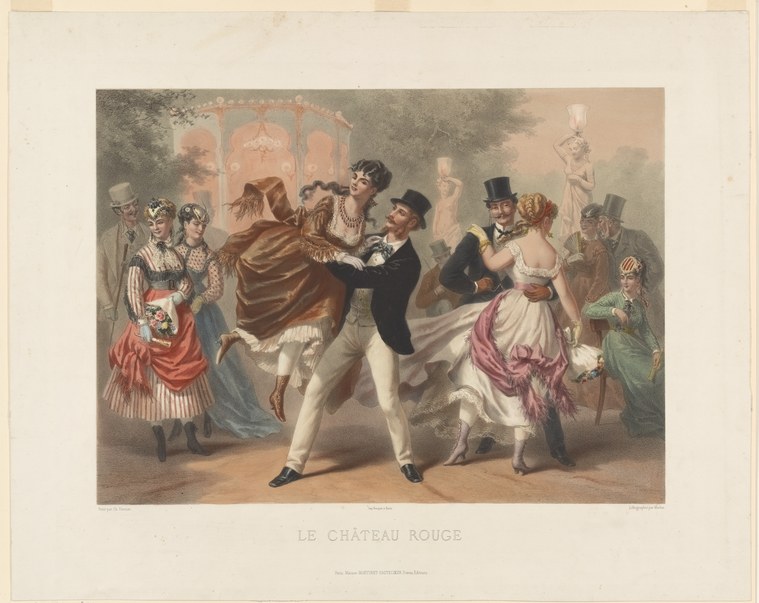
Le Château Rouge
Unknown artist
- Collection:
- Prints depicting dance
- Source:
- New York Public Library
- Rights:
- Public domain — free to use, share and adapt.
- Recorded as:
- Public Domain
This image documents the physical reality of early 19th-century ballroom dancing before standardization, showing the actual body mechanics and spatial relationships that dancers of the period experienced. For historians of dance, it provides rare visual evidence of how turning dances were executed, the degree of exuberance and horizontal swing involved, and how dancing fit into the broader social and courtship practices of Regency and Gilded Age elite society.
What you are looking at
A lively ballroom scene set in an ornate interior with neoclassical architectural details visible in the background. A man in dark evening dress (black jacket, white breeches and stockings, top hat) is caught mid-motion, swinging a woman in a voluminous brown cloak or cape around him in a dramatic rotational gesture. The woman's face is obscured by the cloak, but her body follows the momentum of the swing. To the left stands a fashionably dressed couple in haute couture: a woman in an elaborate patterned dress with a tall feathered headdress and a man in formal dress. To the right, another elegantly dressed woman in a white corseted gown with pink drapery watches the action, accompanied by men in top hats. At least a dozen additional figures crowd the background, dressed in the height of early 19th-century fashion, creating an atmosphere of fashionable entertainment and social spectacle. The lighting is warm and theatrical, with soft illumination highlighting the principal figures against a muted architectural setting.
The dancing
The central dancer executes a vigorous rotational swing with his partner, his body angled forward in the effort of the turn, one arm controlling the woman's weight as she swings outward. His stance and weight distribution suggest sharp, controlled momentum rather than the smooth gliding characteristic of later ballroom waltz. The woman's body, though mostly obscured by fabric, follows the centripetal force of the swing. The bystanders stand in relaxed, observational poses—some with arms at rest, others gesturing in conversation—establishing this as a social rather than formally choreographed occasion.
The dance depicted
This depicts a vigorous turning dance from the early 19th century, most likely a valse or related turning figure such as the allemande or a folk-derived turning dance popular in ballrooms of the Regency and early Gilded Age. The dramatic horizontal swing—a woman's body driven outward in rotation—was characteristic of these dances and distinguishes them from the more upright, controlled Modern Waltz that would emerge later. The costumes and setting place this in the 1820s–1840s, when such energetic turning dances were fashionable in European ballrooms. The French title suggests this may document a specific ballroom scene or character type known to French audiences.
How it was made
This is a hand-colored engraving or lithograph, identifiable by the fine linear detail in the architectural background, the precisely rendered clothing textures, and the selective application of watercolor or chalk color in the principal figures and costumes. The technique allowed for mass reproduction and wide circulation in illustrated periodicals and albums of social scenes. The careful rendering of facial expression and the theatrical staging suggest this was created for a middle- or upper-class audience interested in contemporary social dance and fashionable behavior.
About this work
Le Château Rouge documents a moment of vigorous social dancing in the ballroom of the early 19th century, capturing not just the mechanics of the dance but its social context and the fashionable spectacle surrounding it. The image shows a specific turning dance—likely a valse or related figure—executed with the energetic horizontal swing that characterized early Romantic-era ballroom dancing before the codification of Modern Ballroom technique. The work sits within a tradition of French satirical and observational prints depicting contemporary social life, using dance as a window onto fashionable society, courtship rituals, and entertainment.
How to look at it
Observe the precise moment the artist chose: the woman at the apex of the outward swing, her body weightless and horizontal, the man braced and controlling the momentum. This exaggerated extension was the hallmark of the waltz and related figures and demonstrates how different the dance was from its later Victorian and modern forms. Notice also how the formal social frame—the dressed onlookers, the architecture—legitimizes this once-scandalous dance as a central ritual of fashionable society.
The period
The early 19th century saw a revolution in European ballroom dancing centered on the waltz and related turning dances. These dances, which involved close partnership and rapid rotation, scandalized older generations but became the dominant social dance form of the Regency period (1811–1820) and beyond. French popular prints and satirical images became a major medium for documenting and commenting on fashionable society during this era, often with gentle mockery of social pretension. The specific energy and dynamism shown here—the woman nearly horizontal in the swing—reflects the unrestrained style of the waltz before it was refined into the more controlled Modern Waltz of the Victorian period.
Where it lives
This print is held in the New York Public Library's collection of prints depicting dance. It was a mass-produced work, likely distributed as a loose print or bound into an album or periodical, making it one of many such images that documented and disseminated knowledge of fashionable social dancing across Europe.
Dance in this work
Questions about this work
Is this the waltz?
Most likely yes, or a closely related turning dance such as the allemande or Ländler. The vigorous horizontal swing, the close partnership, and the rapid rotation are all hallmarks of the waltz family. The style shown here—energetic and exuberant—predates the more controlled Modern Waltz codified in the late 19th century.
Why is the woman swung so far out?
This was the natural consequence of dancing the waltz with full rotational momentum. The centripetal force of the turn threw the woman's body outward, and skilled dancers controlled this outward extension to create a dramatic, athletic effect. Later refinements of the waltz reduced this extension in favor of a more upright, controlled position.
Who would have danced like this?
The fashionable elite of the Regency and early 19th-century European ballrooms. The waltz began as a folk dance in Austria and Germany but was rapidly adopted by aristocracy and the upper middle classes as the defining social dance of the era. Despite initial scandal, it became essential to social success and courtship.
More dance artwork





