49 works in this view — arrow keys or swipe to move between them.
Dance in Art
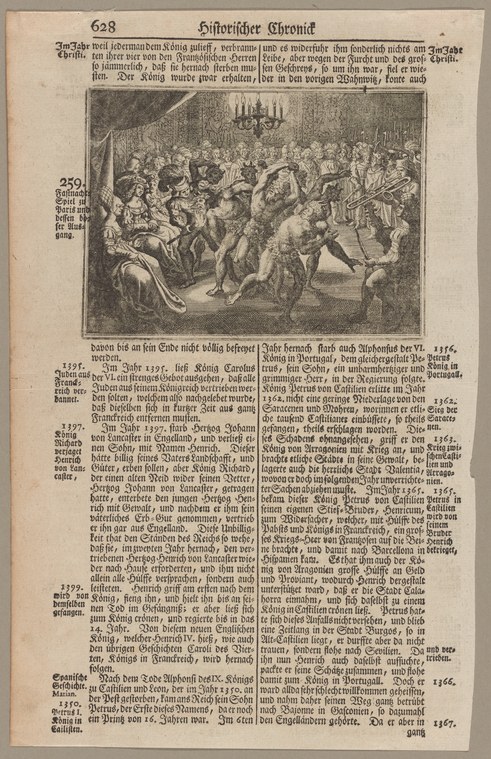
Fastnacht-Spiel zu Paris und dessen böser Äusgang
Unknown artist
- Collection:
- Prints depicting dance
- Source:
- New York Public Library
- Rights:
- Public domain — free to use, share and adapt.
- Recorded as:
- Public Domain
This is one of the few surviving visual records of how ordinary people actually moved and danced in the Renaissance—not the choreographed, formal dances of courts or ballrooms, but the wild, communal, embodied play of carnival. It shows dance as collective transgression, where the body was unleashed rather than disciplined, and where movement served social inversion rather than courtly display. For anyone studying the history of popular movement or the social life of the body in early modern Europe, this image is invaluable.
What you are looking at
This is a woodcut or engraving from a German chronicle depicting a street carnival or Fastnacht (Shrovetide) festival, likely from the 15th or 16th century. The scene is crowded and chaotic, with figures in various states of revelry and disorder across a town square or street. In the background, a Gothic church or cathedral with tall spires dominates the skyline. The foreground fills with costumed and masked revelers, some dancing or gesturing wildly, others fighting, carousing, or engaged in rowdy play. The composition is dense and busy, with figures overlapping and interacting at multiple levels. Some wear pointed hats or fool's costumes; others are partially nude or in exaggerated dress. The overall impression is one of sanctioned chaos and transgression—the licensed disorder of carnival before Lent. The perspective is flattened and the crowd scene captures not a single moment of choreographed dance but rather the anarchic energy of collective festive behavior.
The dancing
The figures do not hold formal dance positions or partnered frames. Instead, bodies are twisted, contorted, and animated in attitudes of abandon: arms flung upward, legs splayed, backs arched. Some figures appear to be leaping or in mid-stride; others crouch or bend forward in exaggerated gestures. The crowding and overlapping of bodies create a sense of energy rather than any legible step pattern or hold. What is visible is vigorous, uncontrolled movement—the opposite of the regulated, partnered hold of court or ballroom dance. The poses suggest individual expression and physical release rather than learned or codified choreography.
The dance depicted
This depicts Fastnacht (Shrovetide carnival), a pre-Lenten festival tradition in German-speaking regions where social hierarchies were temporarily inverted and sanctioned transgression took place. The 'dance' here is not a specific named form but rather festive reveling—street carnival in its most unstructured, communal mode. Men and women of varying social stations mingle, masks and costumes allowing anonymity and role-play. The physical behavior visible—wild gestures, apparent fighting, leaping, contortion—reflects the nature of carnival as licensed disorder rather than choreographed performance. The title references both the location (Paris) and the 'böser Äusgang' (wicked outcome), suggesting that the print may be documenting or warning against carnival excess, possibly linking it to real or imagined social disruption.
How it was made
This is a woodcut or engraving (likely woodcut, given the bold lines and the German source), a mass-reproducible medium that would have circulated widely among both elite and popular audiences in the 16th century. The technique allowed for rapid production of numbered scenes in a chronicle or narrative sequence (note the page number 628 at top). The bold, crude outlines and the density of the composition exploit the medium's strengths—clarity of silhouette and the ability to depict crowds and action without fine detail. This was a tool for documentation, moral commentary, and entertainment, not fine art.
About this work
This is a chronicle woodcut documenting Fastnacht carnival in a German-speaking city, part of a longer historical narrative (likely the Zimmerische Chronik or similar 16th-century chronicle). It records not a choreographed dance but the festive disorder of pre-Lenten carnival—the collective, masked, transgressive behavior that was permitted once a year. The work sits at the intersection of social history, popular culture, and visual documentation. It is a record of how people moved and played together when hierarchies were inverted, a moment when the body was freed from regulation and decorum. For dance historians, it offers rare evidence of non-elite, non-courtly movement—the physicality of common people at play, largely invisible in the courtly dance imagery that dominates the period.
How to look at it
Look at the bodies, not the composition. Notice how few of the figures face forward or hold still—nearly all are twisted, bent, or in mid-motion. Observe how the artist has used exaggeration and distortion to convey energy and disorder rather than grace or control. Look at the relationship between figures: this is not partnered or lined-up dance, but rather a collision of individuals. The cathedral in the background anchors the scene in civic space, which makes the foreground chaos—the inversion of order—more pointed. Finally, note the heterogeneity: men and women of different apparent ages and stations all mixed together, costumes and masks that obscure identity. This is the visual language of carnival as inversion.
The period
This image dates to the era of the printed chronicle and the mass-reproducible woodcut, when the documentation of contemporary events became possible and popular across Europe. Fastnacht carnival was a deeply rooted practice in German-speaking lands, tolerated and even encouraged by civic and religious authorities as a safety valve for social tension. The 16th century saw increasing documentation and artistic interest in carnival and folk custom, partly out of humanist curiosity and partly out of moral concern about disorder. By the time this was printed, printed images of carnival were circulating widely, sometimes as satire, sometimes as ethnographic record, sometimes as moral warning.
Where it lives
This is a page from a German printed chronicle (likely 15th or 16th century). It is held in the New York Public Library as part of the collection of prints depicting dance. It is one of many pages in a longer narrative sequence, as indicated by the page number 628.
Dance in this work
Questions about this work
Is this a choreographed dance?
No. This depicts Fastnacht carnival, a festival of licensed disorder. The movement shown is festive reveling—individual, uncontrolled, and transgressive—not a named dance form with steps or holds. It represents how ordinary people moved when social rules were temporarily suspended.
Why is the crowd so chaotic?
Carnival was intentionally chaotic. It was a period when hierarchy was inverted, masks allowed anonymity, and physical excess was permitted. The disorder visible here is the point—it was the one moment in the year when the body could be unleashed. The 'wicked outcome' mentioned in the title may reflect moral anxiety about this transgression.
How do we know this is Fastnacht and not just a street fight?
The Gothic setting, the costumes and masks, the mixed participation of men and women, and the title 'Fastnacht-Spiel' all indicate carnival. The 'play' (Spiel) was licensed festive behavior. The specific mention of Paris in the title may reference a famous account or a particular incident, but the image type—dense crowd, mixed dress, urban setting—is typical of printed carnival scenes from this era.
More dance artwork





