49 works in this view — arrow keys or swipe to move between them.
Dance in Art
Bavarian maypole dance
Unknown artist
- Collection:
- Prints depicting dance
- Source:
- New York Public Library
- Rights:
- Public domain — free to use, share and adapt.
- Recorded as:
- Public Domain
Maypole dances are now fragmentary in living practice, and images like this are crucial documents of how the tradition actually appeared and was organized in its flourishing period. The engraving shows us not just individual dancers but the entire civic and social structure that sustained the practice—the crowd, the architecture, the seasonal moment—which no written description alone could convey. For historians of European folk dance and material culture, this is primary evidence.
What you are looking at
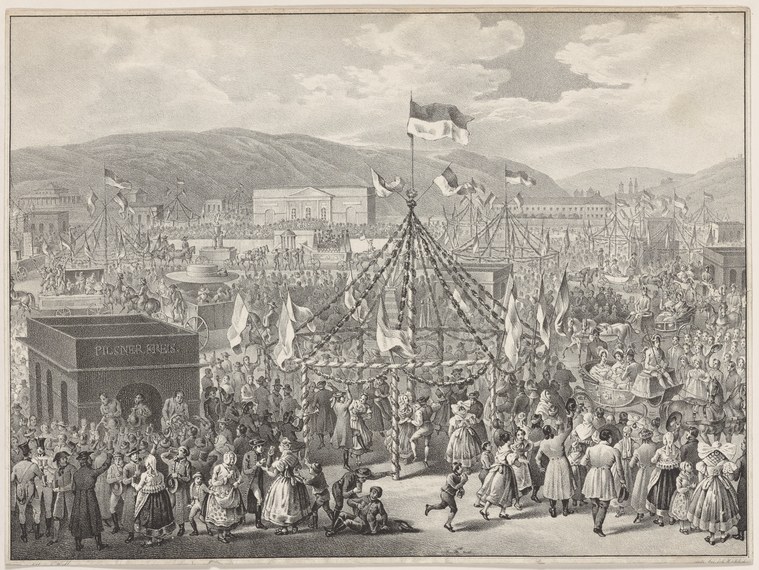
A densely populated town square or marketplace erupts in celebration around a tall maypole. The pole, wrapped in what appears to be woven bands or ribbons and crowned with a flag, stands as the focal point of a vast crowd rendered in the engraver's characteristic fine detail. Figures fill the composition from foreground to distant buildings: men, women, and children in period dress (appearing to be 18th-century), many in motion or gathered in clusters. On the left, a substantial wooden structure or reviewing stand rises above the crowd. The background shows a hill crowned with buildings and a city skyline, with church spires visible. The scene is rendered in the soft tones of an engraving, with careful hatching establishing depth and shadow. The composition captures a moment of collective festivity—some figures dance or process around the pole, others stand in conversation or watch, and the overall impression is one of organized celebration rather than improvised revelry.
The dancing
The dancers appear to move in loose groupings rather than in rigid formations, though a ring or circle around the pole is suggested by the arrangement of figures. Their arms are raised and extended in gestures of celebration; several figures show the high arm positions typical of folk dance. The clothing—women in full skirts, men in breeches and coats—allows visible lower-leg and footwork. The postures suggest folk-dance movement: upright carriage, open frames, and energetic but not virtuosic gestures. The scale of the crowd makes individual technique impossible to assess, but the overall bodily language reads as participatory folk dancing rather than theatrical performance.
The dance depicted
This is almost certainly a depiction of a European maypole dance, a folk tradition with deep roots in spring and early-summer celebration. Maypole dances were communal events in which participants (often segregated by gender or role) moved around a central pole, sometimes weaving ribbons attached to its top. The engraving captures the festive, inclusive character of the tradition: the pole itself is the dominant visual feature, and the crowd's gathering around it in apparent motion suggests the circular, communal nature of the dance. The presence of the large crowd and the civic architecture indicate this was a town or village event of some public significance. Maypole dances were most prevalent in German-speaking regions, English communities, and Scandinavia, which aligns with the catalogue title of 'Bavarian maypole dance.' The image does not reveal the specific regional variant or whether ribbons were actually used in this performance, but the central pole and the gathering pattern are unmistakable.
How it was made
This is an engraving, identifiable from the fine parallel lines (hatching) used to build tone and shadow, the crisp black outlines, and the characteristic appearance of the paper. The technique allowed the artist to achieve remarkable detail across the entire composition—individual figures are distinguishable even in the dense crowd, and architectural elements in the background are rendered with precision. Engravings of this type were produced from copper plates and could be printed multiple times, making them relatively affordable and widely circulated compared to paintings. The size, detail, and subject matter suggest this was a print intended for public sale or distribution, documenting a notable local event or practice for an audience beyond the immediate region.
About this work
This engraving documents a Bavarian maypole celebration, a communal folk dance and spring festival that brought together entire communities around a symbolic central pole. The artist chose to emphasize the scale and festivity of the event, filling the composition with dozens of figures in period dress engaged in or witnessing the dance. The maypole tradition was deeply rooted in German and Alpine folk culture, and this image preserves both the movement and the social context of the practice—not an elite or theatrical performance, but a participatory civic celebration. The work belongs in a gallery of dance imagery because it captures a complete social world of folk performance: the space, the crowd, the dress, the objects, and the bodily practice all inseparably linked.
How to look at it
Attend to the maypole itself: notice how it anchors and organizes the entire composition, even though the artist's main effort goes into rendering the crowd. The pole appears to be the still point around which motion and energy radiate. Observe the range of gesture and posture in the figures: some are clearly in motion (arms raised, bodies angled), others are static or turned inward in conversation, yet all are bound to the same event. The engraver's technique—the careful hatching that builds atmosphere and the fine detail that preserves individual silhouettes even in a crowd—reflects the print medium's capacity to preserve information: this is a record, not an interpretation.
The period
This engraving dates to an era (likely 18th or possibly early 19th century, based on the style and dress) when maypole dances were still living and widespread traditions in German-speaking regions, though the Reformation and Counter-Reformation had suppressed them in many Protestant areas. By the late 18th century, such folk practices were becoming objects of antiquarian and artistic interest—engravers and illustrators documented them as custom and heritage rather than as everyday occurrence. The detailed, celebratory treatment of the scene reflects Enlightenment-era interest in documenting the practices and dress of common people, a strand of thought that fed into later Romantic nationalism and folklore collection.
Where it lives
The work is held in the Prints collection of the New York Public Library. It is catalogued only as 'Bavarian maypole dance' with no artist, date, or technical details recorded, indicating it may be one of many such prints of folk practices that circulated widely and were not always carefully attributed.
Dance in this work
Questions about this work
What exactly is a maypole dance?
A maypole dance is a communal folk celebration, typically performed in spring or early summer, in which participants gathered around a tall pole and moved in circular patterns around it. In some traditions, ribbons were attached to the top of the pole and dancers wove them as they moved, creating a braided pattern. The practice was widespread in German, English, and Scandinavian communities and had roots in pre-Christian spring fertility rites, though it persisted through the early modern period as a secular folk custom.
Why are there so many people in this image?
Maypole celebrations were communal and civic events, not performances for spectators. The entire town or village participated or attended. The large crowd in this engraving reflects the inclusive, participatory nature of the tradition—it was a moment when the whole community gathered around a single symbol and shared in collective motion.
Is this actually a Bavarian dance, or is the title a guess?
The catalogue identifies it as Bavarian, but without artist attribution or detailed provenance, this cannot be confirmed from the image alone. The architecture, dress, and style of the engraving are consistent with 18th-century Germanic regions, but maypole dances were practiced across much of Northern Europe. The title may reflect either genuine local knowledge or a reasonable assumption based on the print's style and content.
Why would someone commission or print an image of this?
By the 18th century, folk practices were increasingly subjects of antiquarian interest and artistic documentation. Prints of local customs and traditional dress circulated among educated audiences as records of cultural heritage. This engraving likely served a similar purpose: documenting and preserving a notable local or regional practice for a wider audience, at a time when such traditions were beginning to be viewed as historically or culturally significant.
More dance artwork





