49 works in this view — arrow keys or swipe to move between them.
Dance in Art
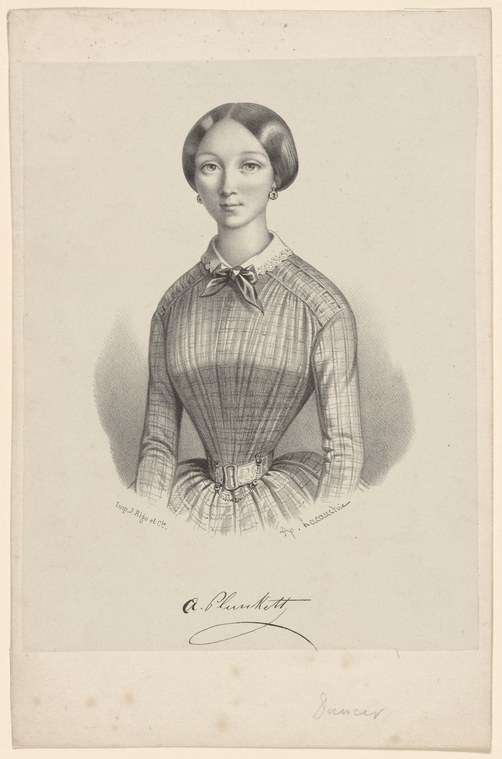
A. Plunkett [facsimile signature]
Unknown artist
- Collection:
- Prints depicting dance
- Source:
- New York Public Library
- Rights:
- Public domain — free to use, share and adapt.
- Recorded as:
- Public Domain
This image demonstrates that not all dance-related imagery documents actual dance—much of it served a commemorative, biographical, or publicity function. For historians tracking the nineteenth-century dance world, portraits like this one are crucial evidence of who the notable performers were, how they were marketed, and what kind of public presence dancers enjoyed. The quality of the engraving and the circulation of such prints suggests that A. Plunkett held sufficient professional standing to merit publication and distribution.
What you are looking at
A single young woman is shown from the waist up against a plain background, presented in a formal portrait style typical of mid-nineteenth-century printmaking. She faces forward with a composed, direct gaze, her head tilted slightly in a graceful pose. She wears a checked or plaid dress with long sleeves fitted at the wrist, and a decorative bow or ribbon at the neck. The dress has vertical pleating or gathering at the bodice and waist, emphasizing a fashionable silhouette of the period. Her dark hair is arranged in a neat, centered parting and drawn back smoothly, framing her face in the restrained style of the 1850s. The figure is rendered in finely-graded tones suggesting the soft modeling of light across her features and dress.
The dancing
The woman stands in a neutral, upright posture with her shoulders relaxed and arms held naturally at her sides or folded—the lower body is not visible. Her frame is still and composed rather than in active movement. The pose emphasizes poise and refinement rather than any specific dance position or hold. There is no indication of weight transfer, partnering, or the dynamic engagement that would characterize an active dancer in motion.
The dance depicted
This image depicts no active dance. It is a formal portrait of a woman identified by the facsimile signature as 'A. Plunkett,' likely a performer or public figure of the nineteenth century given its circulation as a printed portrait. The refined, composed presentation and the deliberate composition suggest a commemorative or publicity image rather than documentation of a dance moment. Without additional context, it is impossible to determine if A. Plunkett was a dancer, a singer, an actress, or another kind of performer.
How it was made
This is a steel engraving or fine-line engraving, a technique that dominated portraiture circulation in the nineteenth century. The careful parallel hatching, fine tonal gradations, and the characteristic crisp detail visible in the features and fabric patterns are hallmarks of steel-plate engraving. This technique allowed for large print runs and relatively affordable reproduction, making such portraits accessible as parlor prints, sheet music covers, theatrical programs, or popular prints. The quality of the line work and the refinement of the rendering suggest a commercially significant subject and a skilled engraver.
About this work
This is a mid-nineteenth-century engraved portrait of a woman identified by signature as A. Plunkett, rendered in the formal, restrained style typical of theatrical and musical personalities of the period. The work is not a representation of dance in progress, but rather a formal commemorative image of what may have been a performer. The portrait preserves the likeness and fashionable presentation of its subject, offering evidence of how theatrical and musical figures were documented and circulated to audiences through reproductive prints. The work belongs in a dance archive primarily as a historical document: evidence of how dance world figures were culturally positioned and presented to the public in the nineteenth century, even when the image itself does not show the act of dancing.
How to look at it
Attend to the portrait's restraint and formality: this is not a dramatic or theatrical representation but a careful statement of respectability and refinement. Notice the contemporary dress, which anchors the image to the 1850s and suggests the work was made during or shortly after the sitter's period of performance activity. The signature 'A. Plunkett' functions as a label, like the name on a theatrical playbill—the print's purpose was to attach identity to image, ensuring the viewer knew exactly whom they were looking at.
The artist
The engraver is not identified in the catalogue record. The technical competence visible in the rendering—the subtle modeling, the control of line weight, the refinement of detail—suggests a professional workshop engraver working for a commercial print publisher, likely in Britain or North America given the style and era. Such portraits were typically produced on commission from theatrical, musical, or performance establishments, or purchased after the fact by fans and performers themselves.
The period
In the 1850s, when this engraving was likely made, the reproductive print was the primary means by which performers circulated their image to the public. Engraved portraits appeared in theatrical programs, on sheet music, as standalone parlor prints, and in periodicals. Dancers, singers, and actors were among the most popular subjects for such images. The female performer was a culturally prominent but morally ambiguous figure in this period: celebrated on stage yet subject to social scrutiny. Formal portraits like this one established a respectable, refined public persona—the sitter is shown not mid-performance but composed, dressed modestly, and presented as a lady of cultivation and refinement.
Where it lives
The work is held in the New York Public Library as part of its collection of prints depicting dance. Such collections typically include portraiture, theatrical imagery, and other visual documentation of performers and performance contexts, not all of which shows dancing in action. This particular work is catalogued as dance-related material, likely because of A. Plunkett's association with the dance or theatrical world, even though the image itself is a formal portrait rather than a representation of performance.
Questions about this work
Is this a portrait of a dancer?
The image is identified as a portrait of A. Plunkett by facsimile signature, but the catalogue record provides no information about her profession or career. Given the quality of the engraving, her inclusion in a dance-related collection, and the conventions of mid-nineteenth-century theatrical portraiture, it is likely she was a performer of some kind—whether dancer, singer, or actress cannot be determined from the image alone.
Why is a still portrait in a gallery about dance?
Dance archives preserve not only images of dancing but also documentary evidence about dancers and the dance world: who they were, how they were presented to the public, and how their work was valued and circulated. This formal portrait is part of that larger record of dance history and culture.
When was this made?
The dress, hairstyle, and engraving technique place this work in the 1850s or early 1860s. The catalogue record does not provide a precise date. The style is consistent with mid-Victorian fashion and reproductive printmaking practice.
More dance artwork





