49 works in this view — arrow keys or swipe to move between them.
Dance in Art
A full-dress party
Unknown artist
- Collection:
- Prints depicting dance
- Source:
- New York Public Library
- Rights:
- Public domain — free to use, share and adapt.
- Recorded as:
- Public Domain
This work documents not dance itself but the cultural expectations and anxieties surrounding formal Victorian ballroom practice—the constant threat of social failure, loss of control, and public embarrassment. It shows how dance, in this period, functioned as a marker of class discipline and self-governance, and how fragile that appearance was. The image is valuable evidence of both the ubiquity of formal social dance in Victorian leisure and the ambivalence with which it was satirized in popular visual culture.
What you are looking at
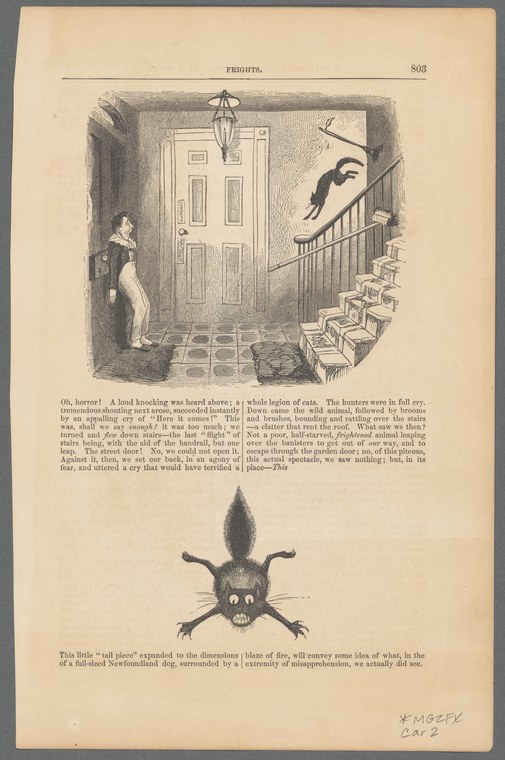
A Victorian parlor scene depicting the moment after a catastrophic fall during a formal dance. A gentleman in evening dress stands at the left, startled, having just witnessed his dance partner plummet down an interior staircase. The woman descends headlong through the composition, her body splayed and inverted against the geometric severity of the stairwell, her pale dress and limbs creating a violent diagonal across the frame. The setting is rendered with meticulous perspective: a tall doorway with panelled frame, a hanging lamp, and the strict linear geometry of the banister and steps all recede into depth. The print's title, "A full-dress party," appears above in typography that matches the text below—this is an illustration to an accompanying narrative, likely from a periodical or book of humorous social commentary. The tone is darkly comic: the gentleman's expression registers alarm rather than tragedy, and the composition emphasizes the absurdity and indignity of the fall rather than any genuine injury. Light and shadow are handled with precise cross-hatching to create volume and spatial depth.
The dancing
Two figures dominate the composition: the stationary gentleman at left, upright and alert in his formal tailcoat, and the falling woman at right, her body inverted and in complete loss of control. Her arms are flung outward, legs splayed, her posture the inverse of any intentional movement—this is the antithesis of the controlled carriage required of formal dance. The gentleman's raised arm and turned head show shock and surprise rather than the composed extension and frame of a dance partner. No hold, frame, or partnered relationship survives the moment the artist has chosen: the fall has obliterated every convention of ballroom decorum.
The dance depicted
This is not a depiction of dance as performed, but of dance catastrophically interrupted. The narrative context suggests a formal Victorian ball—"full-dress party" in the title and the evening wear confirm the social register. The fall itself is the opposite of dance: it represents the complete failure of the controlled, upright posture and precise footwork that formal ballroom dancing demanded. The image belongs to a tradition of Victorian comic illustration that used the ballroom as a setting for humiliation and social embarrassment. Dance is present only by its absence—we understand what should have been happening by the violence of what has instead occurred.
How it was made
This is an engraving or wood engraving, recognizable from the fine parallel hatching lines that build tone and volume, the crisp black lines, and the high-contrast rendering. The technique is characteristic of Victorian book and periodical illustration from the mid-to-late 19th century, when such prints were mass-produced for weekly or monthly publications. The precision of the architectural perspective and the detailed rendering of fabric textures—the gentleman's coat, the woman's skirt—show the considerable skill required; the technique allowed for sharp social satire delivered to a broad readership. The scale and composition suggest this was printed at page size, accompanying text that provided narrative context.
About this work
This is a comic illustration of a social disaster at a Victorian formal ball—the moment a dancing woman falls down an interior staircase while her partner watches in shock. The artist uses the ballroom setting and formal dress to establish social expectations, then violates them completely through the violent inversion of the falling body. The composition treats the accident with dark humor rather than pathos, emphasizing the absurdity and indignity rather than injury or tragedy. The engraving technique allowed for precise architectural perspective and fine detail, making the catastrophe vivid and legible to readers of the periodical in which it appeared. Though dance is present only in its interruption, the image depends entirely on the viewer's knowledge of ballroom convention—we understand the fall only by contrast with the composed, upright, partnered movement that formal dance requires.
How to look at it
Attend first to the geometric precision of the architectural setting—the staircase, the door frame, the lamp—which establishes order and control. Then notice how the falling woman's body violates every line of that geometry, inverting and sprawling against the strict perspective. The gentleman's stillness and upright posture, by contrast, emphasize how completely the woman has lost bodily control. The moment the artist chose is the instant of shock and recognition—before anyone has moved to help, before the chaos of response begins. This is the nadir, the worst moment, held in suspension. The cross-hatching and tonal work, especially in the shadows of the stairwell, create a sense of depth and danger: the woman is falling into a void.
The artist
Unknown. This is a professional engraving from a periodical or book of comic illustration, likely from the mid-Victorian period (1850s–1880s). The unsigned work belongs to a tradition of sharp social satire that was widespread in illustrated newspapers and story papers of the era—publications like Punch, The Illustrated London News, and numerous penny periodicals employed skilled engravers to depict contemporary manners and misadventures. The precision of technique and the sophistication of the composition suggest a practiced professional hand working within commercial publishing, though the specific artist and publication context are not presently recorded.
The period
The Victorian period saw an explosion of formal social dancing among the urban middle and upper classes, particularly at balls and private parties where young people were introduced to society. The waltz, quadrille, and other standard ballroom dances were central to courtship rituals and social performance. Simultaneously, illustrated periodicals and comic literature made sport of social embarrassment and the precariousness of maintaining middle-class respectability. The period saw a tension between the idealization of graceful, controlled movement and a keen awareness of how easily decorum could collapse—how a misstep, a torn dress, or a literal fall could expose the fragility of social order. This image sits at the intersection of those anxieties: it takes the most formal and rule-bound of social dances and uses it as the setting for catastrophic failure.
Where it lives
This print comes from the New York Public Library's collection of prints depicting dance. It is catalogued as an illustration, likely from a periodical or book of comic social narrative published in the mid-to-late 19th century, though specific publication details and date of creation are not presently recorded.
Dance in this work
Questions about this work
Is this actually about dance?
Technically, no—it shows dance interrupted by accident. But it is entirely about ballroom dance culture and the social expectations that surrounded it. The joke depends on the viewer knowing what formal dance should look like: composed, controlled, partnered, upright. The fall's violence comes from that contrast. It belongs in a dance gallery because it tells us something essential about how Victorians understood formal ballroom dancing: as a fragile performance of discipline that could collapse at any moment.
What dance would they have been doing?
Given the formal evening dress and the setting of a private ball (a "full-dress party"), they were almost certainly dancing a waltz, quadrille, or perhaps a polka—the standard ballroom dances of the Victorian period. The gentleman's upright posture and the woman's full skirt are consistent with these dances. But the artist does not depict the dance itself, only its violent interruption.
Who is the artist?
Not recorded in the catalogue. The engraving shows professional skill and the stylistic hallmarks of Victorian commercial illustration, suggesting a trained engraver working for a periodical or publisher, but no signature or attribution is presently known.
When was this made?
The catalogue record gives the date as unknown, but the style of the engraving, the fashion of the dress, and the conventions of Victorian comic illustration all point to the mid-to-late 19th century, probably 1860s–1880s. The technique, the typography, and the aesthetic suggest this period with reasonable confidence, but a precise date cannot be established from the image alone.
More dance artwork





