49 works in this view — arrow keys or swipe to move between them.
Dance in Art
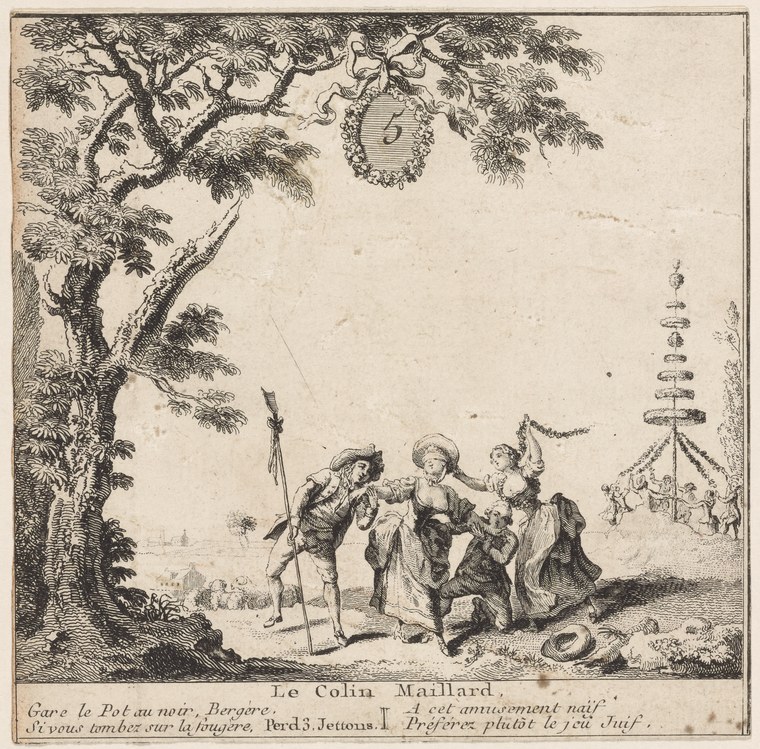
Le Colin Maillard
Unknown artist
- Collection:
- Prints depicting dance
- Source:
- New York Public Library
- Rights:
- Public domain — free to use, share and adapt.
- Recorded as:
- Public Domain
Blind Man's Buff was a significant form of physical social interaction in 18th-century elite culture, combining game logic with the flirtation, hierarchy negotiation, and physical contact that made it socially charged. This engraving is valuable evidence of how bodies moved in informal, non-choreographed settings—the actual texture of aristocratic leisure and the gender dynamics embedded in supposedly playful physical interaction. Understanding dance history requires looking beyond formal dance forms to the improvised games and social practices in which movement, touch, and embodied encounter were central.
What you are looking at
A lively outdoor scene of a parlor game in progress, rendered in fine engraving. A large gnarled tree dominates the left foreground, its trunk and spreading branches creating a natural frame. In the middle distance, four figures in 18th-century dress are grouped together—three women in flowing gowns and a man in coat and breeches, their bodies angled toward one another in active engagement. The man appears blindfolded or has his eyes covered, the central action of the game. Behind them, a decorated pole or maypole rises on the right side, with what appears to be a garland or wreath suspended from it, and a small crowd of onlookers gathers in the background. The setting is pastoral and informal, suggesting a garden or country fête. The composition uses the tree and the pole as compositional anchors, drawing the eye through the scene's narrative movement.
The dancing
The four principal figures are in close proximity, their bodies alive with gestural play. The blindfolded man stands with arms extended or gesturing, creating a sense of uncertainty and playful disorientation—the physical grammar of someone testing the space around him by touch or sound. The three women lean in, their bodies angled toward him with arms raised or in motion, suggesting laughter and teasing. Their skirts are full and active, caught in implied movement. The postures are informal and spirited, without the rigid geometry of formal dance.
The dance depicted
This depicts *Colin-Maillard* (Blind Man's Buff), a parlor game widespread in 18th-century European society that involved dancing, chasing, and physical interaction. The French title and the engraving's style confirm this as a documentation of a fashionable entertainment rather than a codified dance form. The game combined elements of chase, blindfolded touch-seeking, and social flirtation, often performed at country gatherings and aristocratic amusements. The image captures the moment of play itself—not a choreographed sequence but the improvisational, embodied interaction that made such games socially significant.
How it was made
This is a copper-plate engraving, identifiable by the fine parallel line-work (hatching and cross-hatching) used to build tone and texture across the composition. Engraving allowed for precise detail and wide circulation as a printed image; the work could be reproduced and distributed as a print for domestic collections or sale. The technique's linear language is particularly suited to capturing the play of fabric, the articulation of gesture, and the narrative detail of the scene. The fine quality of the engraving and the literary inscription suggest this was a commercially published print, likely part of a series on social entertainments or folk practices.
About this work
A copper-plate engraving documenting the parlor game of Blind Man's Buff (*Colin-Maillard*) as performed in 18th-century aristocratic or gentry society. The work captures a moment of social play involving four figures in formal dress within a pastoral garden setting, with careful attention to gesture, dress, and the implied movement and laughter of the game. The engraving's fine technique and the inclusion of French text and decorative framing suggest this was a commercially produced print, likely one of several depicting fashionable entertainments and social customs of the period. It belongs in a dance history not because it depicts a formal dance, but because it documents the embodied, participatory games and social movement practices that formed part of the lived experience of dance culture in the 18th century.
How to look at it
Attend to the moment the artist chose: not the beginning of the game but the active play, with the man blindfolded and the women in motion around him. Notice how the engraver captures the asymmetry of the game—the man's vulnerability and disorientation contrasted with the women's agile, teasing mobility. The positioning of the figures, their arm gestures, and the implied direction of their movement all work to convey the playful tension and physical engagement at the heart of the game. The formal dress and pastoral setting establish this as genteel entertainment, not folk practice, telling us something about who played such games and what social meanings they carried.
The period
Blind Man's Buff was a popular entertainment across 18th-century Europe, appearing frequently in literature, art, and social commentary. The game involved a blindfolded player attempting to catch and identify others through touch, combining physical exertion, sensory deprivation, and flirtation. It was regularly featured in aristocratic gatherings, country entertainments, and mixed-gender social events where the physical contact and playful rule-breaking offered a sanctioned space for embodied interaction. The game appears in period conduct literature, memoirs, and visual art as a marker of leisure, sociability, and the management of desire within polite society. This engraving dates to an era when such entertainments were being documented and circulated as prints—a sign of both their cultural prestige and the emerging market for prints depicting social customs and 'manners' as subjects of visual interest.
Where it lives
The work is held in the Prints collection at the New York Public Library, one of the major institutional repositories of 18th-century European engraved prints. The title, inscription, and format indicate this was a commercial print, likely part of a suite of engravings documenting social entertainments and customs of the period.
Dance in this work
Questions about this work
Was Blind Man's Buff actually a dance?
Not in the formal sense. It was a parlor game that combined rules, chase, and physical contact, performed to music and involving improvised movement. Dance historians recognize such games as part of the wider ecology of movement practices and social embodiment in a period. The distinction between 'game' and 'dance' in the 18th century was not always sharp.
Why would this game appear in a gallery of dance?
Because understanding how bodies moved in the past requires looking beyond codified dances to the improvised, participatory practices that structured leisure, sociability, and gender relations. Games like this tell us how elite bodies actually moved, what kinds of contact were permitted, and what meanings were attached to physical proximity.
What is the game about?
One player is blindfolded and must catch and identify others through touch, while the other players move around elusively, often teasing or misdirecting. It was popular across European society from at least the 17th century onward and appears frequently in period visual art and literature as a symbol of leisure, flirtation, and social play.
More dance artwork





