49 works in this view — arrow keys or swipe to move between them.
Dance in Art
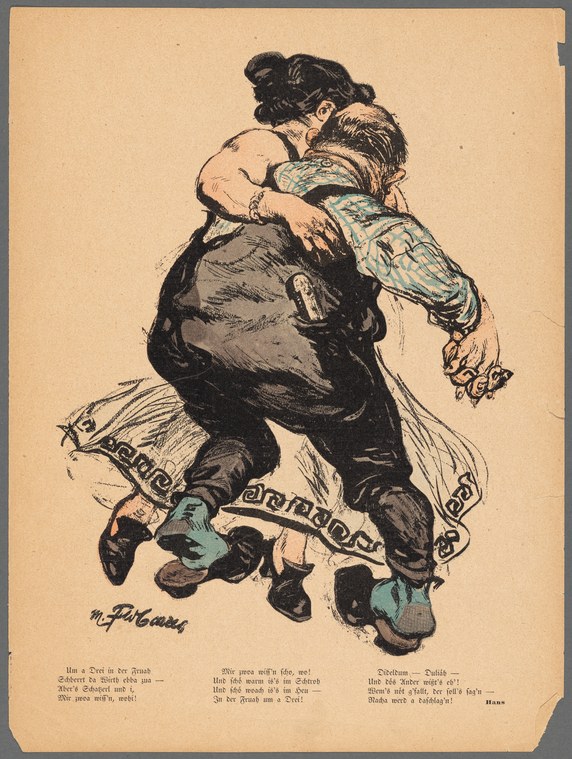
Dancing couple, with poem beginning "Um a Drei"; Jugend
Unknown artist
- Collection:
- Prints depicting dance
- Source:
- New York Public Library
- Rights:
- Public domain — free to use, share and adapt.
- Recorded as:
- Public Domain
The work captures a moment of genuine physical partnership and feminine agency in popular dance—the woman is not ornamental but central, active (even in her passivity), and fully engaged in the movement. For dance historians, it is evidence of the vigorous, lifting, swinging style of Central European folk dances that later influenced modern and theatrical dance forms. The illustration also documents the publishing and celebration of dance culture in early-twentieth-century Germany, a period when popular dance and art were in productive conversation.
What you are looking at
A man and woman dance together in a spirited, energetic pose against a cream-colored background. The man, dressed in dark clothing with visible suspenders, supports the woman as she leans back dramatically in his arms, her body nearly horizontal. She wears a light-colored blouse with puffed sleeves and a patterned skirt. Both figures are captured mid-movement, their feet barely touching the ground, suggesting a vigorous lifting or swinging motion. The composition emphasizes the physical dynamism and intimacy of the pair—the man's grip is firm, the woman's posture abandoned and trusting. Below the figures runs a decorative border with geometric patterns, and beneath that are lines of printed text in what appears to be German, beginning with "Um a Drei" ("Around Three"). The work is executed in black ink with selective hand-coloring in greens and blues, creating a lively, folk-art quality typical of early-twentieth-century German illustrative practice.
The dancing
The man stands upright, one arm supporting the woman's back, the other grasping her arm or hand, maintaining a secure frame. The woman is lifted and arched backward at a steep angle, her weight entirely dependent on her partner, her legs splayed or lifted. This is not a closed ballroom hold but rather a theatrical or folk embrace—the kind seen in vigorous partner dances where lift and swing are central. The artist has captured a moment of maximum extension and trust between the pair, with the woman's body forming almost a curve against the man's vertical support.
The dance depicted
This appears to depict a German folk or popular dance of the late nineteenth or early twentieth century, most likely a variant of the Ländler, waltz, or similar Central European couple dance. The dramatic lift and swing suggest the energetic, exuberant partnering characteristic of rural or tavern dancing of that era. The accompanying text "Um a Drei" ("Around Three" or "At the Tavern") supports a folk or popular-dance context rather than formal ballroom. The style of the embrace—full-bodied, unselfconscious, with the woman nearly horizontal—is typical of dances that emphasized physical partnership and abandon over strict frame. Without more definitive costume or setting markers, the precise style cannot be named with certainty, but the evidence points toward a historic Central European folk or social dance tradition.
How it was made
This is a hand-colored lithograph or possibly a color-printed illustration with selective hand-coloring, executed in black line work with applied green and blue pigments. The technique allows for bold, expressive linework that emphasizes movement and gesture over anatomical precision, and the color application suggests a print intended for popular circulation—possibly from a journal, broadsheet, or calendar. The combination of printed text and image, along with the decorative border, indicates this is a page from a periodical or illustrated publication, likely German given the language and artistic style. The sketchy, energetic line quality and the warm cream paper stock are consistent with early-twentieth-century German art-magazine illustration, a period and medium that valued directness and expressive vitality.
About this work
This is an illustration of a couple engaged in a vigorous, physical dance—a moment of abandon and partnership captured with expressive line work and selective hand-coloring. The work is rooted in Central European folk and popular-dance tradition, likely German, and appears to have been published as part of an illustrated periodical or broadsheet, given the accompanying text and decorative framing. It documents both the movement itself and the spirit in which such dances were performed: joyful, unrestrained, and centered on the physical trust and coordination between partners. The figure of the woman—nearly horizontal, entirely supported, her body a curve of trust—is the emotional and compositional heart of the piece. This is not documentation of formal technique but rather celebration of folk exuberance and the intimacy of social dance.
How to look at it
Attend first to the woman's body: the artist has chosen to depict her at the moment of maximum trust and extension, nearly horizontal and entirely supported. This is the emotional climax of the dance as depicted—not the moment of technical display but of surrender and partnership. Observe the line work: it is sketchy but purposeful, with heavier marks defining the silhouettes and lighter, faster marks suggesting movement and fabric. The artist understood physical exertion and weight—the man's planted feet and braced body, the woman's arched spine and splayed limbs. Look at the face of the woman: tilted back, almost ecstatic, capturing not technique but feeling. This is folk-dance illustration in the service of joy.
The artist
The work is signed by a hand that resembles "m.G.Lonus" or similar (the signature is not entirely clear in reproduction), but the artist is not recorded in the catalogue. The style is consistent with early-twentieth-century German illustrative practice—commercial, energetic, and rooted in folk or expressionist sensibilities. The hand-coloring and printing technique suggest this was produced as part of a popular illustrated publication, possibly *Jugend* magazine (a Munich-based journal of art, literature, and culture, 1896–1940) given the catalogue note. Without definitive attribution, the artist remains one of many skilled commercial illustrators of the period whose work appeared in such publications.
The period
This work dates to a period (early twentieth century, most likely 1910s–1920s) when German art and culture were intensely engaged with folk tradition, modernism, and popular expression. *Jugend* and similar publications celebrated the vitality of vernacular culture and contemporary life in a style that blended academic training with expressionist energy. In dance, this was the era of the Ländler and waltz-derived folk dances in Central Europe, but also the period when such traditions were being absorbed into modern theatrical dance by figures like Mary Wigman and the German modern-dance movement. The illustration sits at the intersection of these worlds—documenting folk practice while celebrating it through the visual language of modern commercial art.
Where it lives
The work is held by the New York Public Library as part of a collection of prints depicting dance, suggesting it was recognized as dance documentation or celebration. The presence of printed text and decorative border indicates it was originally part of a published work—likely a magazine or broadsheet—and has since been catalogued and preserved as a single sheet. The *Jugend* attribution in the catalogue note (if confirmed) would place it within a specific, well-documented publication context.
Dance in this work
Questions about this work
What dance is this?
The exact style is difficult to name from the image alone, but it is clearly a Central European folk or popular couple dance, most likely a Ländler, waltz variant, or similar tradition. The vigorous lifting and swinging are characteristic of Austrian, Bavarian, or German folk dances of the nineteenth and early twentieth centuries. The accompanying text "Um a Drei" reinforces a folk or tavern context.
Why is the woman nearly lying down?
Many folk dances from Central Europe featured dramatic lifts, swings, and extensions that required physical strength and complete trust between partners. The woman's horizontal position reflects both the technical demands of the dance and the emotional expression of abandon and joy that characterized such celebrations. It is a moment of climax, not of rest.
Where was this published?
The catalogue attributes this to *Jugend*, a Munich-based illustrated magazine that ran from 1896 to 1940. Such magazines published artwork celebrating contemporary life, culture, and vernacular traditions. The printed text, decorative border, and hand-coloring are consistent with magazine illustration of the period.
Who is the artist?
The signature appears to be present but is not definitively legible in the catalogue record. The work remains unattributed to a named artist, though the style is consistent with commercial illustrators working for German art magazines in the early twentieth century.
More dance artwork





