49 works in this view — arrow keys or swipe to move between them.
Dance in Art
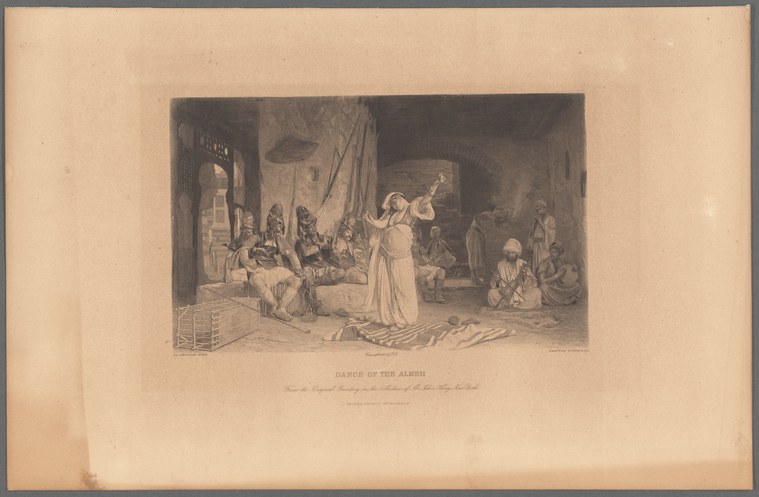
Dance of the almeh, from the original painting in the collection of Mr. John Hoey, New York
Unknown artist
- Collection:
- Prints depicting dance
- Source:
- New York Public Library
- Rights:
- Public domain — free to use, share and adapt.
- Recorded as:
- Public Domain
Historians of Orientalism and colonial visual culture rely on images like this to understand how European printmaking constructed and circulated fantasies of non-Western women's bodies and labour. For dancers and scholars of belly dance and Middle Eastern dance forms, the image is a cautionary record: it shows how Western artists systematized misrepresentation, freezing dynamic traditional practice into static exotic poses for the male European gaze.
What you are looking at
This engraving depicts an Orientalist fantasy of an Egyptian dance performance, set in an interior that reads as exotic through its architectural vocabulary: a deep space with draped fabric, columns, and figures seated informally on cushions and the floor. The central figure is a standing woman in a long, flowing white dress with her arms raised in a gesture of accompaniment or blessing, positioned as a focal point among roughly a dozen seated spectators arrayed around the room. The composition uses atmospheric perspective and heavy chiaroscuro to push the background into shadow, emphasizing the stage-like foreground. The attendants are dressed in a mix of period-appropriate European and loosely 'Oriental' garments; one man in the middle distance plays what appears to be a wind instrument. The mood is voyeuristic and documentary in its pretense, characteristic of 19th-century Orientalist printmaking.
The dancing
The central dancer stands with both arms raised to shoulder height or above, palms open and relaxed, in a posture suggesting sustained accompaniment to rhythm rather than dynamic movement. Her body is upright and frontal, with no visible turn of the hip or weight shift suggested by the engraving's line work. The other figures are predominantly seated, arranged as an audience; their postures are slouched and informal, suggesting leisure and passive observation. No hold, frame, or partner interaction is visible; the dancer performs alone for a stationary group.
The dance depicted
The title identifies this as a 'dance of the almeh,' referring to the *alma* or *alimah* — Egyptian female entertainers, singers, and dancers who performed in coffee houses and private gatherings in the 18th and 19th centuries. The image captures the Orientalist European fantasy of this practice rather than its reality: the raised arms and upright posture are consistent with some Middle Eastern dance forms, but the pose is static and staged for the Western eye rather than dynamic. The almeh tradition combined music, song, and rhythmic movement; the presence of a musician suggests this context, but the image prioritizes the exotic female figure and the male gaze of the assembled audience over any actual choreographic narrative.
How it was made
This is an engraving, likely a steel or copper plate engraving given its fine line work and the small size and reproducibility typical of 19th-century print circulation. The technique allows for subtle modeling through parallel hatching and cross-hatching, visible in the rendering of fabric, shadow, and the woman's face. Engravings of this type were mass-produced for bound albums, periodicals, and popular art collections, making them a primary vehicle for disseminating Orientalist imagery to middle-class European audiences. The inscription 'Dance of the Almeh' below the image, in a style consistent with mid-19th-century captioning, suggests publication as a stand-alone print or plate in a larger series.
About this work
This engraving is a 19th-century European representation of Egyptian almeh performers, a professional entertainment tradition that the Western audience encountered through travel, colonial presence, and the Orientalist imagination. The work belongs to a vast archive of Orientalist prints that shaped European fantasy about non-Western dance and female performance, often conflating documentation with desire. As a dance image, it is valuable not for what it shows about almeh practice itself, but for what it reveals about how European artists and audiences understood, misrepresented, and staged the 'Oriental' body in the 19th century.
How to look at it
Notice the deliberate stillness of the central figure: she is not caught mid-movement, but posed and sustained for display, as if for a studio portrait translated into a social scene. Observe the placement of the audience—they frame her body and direct the viewer's attention inward—and the play of light, which isolates her in luminescence while the musicians and attendants recede. The engraver has chosen to emphasize the exotic costumery and the formal ceremony of observation, not the kinetic energy or skill that would be central to an actual almeh performance. This is a record of a fantasy, not a documentation of dance.
The artist
The artist is not recorded. The work is attributed only to 'the original painting in the collection of Mr. John Hoey, New York,' suggesting the engraving was made from a painting by an unidentified hand, likely a mid-19th-century painter working in or familiar with Orientalist conventions. This anonymity is typical of reproductive engravings of the period, where the engraver's skill and the collector's name carried more prestige than the original painter's identity.
The period
This engraving dates to an era of intense European fascination with the Eastern Mediterranean, Egypt in particular, following the Napoleonic campaigns, the opening of the Suez Canal (1869), and the expansion of travel writing and photography. Orientalist painting flourished in this period, and almeh performers were among the most sexualized and documented subjects in the genre. In the same decades, belly dance was being codified, commodified, and performed on European stages and in ethnographic displays; the almeh image sits at the intersection of this colonial knowledge-making and artistic fantasy.
Where it lives
The work comes from the NYPL Prints collection and is identified as derived from 'the original painting in the collection of Mr. John Hoey, New York.' It is a reproductive engraving, not a unique work. Hoey's collection suggests a mid-19th-century American collector of Orientalist material.
Dance in this work
Questions about this work
What was an almeh?
An almeh (or alimah) was a professional female entertainer in Egypt and the broader Middle East, trained in music, singing, and rhythmic movement, who performed in coffee houses, at celebrations, and in private gatherings. The almeh tradition is centuries old; almeh dancers are documented in medieval Arabic texts and continued to perform into the 20th century. The tradition is distinct from belly dance as understood in the West, though Western artists often conflated the two.
Is this image accurate?
No. It is a Western fantasy. The pose is static and theatrical, designed to present the female body as exotic spectacle for a European male gaze. The composition—a woman performing for a seated, informal audience—captures some aspects of the almeh context, but the engraver has simplified, exoticized, and eroticized the practice according to 19th-century Orientalist convention. Actual almeh performances were dynamic, improvisational, and musically complex.
Why is this in a gallery about dance?
Because it is a primary source for how Western artists represented non-Western dance traditions, and because that representation shaped how European and American audiences understood, valued, and later practiced belly dance and Middle Eastern dance forms. The image is a document of misrepresentation, not of dance itself.
More dance artwork





