49 works in this view — arrow keys or swipe to move between them.
Dance in Art
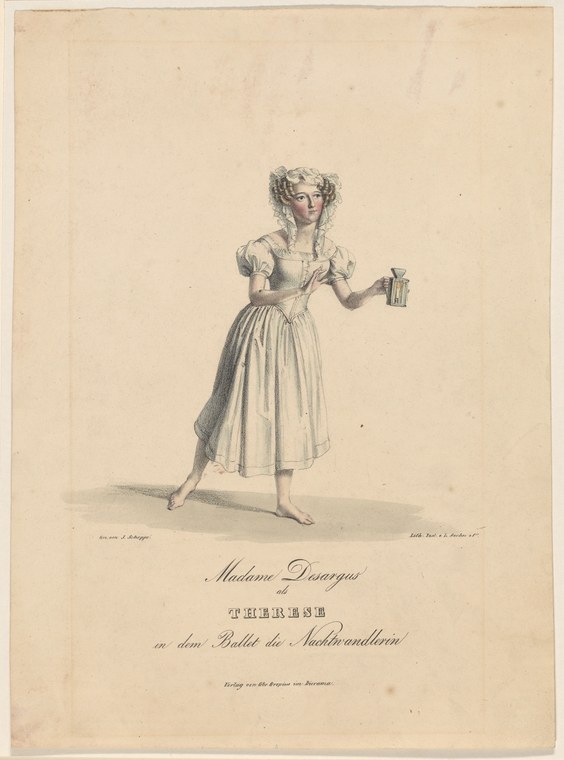
Madame Desargus als Therese in dem Ballet die Nachtwändlerin
Unknown artist
- Collection:
- Prints depicting dance
- Source:
- New York Public Library
- Rights:
- Public domain — free to use, share and adapt.
- Recorded as:
- Public Domain
This print is one of the primary ways a lost performance survives. We have no video, no notation beyond what we can infer from the image, no detailed review. What we have is this—a professional dancer in character, frozen in a pose the choreographer and dancer felt important enough to market. For scholars of Romantic ballet and its repertoire, such prints are primary documents of what the stage actually looked like. For dancers and movement artists, it is a reminder that the sleepwalker's uncanny grace was not a trick of costume or staging but a studied, repeatable, teachable technique.
What you are looking at
A young woman stands alone against a plain pale background in a three-quarter pose, facing left with her body angled toward the viewer. She wears a romantic-era white or cream cotton dress with short puffed sleeves, a fitted bodice, and a full skirt that falls to mid-calf, characteristic of 1830s fashion. Her hair is arranged in ringlets and crowned with an ornamental headdress or wreath. She holds a small object—possibly a candle or lamp—in her right hand, extended at waist level; her left arm hangs naturally at her side. The pose suggests a moment of distraction or reverie, appropriate to the title's reference to sleepwalking. The print itself shows fine linear hatching and tonal gradation typical of hand-colored lithography or engraving, with subtle modeling of the fabric and careful attention to the silhouette.
The dancing
The dancer's weight appears centered and upright, with a slight forward inclination of the upper body that suggests somnambulistic drift rather than deliberate movement. The extended right arm and the object it holds create an asymmetrical composition; the gesture is dreamlike and purposeful yet passive—the posture of someone moving without conscious intent. Her feet are positioned close together, not in a ballet position, and there is no visible turnout. The entire stance conveys the peculiar grace of an unconscious body in motion.
The dance depicted
This is a theatrical ballet role from the Romantic era, specifically a character named Thérèse from a ballet titled *Die Nachtwändlerin* (The Sleepwalker). The print documents a professional dancer—Madame Desargus—in a specific role, likely from a Vienna or German-language theater production of the 1830s or early 1840s. The sleepwalking subject matter was a popular theme in Romantic ballet, where supernatural or altered states of consciousness allowed choreographers to explore weightlessness, automatism, and emotional vulnerability. The costume and pose suggest a narrative moment rather than a classical variation: the candle or lamp she holds suggests she is moving through a darkened space in sleep, following some compulsion or memory.
How it was made
This is a hand-colored lithograph or engraving, executed with considerable refinement. The tonal work suggests lithography, which allowed for softer gradations and atmospheric effects than wood engraving alone. The artist has used fine cross-hatching and stipple to model the fabric, particularly the folds and weight of the skirt, and has left the background nearly blank, focusing all attention on the figure. Such prints were inexpensive to produce in quantity and were commonly distributed to document celebrated dancers and roles of the period; this was the primary means by which performances circulated beyond the theater, functioning as both promotion and archival record.
About this work
This is a European theatrical print documenting a professional ballet dancer in a named dramatic role during the height of the Romantic ballet era. The work preserves not a moment of pure dance technique but a character study—a woman in an altered state, neither fully present nor fully absent. The print belongs to a widespread tradition of theater documentation through portraiture, in which lithographed or engraved images of celebrated dancers in costume and character were sold to audiences and collectors. It is also evidence of the Romantic ballet's fascination with the supernatural, the sleeplike, and the psychologically interior—a shift away from the purely virtuosic display of earlier periods toward narrative and emotional atmosphere. The image is historically significant because it captures the visual and performative vocabulary of a specific production and role, and because it shows how dancer-actors of this era were marketed and remembered.
How to look at it
Notice the quality of stillness in the pose—it is not a position of rest but of suspended motion, as if the body might move at any moment without the dancer's consent. The extended arm and object she holds are crucial: they suggest that she is moving toward something, compelled by dream logic. Observe how the artist has rendered the skirt: it falls heavily and realistically, not caught mid-swirl as in a classical ballet pose, which reinforces the idea of slow, somnambulistic movement rather than virtuosic spinning. The dreamy, inward quality of the face and the blank background situate this figure in an interior, psychological space rather than a theatrical stage—yet it is a theatrical image, designed to convey a staged performance.
The period
This print dates to the height of the Romantic ballet era in Europe, approximately 1830–1850, when the ballet d'action—a ballet organized around a coherent narrative rather than pure spectacle—had become the dominant mode. Ballets about sylphs, ghosts, madwomen, and sleepwalkers proliferated during this period; they allowed dancers (particularly female dancers) to move with abandon, asymmetrically, and without the rigid formality of classical court dance. The subject of somnambulism also had cultural currency: it fascinated physicians and philosophers as a phenomenon that seemed to prove the existence of an unconscious mind, a repository of hidden desires and memories. In the visual arts, lithography had recently matured as a medium and was being exploited for theatrical publicity. German and Austrian theaters were centers of Romantic ballet production, and Vienna in particular was known for ambitious, elaborate productions with strong dramatic components.
Where it lives
This print is held in the New York Public Library's collection of prints depicting dance. It is a published theatrical print, likely produced in Vienna or another German-speaking cultural center in the 1830s or 1840s, and distributed commercially to audiences and collectors as a record of a celebrated performance.
Dance in this work
Questions about this work
What is a sleepwalker ballet?
Sleepwalking and other altered mental states were popular subjects in Romantic-era theatrical ballet (1820–1850). They allowed choreographers to violate classical ballet's rules of symmetry, turnout, and control, and to explore weightlessness and unconscious grace. *La Somnambule* (Somnambulist) and similar works used the sleepwalking premise to justify emotional vulnerability and narrative complexity in female roles.
How do we know about ballet performances before film?
Primarily through lithographed and engraved portraits like this one, which were published commercially and sold to theatergoers. These prints, combined with playbills, reviews, choreographic notation (for some works), and surviving musical scores, are our main sources. They are imperfect—a single pose cannot capture movement—but they are direct records of how the stage looked and how dancers were costumed and marketed.
Why was Romantic ballet so interested in the supernatural and the unconscious?
Romantic-era artists and intellectuals across all media were fascinated by psychology, dreams, the irrational, and the liminal states between consciousness and unconsciousness. Ballet's ability to create otherworldly effects through movement, costume, and lighting made it an ideal vehicle for exploring these themes. The supernatural also offered a pretext for female dancers to move with expressive freedom rather than merely technical perfection.
Who was Madame Desargus?
We do not know much about her from this print alone. She was a professional dancer performing in a German-speaking theater (likely Vienna) during the 1830s–1840s, skilled and celebrated enough to have her role documented and printed. Such prints were markers of status; not every dancer received one.
More dance artwork





