49 works in this view — arrow keys or swipe to move between them.
Dance in Art
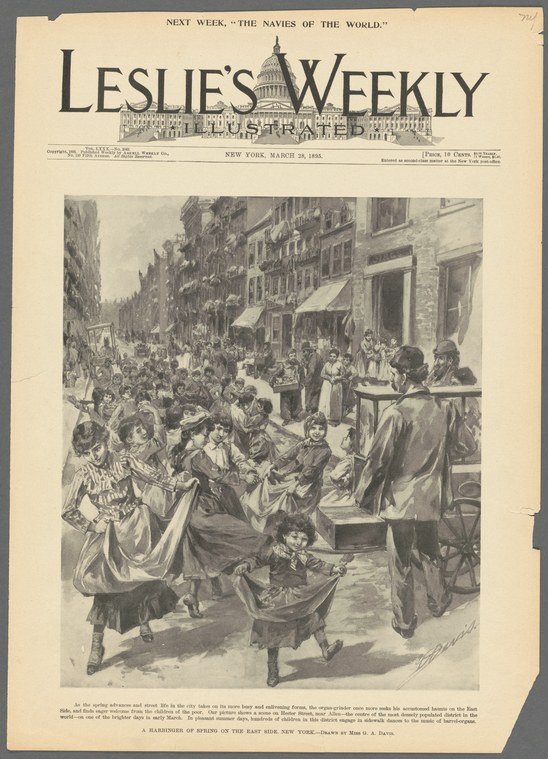
A harbinger of spring on the East Side of New York [front page illustration]
Unknown artist
- Collection:
- Prints depicting dance
- Source:
- New York Public Library
- Rights:
- Public domain — free to use, share and adapt.
- Recorded as:
- Public Domain
This is a rare journalistic record of vernacular street dancing in an immigrant community, created for mass publication and capturing the role of dance as a visible, celebrated feature of urban public life. It shows dance not as a staged spectacle or domestic entertainment but as spontaneous street expression tied to seasonal change and collective social mood.
What you are looking at
A crowded urban street scene on New York's East Side, rendered in the sketch style typical of early-twentieth-century newspaper illustration. The narrow street is densely packed with figures—men, women, and children in winter coats and hats—creating a composition of energetic, overlapping bodies. The buildings lining both sides are tall and closely spaced, with storefronts and windows visible. The foreground is dominated by female figures in long coats with large hats, their postures animated and fluid. The artist has captured a moment of street life with particular attention to the movement and gesture of the crowd, especially the women, whose bodies suggest active, rhythmic motion rather than static congregation.
The dancing
The composition is built from multiple overlapping female figures in the foreground, each rendered with attention to their upper-body posture and arm positions. The women's bodies show a characteristic forward lean and swaying motion—hips and torsos angled, arms extended or held at varied heights. The movement reads as coordinated but informal, without the rigid postures of ballroom or theatrical dance. The density of the crowd and the variety of arm positions suggest spontaneous, social movement rather than trained choreography. Several figures appear to be turning or pivoting slightly, their weight clearly distributed across the street rather than held in rigid frame.
The dance depicted
This is not a formal dance but rather a visual record of street dancing or social dancing as it occurred in immigrant communities on the Lower East Side. The caption describes 'a harbinger of spring'—suggesting the energetic social response to warming weather, when street life intensified. The movement depicted is most consistent with early-twentieth-century social dance and street culture, possibly including elements of vernacular movement forms that blended European immigrant traditions with American street life. The loose, expressive arm work and the obvious pleasure in bodily movement suggest forms like folk dancing or informal social dancing adapted to public space, rather than theatrical or ballroom styles.
How it was made
This is a pen-and-ink or engraved illustration, almost certainly created for reproduction in Leslie's Weekly, a major American newspaper and magazine. The technique is that of rapid reportorial illustration—economical line work, cross-hatching for shadow and depth, and compositional complexity achieved through layering and density rather than fine detail. The medium allowed for quick production and mass circulation to the magazine's readership, making it documentation of social life for a broad public audience rather than a specialized art object.
About this work
This front-page illustration from Leslie's Weekly captures a moment of street life and social dancing in New York's immigrant communities in early spring, likely from the first or second decade of the twentieth century. It is a newspaper illustration documenting urban vernacular dance—the spontaneous, joyful movement of working people in public space. The work belongs in a dance gallery not as representation of a formal dance style but as evidence of how dance functioned as ordinary social practice, expression, and community formation in the period.
How to look at it
Attend to the overlapping and layered bodies in the foreground, particularly the women's postures and arm positions—notice how the artist has used variation in gesture to suggest movement and rhythm across a still image. Look at the relationship between the figures and the street itself: there is no stage, no formal floor, no separation between dancers and non-dancers. The denseness and informality of the gathering, and the artist's apparent interest in capturing motion and pleasure in the body, are the clues that this is dance, not merely congregation.
The artist
Unknown. The work is an editorial illustration in the style typical of Leslie's Weekly staff illustrators in the early twentieth century. The magazine employed numerous artists to create weekly scenes of current events, social life, and human interest stories, all rendered in the rapid, assured pen-and-ink style visible here.
The period
This drawing dates from a period of intense immigration to the United States, particularly from Southern and Eastern Europe. The Lower East Side of Manhattan was the arrival point and early settlement area for hundreds of thousands of immigrants, and by the early 1900s had developed distinct immigrant neighborhoods with their own commercial life, street culture, and social practices. Street dancing and vernacular music were visible aspects of this life, particularly in spring and summer. The illustration's appearance in Leslie's Weekly reflects a wider contemporary interest in documenting and depicting the urban immigrant experience for middle-class American readers.
Where it lives
This is a front-page illustration from Leslie's Weekly magazine, reproduced here from the New York Public Library's collection of prints depicting dance. It is a published newspaper illustration, not an original artwork, and exists in multiple identical copies.
Dance in this work
Questions about this work
What kind of dance is this?
This is not a named, formal dance style, but rather street dancing or vernacular social dancing as it occurred in early-twentieth-century immigrant communities. The loose, expressive arm work and the informal street setting suggest improvised or traditional folk-based movement rather than choreographed theatrical dance.
Where on the Lower East Side is this?
The illustration does not specify a particular street or location beyond 'the East Side of New York.' The narrow street, dense buildings, and storefronts are typical of the immigrant neighborhoods that densely covered the area, but the specific location cannot be determined from the image alone.
Why did Leslie's Weekly publish this?
The magazine covered contemporary urban life and social trends for a middle-class readership. Immigrant street culture and community life were of interest to readers, and the energetic spring scene of street dancing was an appealing human-interest subject that illustrated the vitality and activity of the immigrant population.
Is this a documentary record or an artistic interpretation?
It is both. As a newspaper illustration, it was created to document and report on an actual social phenomenon; but the artist has rendered it with formal compositional skill and expressive line work. The scene is rooted in observed street life, but its arrangement and emphasis reflect artistic choices about what to notice and celebrate.
More dance artwork





