49 works in this view — arrow keys or swipe to move between them.
Dance in Art
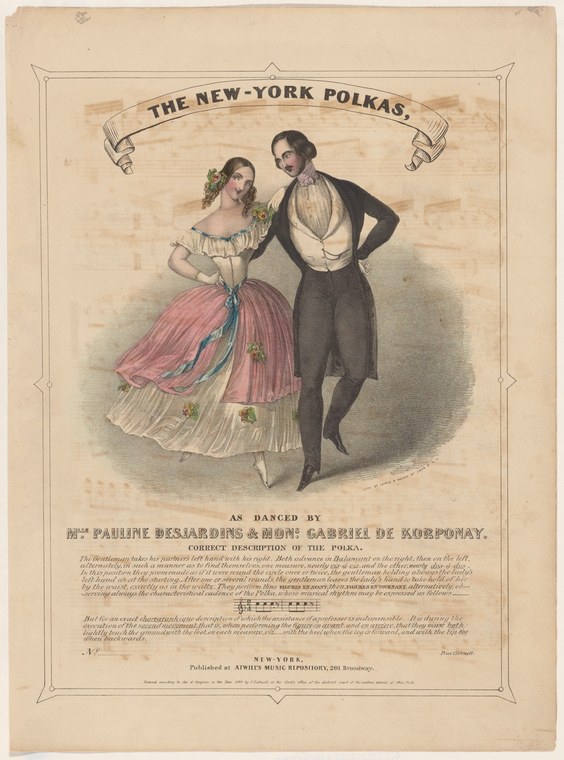
The New York Polkas, as danced by Mlle. Pauline Desjardins & Mons. Gabriel de Korponay
Unknown artist
- Collection:
- Prints depicting dance
- Source:
- New York Public Library
- Rights:
- Public domain — free to use, share and adapt.
- Recorded as:
- Public Domain
The polka was a transformative social dance in 19th-century urban culture, and this print is evidence of how it was taught, promoted, and understood. Named-performer promotional prints like this one are rare; most dance imagery of the period is generic or theatrical. This image proves that Pauline Desjardins and Gabriel de Korponay were known dancers in New York and that their partnership in the polka was deemed noteworthy enough to publish and sell.
What you are looking at
A hand-colored lithograph presents a couple mid-polka in the refined dress of the 1840s–50s. The man, in formal black tailcoat and waistcoat, stands with his weight forward and arm extended toward his partner. The woman wears a full-skirted gown with a deep pink overlay skirt and cream underskirt, the hem lifted to reveal her footwork; her off-shoulder bodice and hair ornament signal ballroom formality. The pair occupy the center of a framed composition with minimal setting—a plain background that throws all attention onto their bodies and the moment of the dance. The man's posture and the woman's lifted skirt capture the characteristic bounce and lift of the polka, a dance defined by its springing hop. A decorative banner overhead announces the title; text below provides description and credits.
The dancing
The dancers are in a close ballroom hold, with the man's right arm extended and the woman leaning into him, their bodies tilted forward in the dynamic posture the polka demands. The woman's left arm reaches toward the man's shoulder; her right skirt is caught mid-lift, showing the vigorous footwork beneath. Both figures' weight is off the floor, captured at the apex of the characteristic hop that defines the polka. The composition isolates the couple against a neutral ground, emphasizing the geometry of their frame and the energy of their shared motion.
The dance depicted
This is explicitly a polka, as stated in the title and confirmed by the woman's lifted skirt and the couple's forward-tilted posture and hopping motion. The polka emerged in Bohemia around 1830 and became a sensation in European and American ballrooms by mid-century. This print documents the dance as performed by the named dancers Pauline Desjardins (a French performer) and Gabriel de Korponay, suggesting it was created to capture and advertise a specific celebrated performance or partnership, likely in New York. The image shows the polka in its ballroom context—a closed-couple dance in formal dress performed in social settings—rather than as theatrical spectacle.
How it was made
This is a hand-colored lithograph, a commercial reproductive medium that allowed colored prints to reach broad audiences affordably. The technique involved drawing on a prepared stone and hand-tinting the printed impressions. The presence of the title banner, performers' names, descriptive text, and publisher information (Amoretti & Company, New York) indicates this was a commercial popular print, likely sold as sheet music cover art or a parlor decoration. Lithography's capacity for detail and subtle shading made it ideal for capturing the specific dress and proportions of fashionable ballroom dancers, and the hand-coloring gave the expensive materials (the woman's silk gown, the man's formal coat) visual fidelity.
About this work
This is a mid-19th-century popular print documenting a ballroom polka as danced by two named performers in New York. The polka was one of the defining dances of the era—a relatively new, energetic couple-dance that crossed class lines and generated intense enthusiasm in the 1840s–50s. The print captures not just the dance but its social meaning: formal dress, ballroom setting, the embrace of a fashionable, exuberant movement that was transforming public dance culture. As a named performance by identifiable dancers, it offers a rare glimpse of who was dancing what in mid-century New York, and it shows how dance was marketed and visualized for a public hungry for instruction and entertainment.
How to look at it
Notice the woman's lifted skirt and the suspended posture of both dancers—the artist has caught them at the precise moment of the hop that gives the polka its character. The formal dress and ballroom posture tell you this is not theatrical dance but social ballroom dancing, performed by named individuals in an urban public context. The prominent display of the performers' names above the image signals that Desjardins and Korponay were known enough to draw an audience; their fame rested on their mastery of this now-fashionable step.
The period
The polka arrived in Europe from Bohemia around 1830 and reached the United States by the 1840s, where it sparked a dance craze that rivaled waltzing. It was faster, more playful, and more egalitarian than the waltz—easier for ordinary dancers to learn and perform socially. By mid-century, polka instruction was common, and polka prints and sheet music were staple parlor items. The 1840s–50s in New York saw an explosion of commercial dance imagery, especially lithographs, aimed at dancers who wanted to learn steps, admire celebrated performers, or decorate their homes with fashionable social imagery. This print sits at the intersection of commercial popular culture and dance history, at a moment when the polka was at the height of its fashion.
Where it lives
This print is held in the New York Public Library's collection of prints depicting dance. It was published by Amoretti & Company in New York, making it a commercial product of the mid-19th-century dance publishing industry.
Dance in this work
Questions about this work
Who were Pauline Desjardins and Gabriel de Korponay?
The catalogue record does not provide biographical information, but their names on this published print indicate they were known performers in New York's ballroom dance world in the mid-19th century. The fact that a commercial publisher chose to name them in print suggests they had enough reputation to sell copies. No further details are available from this image alone.
What is a polka and how was it danced?
The polka is a fast, hopping couple-dance in 2/4 time that originated in Bohemia around 1830. Dancers move in a closed ballroom frame, executing a characteristic hop on each beat. It is lighter and more playful than a waltz, and less formal. This print captures that hopping motion in the suspended posture of both dancers and the lifted skirt of the woman.
Why was this print made?
Popular prints like this one served multiple purposes: they advertised performers and their partnerships, provided visual instruction for dancers learning the steps, and decorated the parlors of middle-class households interested in fashionable social dance. They were also often sold alongside sheet music or used as cover art for polka compositions.
More dance artwork





