49 works in this view — arrow keys or swipe to move between them.
Dance in Art
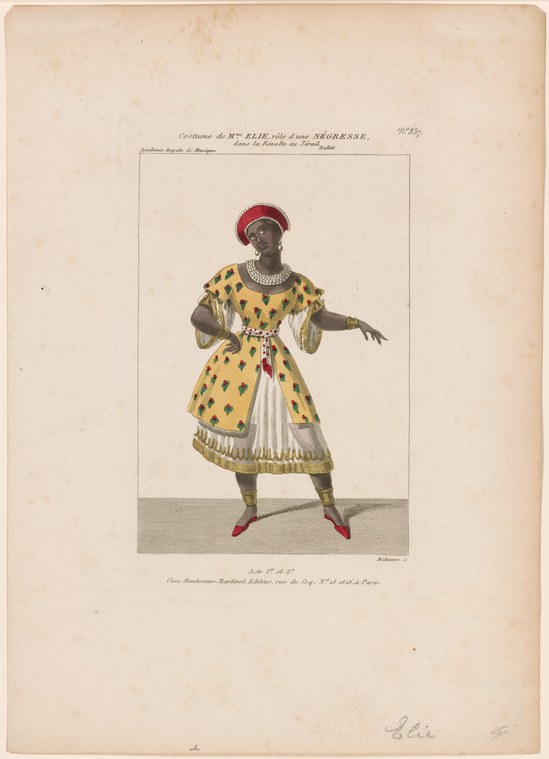
Costume de Mme. Elie, rôle d'une négresse, dans La révolte au Sérail, ballet, acte 1er. et 2e.
Unknown artist
- Collection:
- Prints depicting dance
- Source:
- New York Public Library
- Rights:
- Public domain — free to use, share and adapt.
- Recorded as:
- Public Domain
Costume plates like this are primary evidence for how ballet performers were costumed and visually differentiated on stage in the 18th century, but they also document the racial casting practices and blackface conventions embedded in European theatrical culture. For dancers and historians, the work demands critical attention: it reveals how race and exoticism were used as costume codes in ballet, and how the surviving visual record can perpetuate those framings unless we read them against the grain.
What you are looking at
A single figure stands alone against a plain background in a formal stage pose. She wears a yellow tunic decorated with a pattern of black floral or geometric motifs, trimmed at the hem with white striped fabric and bordered with what appears to be fur or feathered trim. A white pleated skirt extends below, and her legs and feet are bare except for red heeled shoes. Around her neck hangs a thick beaded collar in a pale color, likely representing ivory or pearl. She wears a tall red feathered headdress or crown that rises prominently above her head, and her skin is darkened, consistent with the theatrical practice of blackface. Her posture is relaxed and open, with one arm extended outward in a gesture of display. The overall composition suggests a costume design for a theatrical performer, presented as a formal portrait rather than a dynamic movement study.
The dancing
A single standing figure occupies the center of a neutral stage space. Her weight is distributed evenly on both feet; there is no indication of motion or a captured moment of movement. One arm extends outward in a presentational gesture, the other hangs at her side. The pose emphasizes the costume itself rather than demonstrating any particular dance technique or movement quality. Her upright stance and the formal frontality of the presentation suggest this is a costume plate designed to be read as a complete visual design rather than evidence of choreographed motion.
The dance depicted
The title identifies this as a costume for a performer playing "une négresse" (a Black woman) in *La révolte au Sérail* (*The Revolt in the Harem*), a multi-act ballet. This appears to be a costume design document rather than a record of actual dance. The stylized dress and the theatrical blackface indicate an 18th-century European theatrical context in which such roles were performed by white dancers in racialized costume. The static presentation tells us nothing about the movement vocabulary or technique of the ballet itself, only that the role was visually marked through exotic dress and the racist conventions of the period.
How it was made
This is a hand-colored engraving or aquatint, likely a costume plate from a theatrical publication or collection. The neat border, the formal French inscription at top and bottom, and the single-figure presentation are consistent with 18th-century costume documentation. The color work—applied by hand over the printed line—shows careful attention to the decorative detail of the tunic pattern and the gradations of the pleated skirt. Such prints circulated among theater professionals, patrons, and the educated public who attended ballet, and served both documentary and promotional purposes.
About this work
This is a costume design document for a named theatrical role in an 18th-century French ballet. It records not choreography or technique but the visual identity assigned to a performer in a specific production. The work is a direct artifact of its historical moment: it documents both the artistic conventions of late 18th-century ballet and the racist theatrical practices that were normalized in that period. For historians of dance, it raises questions about performance casting, racial representation, and the evidence we recover from the archive—costume plates show what was worn and how roles were visually defined, but they are silent about how dancers moved through or resisted those visual assignments.
How to look at it
Read this as a complete costume design object, not a movement study. Notice how the designer has organized visual information: the structured upper garment with its pattern, the quantity and weight of the skirt, the height and material of the headdress, the jewelry. Observe that the figure is presented frontally and at rest—there is no implied motion, no tilted weight, no suggestion of the dancer's body beneath the costume. The red shoes with heels were typical of 18th-century stage dress and would have affected how the dancer moved. The beaded collar and headdress are costume codes signaling 'exotic' status; the blackface extends that coding to the performer's skin. All of this was considered necessary information for a patron or fellow professional to understand what this role looked like on stage.
The period
In the mid-to-late 18th century, French ballet was expanding beyond aristocratic court contexts into public theaters. Ballets often drew on exotic and orientalist themes—harems, sultans, foreign lands—that allowed choreographers and designers to introduce variety in costume and movement while maintaining a fundamentally European narrative and aesthetic. The role of the 'negresse' or enslaved woman was a stock type in such productions, typically assigned to white dancers in blackface and exotic costume. This was a period before Romantic ballet's emphasis on the sylph and the supernatural, yet well into the classical vocabulary's development. The costume plate was a standard genre for documenting and publicizing theatrical design, and surviving examples are among the richest visual sources for 18th-century stage practice.
Where it lives
The work is held in the New York Public Library's collection of prints depicting dance. It carries a French inscription identifying the costume and the production, suggesting it was part of a published or collected series of theatrical designs, likely from a 18th-century French source.
Questions about this work
Was this costume actually worn in performance, or is it just a design?
The print appears to be a published costume design document, documenting what was worn or intended to be worn. We cannot confirm from the image alone that this exact costume appeared in a specific performance, but such plates were typically based on actual theatrical practice and were published to record and circulate designs. The inscription names a specific production and role, suggesting it documented real casting and costuming.
Why is the figure drawn in blackface?
This is a document of 18th-century European theatrical racism. The role of 'une négresse' was performed by white dancers wearing blackface, and the costume plate records that practice as standard. For modern viewers, it reveals how race was literally applied and marketed as a costume element in 18th-century ballet. Any discussion of this work now must acknowledge and critically frame this history rather than treating it as a neutral design record.
What was *La révolte au Sérail*?
The title translates as 'The Revolt in the Harem,' a multi-act ballet with an orientalist plot. Such ballets were common in the 18th century and typically featured exotic locations, enslaved women, sultans, and Western protagonists navigating these settings. The specific choreography and narrative details are not recoverable from the costume plate alone; you would need the libretto or other documentation of the production.
Can you identify the artist from the engraving style?
The catalogue record does not name the artist, and the print itself does not carry a visible signature in the image provided. The neat, methodical engraving style is consistent with late 18th-century theatrical costume documentation, but without a signature or inscription attributing the work, the artist cannot be identified from the image.
More dance artwork





