49 works in this view — arrow keys or swipe to move between them.
Dance in Art
Peasant dance
Unknown artist
- Collection:
- Prints depicting dance
- Source:
- New York Public Library
- Rights:
- Public domain — free to use, share and adapt.
- Recorded as:
- Public Domain
For historians of folk and social dance, this image is direct evidence of peasant movement vocabulary and the occasions on which it occurred—not as it was, but as it was imagined and circulated by and for the educated public. The presence of officials and the formal framing distinguish this from a purely documentary image; it shows how peasant dance was understood as spectacle and as a marker of social difference.
What you are looking at
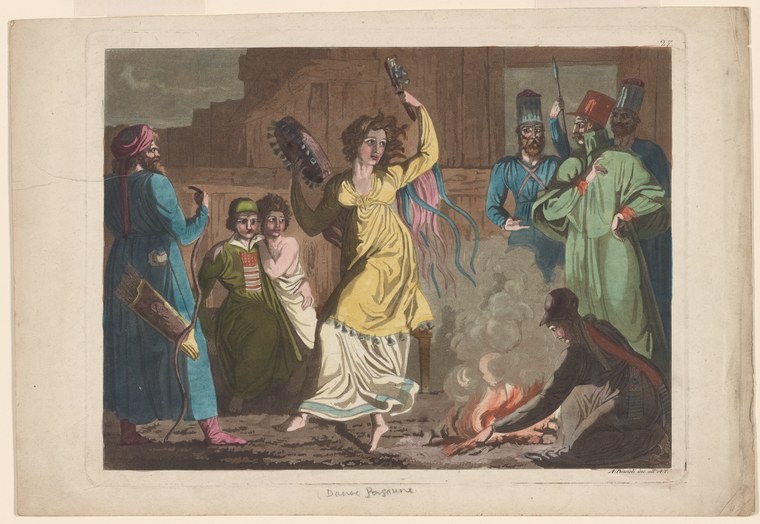
A peasant celebration unfolds in a rustic interior with wooden beams visible in the upper portion. At the center, a woman in a yellow dress dances with arms raised, her body in energetic motion. To her left, an older woman in blue holds two small children; to the right stand several figures in traditional dress—men in green robes with tall hats and weapons (staffs or pikes), and what appears to be officials or musicians. The ground is earthen, and a fire burns in the lower right foreground, with a seated figure tending it. The scene captures a moment of folk celebration with clear social hierarchy: the dancers at center, attendants and children to the left, authority figures (possibly military or administrative) to the right, and servants or the poor at the margins. The light is warm and theatrical, focusing on the dancing woman.
The dancing
The central dancer stands with both arms raised in an open, celebratory posture—one arm bent at the elbow, the other extended upward—suggesting vigorous, joyful movement rather than formalized technique. Her body is upright and mobile, weight apparently shifting. She wears a full skirt that falls straight, without the fitted bodice or elaborate construction of court dress. The other figures stand largely still, framing the dancer: the older woman and children form a static group, while the men in formal dress stand in an ordered line. No couple work or synchronized group movement is visible; this is solo performance watched by an assembled company.
The dance depicted
This is peasant or folk dance, most likely a moment of celebration at a village festival, wedding, or harvest gathering. The loose, exuberant arm position and solo performance suggest social vernacular dance rather than court or theatrical training. The presence of what appear to be military or civic officials (the men in tall hats with pikes) suggests this may depict a sanctioned public celebration—possibly carnival, a festival day, or a moment when peasants were permitted or invited to dance before their superiors. The image does not show the structured figures or holds of formal European dance of any era; instead it captures spontaneous, joyful movement in a public setting.
How it was made
This is a hand-colored engraving or aquatint, identifiable by the fine linear work, the systematic use of tone through cross-hatching and stippling, and the warm brown printing ink visible in the architecture and flesh tones. The coloring—applied by hand in transparent washes of yellow, blue, green, and pink—is uneven and sometimes crude, suggesting either rapid commercial production or deliberate folk aesthetic. The technique allowed for multiple impressions and wide circulation to a popular audience; this was a cheap, reproducible image sold to people who could not commission paintings. The style of printmaking and hand-coloring is consistent with 18th-century European commercial prints.
About this work
This hand-colored engraving depicts a moment of peasant celebration, capturing a woman dancing alone in an energetic, unselfconscious pose before assembled villagers and authority figures. The scene is a record of folk practice as it was understood and depicted for a broad commercial audience in the 18th century. The composition—with the dancer framed by onlookers of different social rank—reveals how folk dance was positioned in the social imagination of the period: as exuberant but witnessed, spontaneous but contained within hierarchy. The print is part of a large tradition of genre imagery that documented rural life and custom for urban consumers, making it valuable evidence of what peasant dance was believed to look like and how it was valued.
How to look at it
Watch the dancer's posture and arm position: the raised arms and upright spine show confidence and joy, not training or constraint. Notice how she is framed by stillness—the official figures stand rigid in their formal dress, the children are held close, the servant tends the fire. This contrast is the image's argument: that folk dance was unrestrained feeling made visible. The artist chose to freeze the moment of maximum lift and extension, not a grounded or balanced pose, emphasizing exuberance. The composition—with the dancer slightly off-center and the officials ranged on either side—reflects a 18th-century European preoccupation with depicting social order even in scenes of celebration.
The artist
Unknown. The print is inscribed 'Peasant Danseurs' but carries no artist's signature visible in this impression. It belongs to a large 18th-century tradition of hand-colored satirical and genre prints depicting rural and lower-class life, produced in London, Amsterdam, and Paris for commercial sale. Such prints were often unsigned or attributed to publishing houses rather than individual artists.
The period
In the 18th century, peasant and folk dance became objects of curiosity and aesthetic interest for the urban educated classes, coinciding with the rise of genre painting and Romantic idealization of rural life. Simultaneously, court and theatrical dance (ballet) was becoming increasingly formalized and divorced from popular practice. Prints like this one served dual purposes: they documented folk custom and they entertained urban audiences by depicting 'otherness'—the unrestrained, emotional movement of the lower orders contrasted with the controlled elegance of the ballroom. The presence of military or civic authority in the scene reflects the reality that peasant gatherings were often tolerated rather than genuinely autonomous.
Where it lives
The work is held in the New York Public Library's collection of prints depicting dance, part of a larger commercial print tradition. It is one of thousands of similar hand-colored engravings produced for a broad urban market in the 18th century.
Dance in this work
Questions about this work
What kind of dance is this?
This is folk or peasant dance, the kind danced by rural people at celebrations, festivals, and gatherings. Unlike court dances or ballet, it has no formal steps or holds; it is exuberant and personal. The print does not name a specific dance, and the loose arm position suggests either a regional tradition now lost or a generalized depiction of 'peasant dancing' as the urban educated classes imagined it.
Why are there soldiers or officials in a dance scene?
The figures in tall hats and formal dress with weapons (likely pikes or halberds) suggest civic or military authority. Their presence indicates that this is a public, sanctioned celebration—possibly carnival, a saint's day, or a festival when peasants were permitted to gather and dance. The composition suggests that folk dancing was something to be witnessed and regulated by authority, not purely autonomous.
Who made this print and when?
The artist is not recorded on this impression. Based on the style—hand-colored engraving with 18th-century conventions of dress, print technique, and social composition—it was likely produced in the 1700s for a commercial print market in northern Europe. Thousands of similar prints were sold without attribution to publishing houses or anonymous artists.
Is this a reliable image of how people actually danced?
Not entirely. This is how urban, educated people imagined peasant dancing—exuberant, physical, and socially different from their own refined behavior. The image reflects the concerns and aesthetics of the print-buying public, not necessarily the lived practice of rural dancers. It is valuable as evidence of imagination and representation, less so as documentary proof of actual movement.
More dance artwork





