49 works in this view — arrow keys or swipe to move between them.
Dance in Art
The ball
Unknown artist
- Collection:
- Prints depicting dance
- Source:
- New York Public Library
- Rights:
- Public domain — free to use, share and adapt.
- Recorded as:
- Public Domain
This image preserves the spatial and social reality of Gilded Age ballroom dancing—not the movement in isolation, but the entire apparatus of the ball as a social institution. It shows how dancers, onlookers, interior architecture, and formal dress worked together to create and maintain class hierarchy, and how the couple-dance dominated late 19th-century elite social life.
What you are looking at
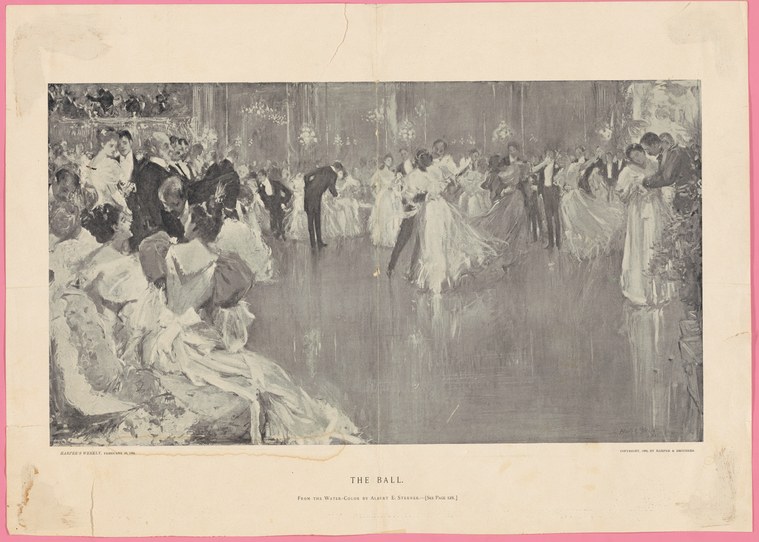
A formal indoor ballroom filled with dozens of elegantly dressed figures in late 19th or early 20th-century attire. The composition is shallow and crowded, with figures in dark tailcoats and white gowns distributed across the floor in a grand interior with tall columns and draped elements visible in the background. The foreground is dominated by a woman seated in a white ball gown with elaborate folds of fabric, her back to the viewer, observing the dancers. Throughout the scene, couples dance in various positions while onlookers stand conversing along the sides. The print has the soft, atmospheric quality of a photogravure or aquatint, with rich grays and blacks creating depth despite the crowded composition.
The dancing
The seated woman in the foreground has her head turned slightly, her posture formal and watchful. The dancing couples visible in the middle ground hold each other in closed ballroom positions—the standard frame for 19th-century social dancing, with men's right hands on women's waists and left hands joined with partners' right hands. The dancers' bodies are upright and composed rather than energetic. Several figures stand or move slowly, and the spacing suggests a leisurely, processional quality rather than rapid individual turns.
The dance depicted
This is a formal social dance of the gilded age ballroom, most likely a waltz, cotillion, or quadrille—the dominant social dances of the late Victorian period. The closed couples, upright carriage, and the formal dress code all point to the structured, couple-based dances of this era. The presence of both active dancers and onlookers, and the leisurely spacing, suggest this may document a cotillion or grand march where social standing and careful positioning were as important as the movement itself. The print appears to be a record of a specific ball or ball-season event rather than generic dance instruction.
How it was made
This is a photogravure or aquatint reproduction, likely from the late 19th or early 20th century, made from a painting or drawing. The soft tonal rendering, fine detail, and the capacity to capture atmospheric depth are characteristic of photogravure—a process that used photographic plates to create fine art prints suitable for art publication and exhibition. This technique allowed wide circulation of costly paintings to educated audiences and suggests the work was intended for publication in an illustrated periodical or fine-art folio.
About this work
This print documents the formal ballroom culture of the Gilded Age, capturing the elaborate social choreography of elite dancing in an interior of conspicuous elegance. The composition centers not on virtuosity but on ceremony: the careful arrangement of bodies, the distinction between dancers and observers, and the self-conscious performance of status through dress and carriage. The work is both a dance record and a social document—it preserves the look of a specific moment in ballroom practice when waltzes, quadrilles, and cotillions structured the social calendar of the wealthy.
For a dance historian, the image is valuable as evidence of scale, spacing, and the relationship between active dancers and the public that watched them. The print medium guaranteed it reached contemporary audiences interested in both art and social commentary, making it a window into how the era understood and valued ballroom culture.
How to look at it
Notice the relationship between the foreground seated woman and the dancers behind her. She is not dancing but observing—a common position for married women, elder women, and women without partners. The artist has chosen a moment of relative stillness rather than dynamic movement, emphasizing the formal structure and social positioning of the ball. The print captures the ball as a space of regulated movement and careful surveillance, where one's position and dress communicated status as clearly as the steps themselves. Attend to how the couples are distributed through the space and how the composition creates a sense of orderly, almost processional quality.
The period
In the late 19th and early 20th centuries, ballroom dancing remained the primary social dance of the urban elite across Europe and America, even as new popular dances (ragtime, tango, foxtrot) were beginning to challenge its monopoly. The formal waltz, cotillion, and quadrille had been standardized by decades of practice and published instruction manuals. This was the high point of the printed ball report—illustrated magazines and fine-art publications regularly documented major social events, and prints like this one were collected and exhibited as records of contemporary life. The composition and printing technique suggest this image was aimed at an educated middle and upper-class audience.
Where it lives
This print is held in the NYPL's collection of prints depicting dance, suggesting it was collected as documentary evidence of dance practice and social life rather than as autonomous fine art. The title 'The Ball' and the attribution line suggest it was published as an illustrated reproduction, likely in a magazine, annual, or bound volume of fine art.
Dance in this work
Questions about this work
What dances were being done at balls in this period?
The Waltz, Quadrille, and Cotillion dominated formal ballrooms in the late 19th century. Waltzes involved couples in closed position rotating around the floor; quadrilles were square-formation dances for four couples performed to specific figures; cotillions were elaborate formal dances combining couple, line, and group formations. All three required instruction and practice, and all were considered essential knowledge for anyone with social pretensions.
Why are so many people not dancing?
A ball was as much a social event as a dance event. Many attendees came to be seen, to converse, to secure marriages, and to observe. Unmarried women required a male partner to dance; married women often sat out dances; men with no partner or poor dancing reputation would stand aside. The composition reflects the actual social economy of the ballroom.
How do I know this is from the Gilded Age?
The dress codes—men in dark tailcoats with white shirts and women in elaborate white ball gowns with full skirts—are characteristic of 1880–1910. The interior architecture (columns, height, scale) and the formal gathering itself reflect the late-Victorian elite ballroom. The printing technique (photogravure) and the composition style also suggest late 19th-century production.
What is the difference between a ball and a dance?
A ball is a formal evening social event at which dancing is one activity among many; a dance is the movement itself. A ball involved multiple dances performed in sequence, with breaks for refreshment and conversation. The social hierarchy, dress code, and guest list were often more important than the choreography.
More dance artwork





