49 works in this view — arrow keys or swipe to move between them.
Dance in Art
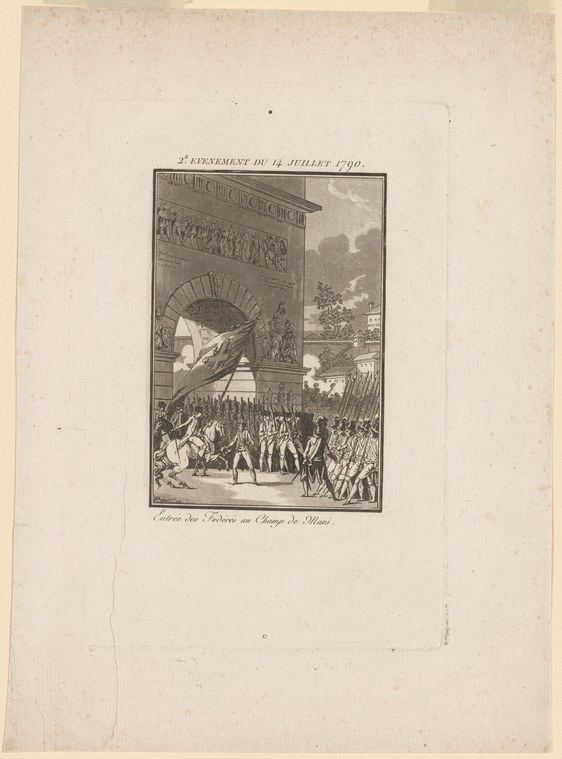
Entrée des Fédérés au Champ de Mars
Unknown artist
- Collection:
- Prints depicting dance
- Source:
- New York Public Library
- Rights:
- Public domain — free to use, share and adapt.
- Recorded as:
- Public Domain
For historians of dance and spectacle, this image is essential evidence of how late-18th-century political power was performed through the organization of bodies in space. The Federation Festival was itself understood as a kind of civic theater, and the careful disposition of tens of thousands of people enacted the social contract and national unity that the Revolution sought to embody. The engraving shows that ritual, pageantry, and choreographic thinking were not confined to the ballroom or stage, but extended into the public sphere and mass political culture.
What you are looking at
A large crowd assembles in an urban public space before a monumental classical building with a prominent arched gateway. The composition centers on the gateway, above which flies a large flag or banner. Thousands of figures fill the plaza, depicted in dense formation—some standing, some seated or kneeling. The crowd appears to be a organized gathering rather than spontaneous assembly, with clear spatial structure and apparent hierarchy of position. The architecture suggests an official or civic venue. In the background, beyond the gateway, a landscape with trees and distant buildings suggests this is a bounded public precinct. The engraving uses fine cross-hatching to create atmospheric depth and distinguish the packed crowd from the stone architecture. The scene conveys both ceremonial solemnity and popular assembly—this is a moment of public congregation before an emblem of state or civic authority.
The dancing
The figures are rendered at small scale owing to their multitude, making individual gesture hard to discern at detail. However, the crowd is not chaotic: bodies are oriented toward the gateway and the flag above it, suggesting focused attention on a central point or event. Some figures in the foreground appear to be in kneeling or bowing postures. The density and posture of the crowd suggest ceremonial bearing rather than social dance—these are participants in a civic or political gathering, not couples in partner hold or individuals performing. No clear footwork or rhythmic body alignment is visible; the bodies are disposed vertically, awaiting or witnessing rather than moving through space.
The dance depicted
This image does not depict dance in the conventional sense. The gathering is civic or political in character—a mass assembly before a state building, as the title indicates. The title 'Entrée des Fédérés au Champ de Mars' (Entry of the Federated Forces to the Field of Mars) and the date of 1790 place this almost certainly within the French Revolutionary period, likely documenting the Federation Festival (Fête de la Fédération) of July 14, 1790, a key symbolic moment when National Guards from across France gathered in Paris. This was a ceremonial and political act, not a performed dance, though the gathering itself was highly choreographed and ritualized in character. The structure and comportment of the crowd reflect the aesthetics of civic ceremony and mass assembly that the Revolution cultivated.
How it was made
This is an engraving, identifiable by the fine parallel line work (cross-hatching) used to model form and create tonal variation, and the characteristic clarity of line. The technique of engraving allowed for mass circulation of images, and this work was likely produced soon after the event to circulate an account of it to a broad public across France and Europe. The fidelity of architectural detail and the attempt to render thousands of figures—though necessarily schematic—suggests a record-making purpose: to document the scale and grandeur of the Federation Festival. The engraving's format and style place it within the tradition of French revolutionary prints, which served both as news and as political imagery.
About this work
This engraving records the Federation Festival (Fête de la Fédération) held on the Champ de Mars in Paris on July 14, 1790, a pivotal moment in the French Revolution when National Guards from across the nation gathered to reaffirm their allegiance to the new constitutional order. Although not a dance scene in the performing sense, the work belongs to the visual history of collective movement and ritual ceremony—the gathering itself was a carefully orchestrated public spectacle with processional and ceremonial elements. The engraving documents a moment when the bodies of thousands were arranged in space according to political meaning rather than musical or choreographic direction. It stands as a record of how the Revolution sought to visualize popular sovereignty and national unity through mass assembly.
How to look at it
The viewer should attend first to the architectural focus—the gateway and flag above it—which structures the composition and the attention of the crowd. The engraver has used the building as a vanishing point toward which the eye and the bodies are directed. Note the density and stillness of the crowd compared to depictions of social dance or festivity: this is an assembly of witnesses and participants in a political ceremony, not a moment of dancing or movement. The fine detail of the architecture contrasts with the schematic rendering of the thousands of bodies, emphasizing that the civic venue and symbol (the building, the flag) are as important as the people. Look also at the atmospheric perspective—the landscape visible through the gateway and the sky beyond—which locates this gathering in a real, documented place and moment.
The period
This work belongs to the French Revolution, specifically the period 1789–1794 when the revolutionary government sought to replace the ceremonies and symbols of the Old Regime with new forms of civic spectacle. The Federation Festival of 1790 was an attempt to demonstrate national unity and the success of the constitutional settlement; it was conceived as a vast public ceremony with military processions, speeches, and mass participation. The same period saw experiments in revolutionary theater, pageantry, and mass spectacle intended to shape public sentiment and enact new political values. Engravings like this circulated widely and served as both documentation and propaganda. The artistic tradition of depicting civic gatherings and public ceremonies extends back through the 17th and 18th centuries, but the scale and explicitly political purpose here are distinctly revolutionary.
Where it lives
This engraving is held by the New York Public Library in its collection of prints depicting dance. It is catalogued by date of event (1790) rather than creation date, as is common for historical prints. The work is part of the library's broader collection of performance and spectacle imagery.
Questions about this work
Why is a political rally in a dance collection?
The Federation Festival was itself conceived and executed as a form of civic spectacle—a carefully choreographed assembly of masses for political and emotional effect. While not performing dance, it exemplifies how choreographic thinking and the organization of bodies in space extended into revolutionary ceremony and public ritual. Dance historians study spectacle and collective movement in all contexts.
Is this the same as the Fête de la Fédération of July 14, 1790?
Almost certainly yes. The date on the engraving (14 juillet 1790), the title (Entry of the Federated Forces to the Field of Mars), and the massive scale of assembly all correspond to the Federation Festival held on the Champ de Mars in Paris. The engraving was produced shortly after as a record of the event.
How many people are shown?
The engraver has rendered thousands of figures in schematic form. The historical Federation Festival drew an estimated 50,000 to 100,000 participants and spectators, making it one of the largest public assemblies of the revolutionary period. The print conveys vastness through density and repetition rather than precision.
More dance artwork





